TRANSMISSION // 2026.11.21.768332v1
A hidden layer in plants’ rapid light response
Source published
An Arabidopsis study found that a PsbS variant lacking two key proton-sensing residues could still support a small, rapid quenching response when zeaxanthin and lumen acidification were present. The results suggest the response involves more than those two residues, but do not resolve the molecular mechanism.
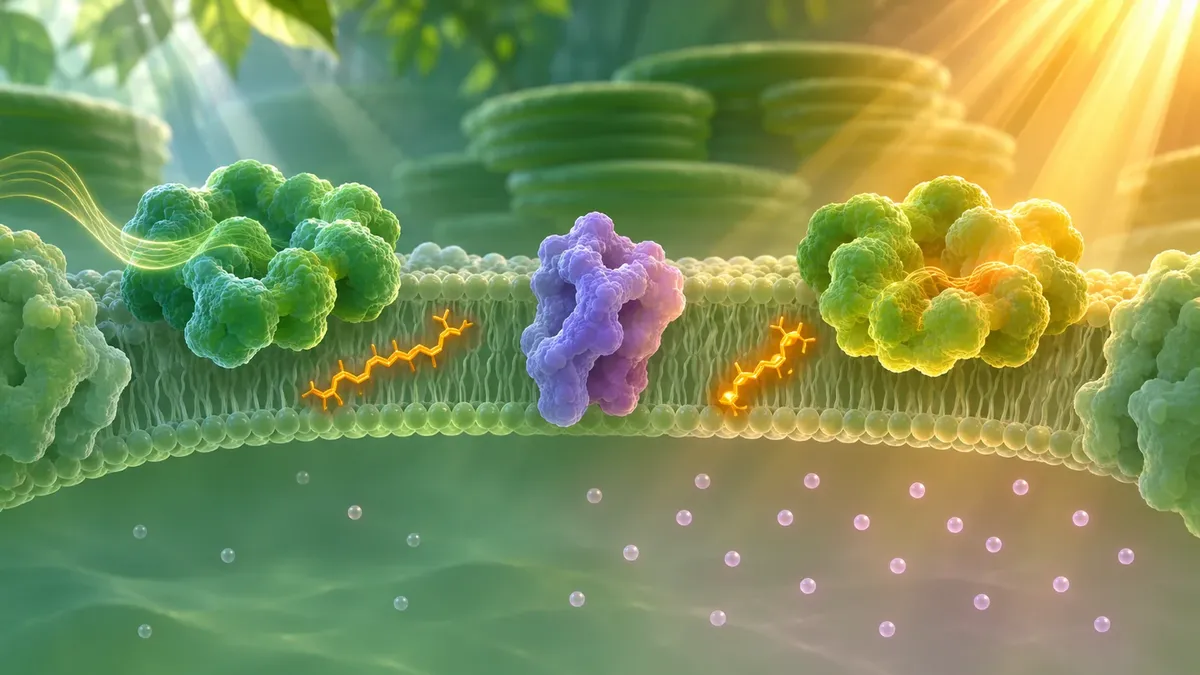
Plants can shed excess absorbed light as heat through a rapid process called energy-dependent quenching, or qE. A bioRxiv preprint reports that an altered version of the protein PsbS still supported a small qE-like response under particular conditions. The experiments point to possible roles for zeaxanthin and antenna proteins, while leaving the precise interactions uncertain.
When a plant absorbs more light than it can use, some of that energy can be dissipated as heat instead of being passed along for photosynthesis. One rapid response is energy-dependent quenching (qE), part of a broader set of processes known as non-photochemical quenching (NPQ). A protein called PsbS and the pigment zeaxanthin are both linked to this response, but how they work together remains unresolved.
In a study of Arabidopsis thaliana, researchers tested plants that contained PsbS with two altered amino acids, E122 and E226. These glutamate residues are exposed to the thylakoid lumen—the inner space of the chloroplast’s photosynthetic membrane. Lumen acidification can protonate them, a change thought to help trigger qE. The altered PsbS could not use these two residues in the usual way. The researchers compared the plants with both a PsbS-null line and lines in which only one of the two residues was altered.
A response after pigment builds up
The researchers tracked NPQ in leaf discs using chlorophyll fluorescence. They exposed the discs to light and dark cycles and measured pigments by high-performance liquid chromatography. Additional experiments used dithiothreitol (DTT), which inhibits the enzyme involved in making zeaxanthin, and nigericin, which dissipates the proton gradient across the thylakoid membrane. The team also examined plants lacking CP29, a light-harvesting antenna protein.
During the first light-dark cycle, the double-mutant line’s NPQ response was similar to that of the PsbS-null line and differed from the response in wild-type plants. After an initial light exposure had allowed zeaxanthin to accumulate, however, a subsequent transition from darkness to light produced a small, rapid increase in NPQ in the double mutant. The researchers named this response the “EQ jump.” It did not occur in the line lacking PsbS altogether.
Several tests linked the EQ jump to both zeaxanthin accumulation and lumen acidification. DTT treatment eliminated the response, and nigericin treatment also prevented it. A longer initial light exposure made the jump more apparent; lowering the intensity of the later light exposure was associated with a smaller jump. These results support a connection between the response, the pigment and changing lumen acidity. The treatments do not, however, reveal the exact molecular steps involved.
The researchers also found that removing CP29 from the double-mutant background reduced the measured EQ jump by about 40–50%. This points to a contribution from CP29 or from the larger antenna organization associated with it. It does not show that CP29 alone produces the effect: its absence can also alter other protein arrangements. In the CP29-deficient line with functional PsbS, rapid NPQ was comparable to that in wild type, highlighting that the CP29 result was specific to the altered-PsbS context.
What the findings do—and don’t—show
The results suggest that PsbS can support some rapid quenching even when E122 and E226 are altered, provided zeaxanthin has accumulated and light-induced lumen acidification occurs. The authors propose that other protonatable residues in PsbS may contribute. They also suggest that PsbS and zeaxanthin may interact directly or through antenna proteins such as CP29. The experiments do not identify which additional residues are responsible, demonstrate direct molecular contact, or settle how these components are arranged. The authors note that removing CP29 also affects the organization of related antenna proteins, complicating interpretation.
The EQ jump was smaller than rapid NPQ responses in lines with functional PsbS. The experiments measured NPQ in Arabidopsis leaf discs under controlled conditions; they did not test whether the response prevents damage, improves plant growth or affects performance outdoors. DTT and nigericin also act on processes beyond the proposed interactions, so the treatment results are best read alongside the other measurements, not as proof of a single mechanism.
This report is a bioRxiv preprint posted November 24, 2026, and has not been certified by peer review. Its findings are provisional. Further experiments are needed to test the proposed additional protonation sites and establish how PsbS, zeaxanthin and antenna proteins contribute to rapid quenching.
- photosynthesis
- Arabidopsis
- PsbS
- zeaxanthin
- photoprotection
- non-photochemical quenching