TRANSMISSION // 2026.11.20.768177v1
How root hairs turn polarity into growth
Source published
A bioRxiv preprint reports that ROP activity helps recruit the wall-loosening protein EXPA7 to the site where root hairs begin to grow.
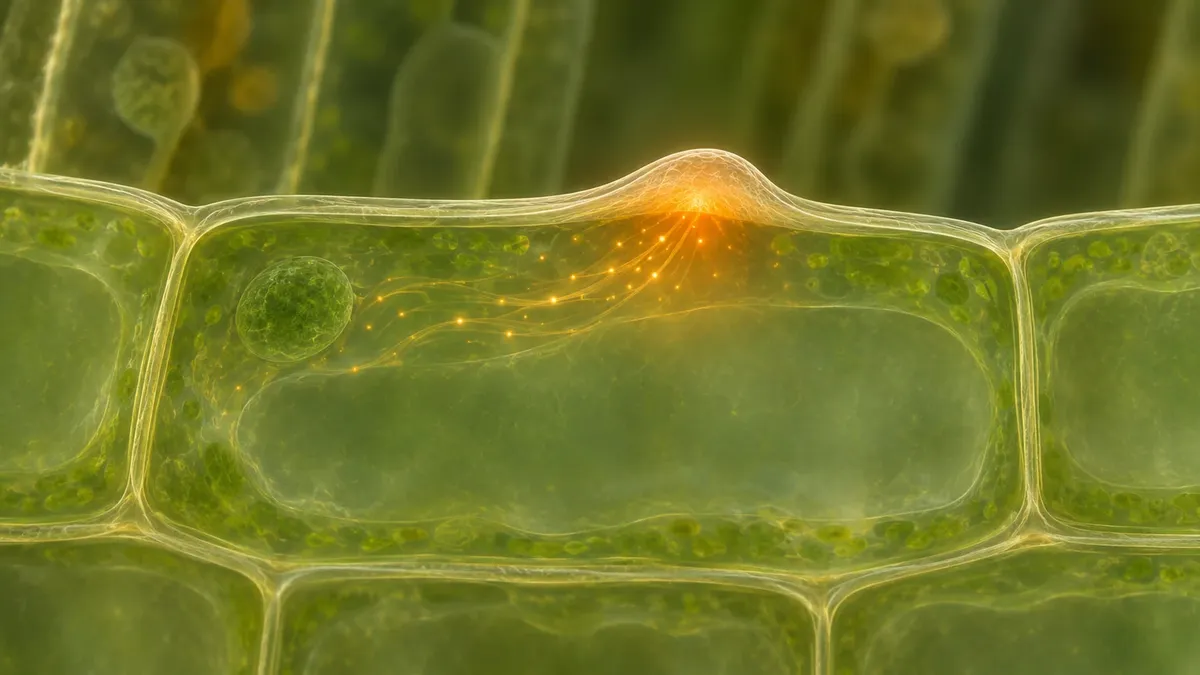
Root hairs emerge from a specific spot on root cells, rather than expanding evenly in every direction. A preprint investigates how cell-polarity signals may help direct wall loosening to that growth site.
Turning a polarity signal into growth
Plant cells are pressurized, and that pressure can push their walls outward. But when a root hair grows from one particular spot, the wall must become more accommodating in a localized region. How does a cell translate a polarity signal—a signal concentrated in one part of the cell—into targeted wall loosening?
A bioRxiv preprint by Ke Zhou, Y. Zheng and Daniel J. Cosgrove investigates EXPA7, an expansin found in root-hair-forming cells. Expansins help loosen plant cell walls, making enlargement possible. The researchers examined whether the polarity regulator ROP directs EXPA7 to the root-hair initiation domain, where a new hair begins to emerge.
What the study reports
According to the abstract, ROP activation directs EXPA7 recruitment to the initiation domain. The recruitment was sensitive to brefeldin A, a compound that affects vesicular trafficking. The authors also report that YIP4a and YIP4b are required for normal EXPA7 secretion and deposition in the cell wall.
The abstract says recruited EXPA7 contributes to wall enlargement induced by ROP2, and that EXPA7 accumulation accompanies local bulging of the wall. Taken together, these findings suggest a link between polarity signaling and localized growth: ROP activity is associated with EXPA7 arriving at the initiation site, where wall enlargement occurs.
Why location matters
A signal marking a particular region does not, by itself, explain how that region grows. These findings point to protein delivery as one part of the connection. In the authors’ account, ROP activation helps localize a wall-loosening protein, while trafficking and secretion contribute to its normal deposition in the wall.
The proposed link could help explain how signals that converge on ROP activation influence root-hair growth. But the abstract does not show that every ROP-activating signal acts through EXPA7, or that this route explains polarized growth throughout plants. The results concern the root-hair context described in the preprint.
What remains uncertain
The available source here is the abstract, rather than the full methods and results. It does not provide enough detail to assess the experimental designs, measurements, controls, effect sizes or how the authors distinguished direct effects from indirect ones. Those details matter for judging how strongly the reported observations support the proposed mechanism.
The abstract describes EXPA7 recruitment as sensitive to brefeldin A, but does not specify exactly how EXPA7 moves through the trafficking pathway. Nor does it establish how essential or broadly applicable this route is beyond the system studied. The findings therefore offer a mechanistic lead, not a complete account of polarized plant growth.
This article summarizes the source abstract; it does not independently verify the experiments or establish the paper’s peer-review status. Readers interested in the evidence should consult the full source and any later versions or publications. The conclusions should be understood within the limits of the abstract available for this account.
- root hairs
- plant cell polarity
- ROP GTPase
- EXPA7
- expansin
- vesicular trafficking
Reviewed cross-references
These connections were reviewed by a model, not independently fact-checked by a human. Similarity does not imply agreement; consult the original papers and the evidence below.
How salt may slow plant growth at the cell wall
Supporting evidence: Both preprints connect expansin-mediated wall loosening with plant cell growth: the root-hair study reports EXPA7 recruitment alongside ROP2-induced wall enlargement, while the salinity study reports that NaCl suppresses α-expansin-mediated wall creep. These findings support the bounded link between expansin activity and wall expansion, but differ in tissue, experimental context and question; they do not establish a shared mechanism or show that salt affects root-hair growth.
Model review: · openai-codex/gpt-6-luna
Evidence and provenance
Selected excerpts, not complete papers. PDF extraction can omit figures or damage equations, tables and reading order; sources may be preprints.
2026.11.20.768177v1 — Original paper
Excerpt reference:
content/articles/2026.11.20.768177v1.md#extra.abstract
Basis: Abstract only; full paper text was not used for this evidence
Source SHA-256:f5c5c8f1890ec13449bc868211b3a930d23f27e2c92db1274bb97756117b3a152026.11.14.766679v1 — Original paper
Excerpt reference:
static/papers/2026.11.14.766679v1.md:20-78
Basis: Paper text
Source SHA-256:de70cb3d18ce5ceb704297dc1669670e4b405e9ef383a6daea68803ac998c80e
Related reading
Automatically matched by shared topic keywords. These links do not imply that the sources agree or establish a consensus.