TRANSMISSION // 2026.11.20.768174v1
How Mitochondria Signal During Stomatal Immunity
Source published
An Arabidopsis preprint links hydrogen sulfide and cytochrome c to guard-cell redox changes and stomatal closure in response to microbial signals.
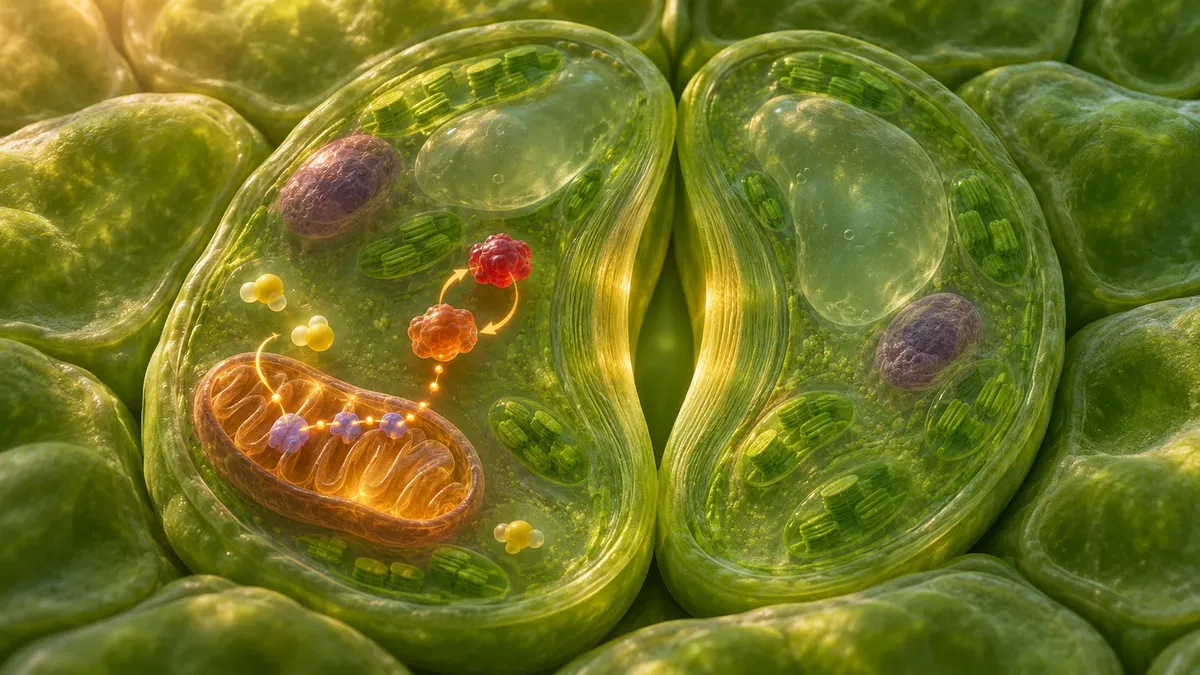
Stomata are tiny leaf pores that help regulate gas exchange—and can be entry points for pathogens. A bioRxiv preprint reports that mitochondrial hydrogen sulfide signalling and cytochrome c are involved in guard-cell responses to microbial signals, while leaving the precise molecular sequence unresolved.
Stomata are small pores on plant surfaces. They allow carbon dioxide to enter and water vapor to escape, but can also provide a route for pathogens to get inside. Guard cells bordering each pore control whether it opens or closes. How immune signals connect to activity inside these cells’ mitochondria is not fully understood.
A preprint by Pantaleno and colleagues investigates this question in Arabidopsis thaliana. The researchers focus on hydrogen sulfide (H₂S), a signalling molecule associated with guard-cell responses, and cytochrome c, a mitochondrial protein that transfers electrons during respiration. They ask how these factors relate to mitochondrial redox changes—shifts in chemical conditions associated with oxidation and reduction—and immune-triggered stomatal closure.
Tracking signals in guard cells
The team used genetically encoded redox sensors in Arabidopsis guard cells. They tested flg22, a pathogen-associated molecular pattern (PAMP), and AP39, a compound that delivers H₂S to mitochondria. They also examined cas-c1 mutants, which lack a mitochondrial source of H₂S, and cytochrome-c-deficient plants. In a further test, they used 2,4-dinitrophenol to disrupt mitochondrial membrane potential, the electrical difference across the mitochondrial membrane.
A dimedone-switch assay tested whether cytochrome c undergoes persulfidation, a chemical modification associated with H₂S signalling. The researchers also compared whole-plant susceptibility after spray inoculation with Pseudomonas syringae pv. tomato hrcC−.
What the preprint reports
Both flg22 and AP39 increased mitochondrial hydrogen peroxide (H₂O₂) in guard cells within five minutes. The flg22-triggered increase was weaker in cas-c1 mutants, consistent with a role for the mitochondrial H₂S source in this response.
Disrupting mitochondrial membrane potential prevented the measured mitochondrial oxidation and stomatal closure. This links mitochondrial activity to the observed response, but does not by itself establish every step in the signalling pathway.
Cytochrome-c-deficient plants retained stomatal responses to the hormone abscisic acid and to light, but failed to close their stomata in response to the tested PAMPs. In these plants, AP39 and flg22 also did not produce the reported guard-cell mitochondrial hyperpolarization or increase in cytosolic H₂O₂. The assay indicated that cytochrome c is persulfidated in vivo, identifying it as a possible target of H₂S signalling—not showing that this modification causes the other effects.
At the whole-plant level, cytochrome-c-deficient plants were more susceptible at early stages after inoculation. This finding is consistent with a role for cytochrome c in defense, but does not establish that the guard-cell mechanism alone explains the infection outcome.
What remains uncertain
The results support a model in which H₂S signalling and cytochrome c connect mitochondrial activity with redox changes during immune-related stomatal closure. The abstract does not establish the precise order of events or whether cytochrome c persulfidation directly drives the response. It also does not provide detailed sample sizes, effect sizes, or a full account of controls, limiting assessment of those aspects here.
This article is based on the paper’s abstract rather than a full-text review. The work is a bioRxiv preprint and has not been certified by peer review, so its findings should be treated as preliminary. Further research will be needed to test the proposed mechanism and its relevance beyond the experiments described.
- plant immunity
- stomata
- guard cells
- mitochondria
- hydrogen sulfide
- cytochrome c
- Arabidopsis
Reviewed cross-references
These connections were reviewed by a model, not independently fact-checked by a human. Similarity does not imply agreement; consult the original papers and the evidence below.
A second kind of oxidative burst may help plants detect danger
Supporting evidence: Both preprints report mitochondrial redox changes during plant immune elicitation: the origin study links flg22-triggered mitochondrial H₂O₂ in Arabidopsis guard cells to CAS-C1 and cytochrome c, while Barreto et al. report a flg22-associated respiratory and intracellular redox response in leaves. This supports the bounded connection that mitochondria contribute to immune-associated redox signaling, but the different tissues and proposed mechanisms do not establish a shared pathway.
Model review: · openai-codex/gpt-6-luna
Evidence and provenance
Selected excerpts, not complete papers. PDF extraction can omit figures or damage equations, tables and reading order; sources may be preprints.
2026.11.20.768174v1 — Original paper
Excerpt reference:
content/articles/2026.11.20.768174v1.md#extra.abstract
Basis: Abstract only; full paper text was not used for this evidence
Source SHA-256:6f3cff4db27420fc641c17f8e27588e81a6b415f6ae0990d7f4e0abda8c7a6312026.11.18.767486v1 — Original paper
Excerpt reference:
static/papers/2026.11.18.767486v1.md:212-257
Basis: Paper text
Source SHA-256:ed575c3fe365796e2d35c299b246a63a598aa8c38e522e9325d01a44d3f05888
Related reading
Automatically matched by shared topic keywords. These links do not imply that the sources agree or establish a consensus.
A cellular switch helps plants close their leaf pores
Source published
Shared keywords: guard cells
A second kind of oxidative burst may help plants detect danger
Source published
Shared keywords: plant immunity
How a plant defense gene puts a brake on itself
Source published
Shared keywords: plant immunity
Two cellular delivery routes help plants block pathogen entry
Source published
Shared keywords: plant immunity
A conserved immune-receptor domain across wheat species
Source published
Shared keywords: plant immunity