TRANSMISSION // 2026.11.19.767995v1
How a plant defense gene puts a brake on itself
Source published
In Arabidopsis, RSI1 RNA rises after pathogen challenge, but experiments suggest RSI1 can also restrain its own expression. The proposed feedback involves RSI1 binding near its gene and changes to histone marks.
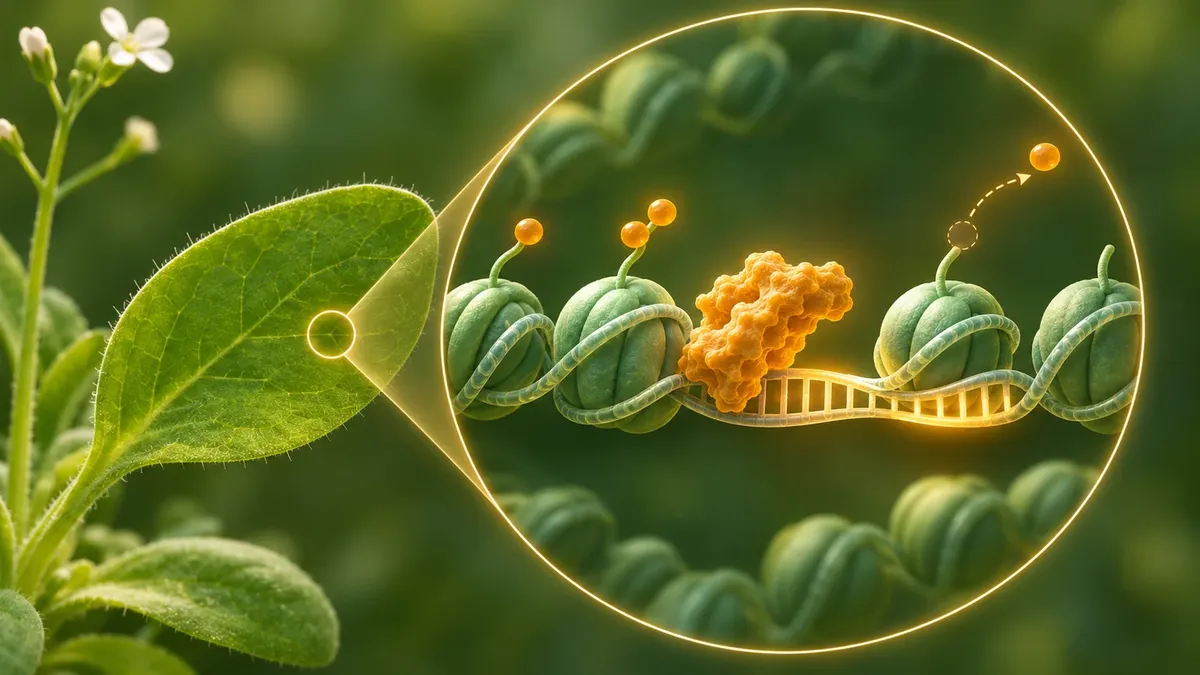
Plants can develop systemic acquired resistance (SAR), a defense state that helps protect tissues beyond an infection site. A bioRxiv preprint investigates how RSI1, a gene needed for SAR in Arabidopsis, may also limit its own pathogen-induced expression.
A defense response with a possible built-in brake
When a pathogen attacks a plant, defenses can extend beyond the infected area. In Arabidopsis thaliana, systemic acquired resistance (SAR) helps prepare other parts of the plant to respond. The gene RSI1, also known as FLOWERING LOCUS D (FLD), is required for SAR activation. Its protein is a histone demethylase: it can remove methyl groups from histone H3 at lysine 4. The marks H3K4me2 and H3K4me3 are generally associated with active gene expression.
Earlier work found that RSI1 RNA increases in local and systemic tissues after pathogen inoculation. How that increase is regulated was not clear. Singh and colleagues asked whether RSI1 might also restrain its own expression—a feedback process that could help limit the response.
Comparing plants and tracking gene activity
The researchers induced SAR with Pseudomonas syringae carrying the AvrRpt2 effector, then measured RSI1 RNA in systemic leaves that had not been inoculated. They compared wild-type plants with an rsi1 mutant, whose RSI1 protein is nonfunctional. They also studied a gstt2 mutant, because GSTT2 has been linked to RSI1 and SAR.
To test whether RSI1 could suppress its own promoter, the team used a transient assay in mutant leaves. They introduced a construct in which the RSI1 promoter drives GUS, a measurable reporter, with or without a construct producing RSI1. They also used chromatin immunoprecipitation (ChIP) to examine RSI1 association and histone marks at regions of the RSI1 gene. ChIP detects proteins or histone features associated with particular DNA regions.
Evidence for self-regulation
After SAR induction, RSI1 RNA increased in wild-type plants. The authors report higher RSI1 RNA in the rsi1 mutant, consistent with functional RSI1 normally restraining its expression. In the transient assay, adding RSI1 reduced activity from the RSI1-promoter reporter after pathogen challenge. A separate control reporter was not similarly reduced, supporting an effect on the RSI1 promoter rather than a general shutdown of reporter activity.
Pathogen-induced RSI1 expression in local and systemic tissues also depended on GSTT2: the increase seen in wild-type plants was not observed in the gstt2 mutant. ChIP detected RSI1 near the transcription start site of its own gene. In a separate measurement, H3K4me2 and H3K4me3 signals across the RSI1 locus were higher in rsi1 plants than in wild type. Together, these results support a model in which RSI1 associates with its own gene and helps remove histone marks linked to active expression, thereby limiting RSI1 expression.
The authors suggest this feedback could help keep SAR at an “optimal” level. The experiments do not establish what level is optimal or show that the feedback improves plant survival or resistance. They measure gene expression and chromatin features, not a practical benefit in crops.
What remains uncertain
The experiments provide complementary evidence, but do not settle every step of the proposed mechanism. The promoter experiment is a transient assay in leaves, and ChIP shows association with a DNA region; neither alone proves the full sequence of molecular events that causes expression to fall. Several measurements report three biological replicates. The manuscript says data are available from the corresponding author upon reasonable request, rather than through a public repository.
This work is a bioRxiv preprint posted November 23, 2026, and has not been certified by peer review. Its conclusions should therefore be considered provisional. The study offers a possible explanation for how RSI1 expression is restrained during plant immunity, but further research is needed to establish how this feedback affects SAR in other conditions or settings.
- Arabidopsis
- plant immunity
- systemic acquired resistance
- RSI1
- FLOWERING LOCUS D
- histone demethylation
- gene regulation
Reviewed cross-references
These connections were reviewed by a model, not independently fact-checked by a human. Similarity does not imply agreement; consult the original papers and the evidence below.
Chromatin proteins link a plant clock gene to flowering time in Arabidopsis
Shared method: Both studies use chromatin immunoprecipitation with qPCR: the RSI1 study tests RSI1 association and histone-mark abundance at its locus, while the PWO study measures H2Aub at PRR7. This is a methodological connection, not evidence that the proteins or regulatory outcomes are equivalent.
Model review: · openai-codex/gpt-6-luna
Evidence and provenance
Selected excerpts, not complete papers. PDF extraction can omit figures or damage equations, tables and reading order; sources may be preprints.
2026.11.19.767995v1 — Original paper
Excerpt reference:
static/papers/2026.11.19.767995v1.md:580-688
Basis: Paper text
Source SHA-256:97003a8e5a7f47d9f1b74acb98bf584a5ae780e3f454b8ea4a7ec2330aaf46d32026.11.03.763775v1 — Original paper
Excerpt reference:
static/papers/2026.11.03.763775v1.md:1621-1722
Basis: Paper text
Source SHA-256:d747678e1e290723a1e7db4a45d4c85dbf2b8b78eae427b8e144b68cf0912076
Related reading
Automatically matched by shared topic keywords. These links do not imply that the sources agree or establish a consensus.
Wheat Rust Study Maps Candidate Regulatory RNAs
Source published
Shared keywords: plant immunity
Two cellular delivery routes help plants block pathogen entry
Source published
Shared keywords: plant immunity
When PHE1 binds but genes stay less active
Source published
Shared keywords: gene regulation
A conserved immune-receptor domain across wheat species
Source published
Shared keywords: plant immunity
A second kind of oxidative burst may help plants detect danger
Source published
Shared keywords: plant immunity