TRANSMISSION // 2026.11.19.767895v1
When PHE1 binds but genes stay less active
Source published
In Arabidopsis endosperm, PHE1 often occupies both parental copies of its target genes. The study finds that H3K27me3 is associated with lower maternal expression at some targets.
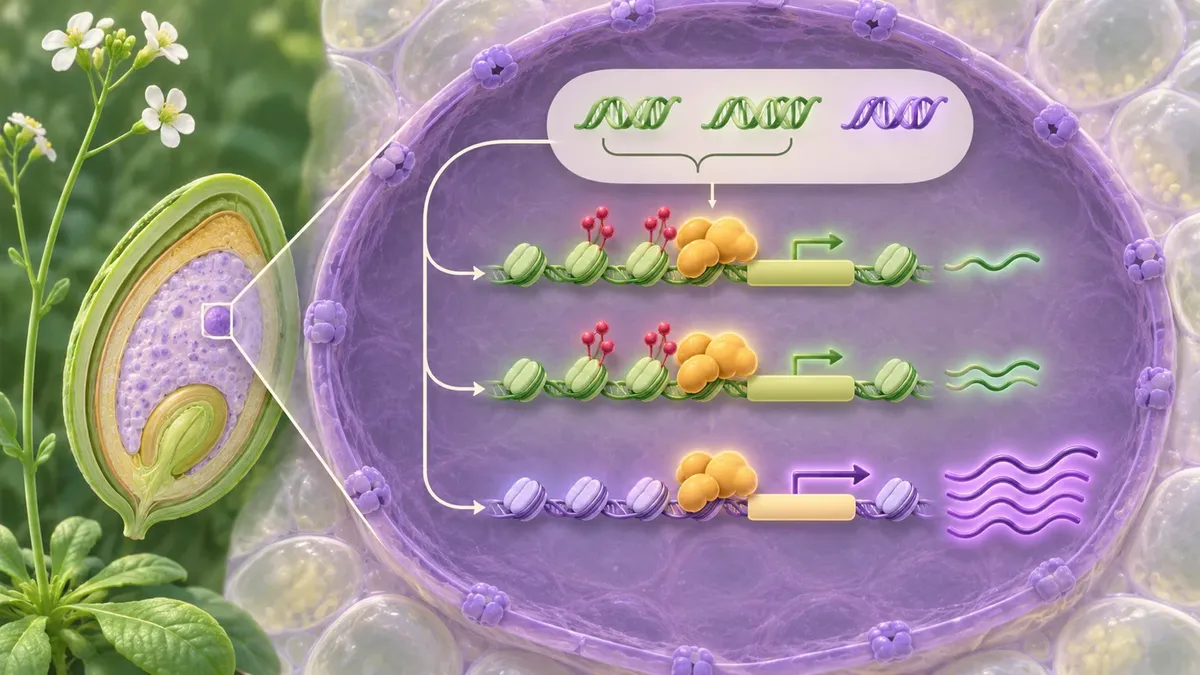
A transcription factor can bind DNA without switching a gene on. A bioRxiv preprint on developing Arabidopsis seeds reports that PHE1 usually occupies both parental copies at the targets researchers could assess, while a repressive chromatin mark is associated with reduced expression from maternal copies at some genes.
In developing seeds, some genes are expressed more from one parent’s copy than the other. This parent-of-origin pattern, called genomic imprinting, is important in the endosperm, the tissue that supports embryo growth. The question is how one copy can remain less active when a gene-regulating protein is bound to it.
A study of Arabidopsis thaliana investigates this puzzle through PHERES1, or PHE1, a transcription factor previously linked to endosperm genes, including paternally expressed genes (PEGs). The researchers ask whether PHE1 binds differently to maternal and paternal copies, or whether the surrounding chromatin helps determine whether binding is followed by gene activity.
Mapping PHE1 in developing seeds
PHE1 is expressed in the endosperm for a limited period, making it difficult to collect enough material for conventional genome-wide binding experiments. The team adapted CUT&Tag, a method that uses an antibody to identify DNA near a protein of interest and prepare those fragments for sequencing. They compared its binding maps with previously published ChIP-seq results, which also identify protein-binding regions.
CUT&Tag recovered many previously reported PHE1 targets, but the two methods did not produce identical lists. The analysis identified 994 genes associated with CUT&Tag targets; 562 of those were also identified in the earlier ChIP-seq data, which included 1,749 targets. PHE1 binding was enriched at imprinted genes, particularly PEGs, and at certain transposable elements—DNA sequences that can move or copy themselves within the genome.
To distinguish parental copies, the researchers used crosses between plants with genetic differences, allowing some sequencing reads to be assigned to maternal or paternal DNA. Such allele-specific assessments required reads containing informative genetic differences. The study also analyzed published chromatin and gene-expression datasets, including expression data from fie plants lacking a core PRC2 component. These were reanalyses of prior data, not a single new experiment measuring binding, chromatin marks and expression together after one targeted intervention.
Occupancy does not guarantee activity
Among the PHE1-bound PEGs that could be assessed, most showed predominantly biallelic PHE1 occupancy: the protein was detected on both parental copies. Yet the maternal copies of these PEGs were enriched for H3K27me3, a chemical modification of histone proteins associated with repression. Thus, the presence of PHE1 did not mean that both copies were expressed equally.
The pattern was not limited to PEGs. A group of PHE1 targets with higher H3K27me3 enrichment showed maternal-biased expression, while other target groups were generally biallelically expressed. This indicates that reduced maternal activity is associated with the chromatin-marked group, not a uniform feature of every PHE1-bound gene.
In published expression data from fie mutants, many PHE1 targets were more highly expressed than in wild type, with stronger expression from maternal copies. Targets with higher H3K27me3 enrichment tended to show larger expression changes. These observations fit the idea that PRC2-associated H3K27me3 helps restrict maternal expression even when PHE1 binds. They do not, by themselves, prove that the mark is the sole cause of the expression pattern.
The researchers also tested PHE1 binding in mea/+ material, where MEA, another PRC2 component, is impaired in some seeds. They found no substantial increase in PHE1 binding specifically to maternal copies. The paper notes that binding could be affected on both parental copies, rather than shifting only toward the maternal one.
What the evidence can—and cannot—show
The results distinguish DNA occupancy from transcriptional output: a regulator can be present at a gene without producing equal activity from both parental copies. The authors propose that chromatin context, including H3K27me3, limits PHE1-associated activation at some targets. The proposed causal role is inferred from binding patterns and expression changes in previously published mutant datasets, rather than established through targeted, gene-by-gene manipulation of H3K27me3. How the amount of the mark is set at particular targets also remains unresolved.
The binding maps offer partial overlap, not interchangeable measurements: CUT&Tag recovered fewer targets than ChIP-seq, and the shared genes are one part of each method’s results. Allele-specific conclusions also apply to targets with enough informative reads, so they should not be assumed to cover every PHE1 site.
This study is a bioRxiv preprint posted in November 2026 and had not been certified by peer review at posting. Its findings are preliminary. They support a model in which chromatin context helps shape expression despite PHE1 binding, but do not establish that the same relationship applies to every target or beyond the studied Arabidopsis endosperm.
- Arabidopsis
- genomic imprinting
- PHE1
- H3K27me3
- PRC2
- endosperm
- CUT&Tag
- gene regulation
Reviewed cross-references
These connections were reviewed by a model, not independently fact-checked by a human. Similarity does not imply agreement; consult the original papers and the evidence below.
Rice seedlings may prepare for heat by responding more selectively
Supporting evidence: Both preprints connect H3K27me3 with restrained gene expression: the Arabidopsis endosperm study reports maternal-allele activation of PHE1 targets after PRC2-mark depletion, while the rice study associates mark retention with a more restrained heat response. The comparison is limited: these are different species, tissues and regulatory settings, and the rice authors state that causality remains untested; both reports are preprints.
Model review: · openai-codex/gpt-6-luna
Evidence and provenance
Selected excerpts, not complete papers. PDF extraction can omit figures or damage equations, tables and reading order; sources may be preprints.
2026.11.19.767895v1 — Original paper
Excerpt reference:
static/papers/2026.11.19.767895v1.md:956-1066
Basis: Paper text
Source SHA-256:58f3fe2b320c54c05825746659fcb8df440e5f40cb6b7b4d0055e6f55f52d0012026.11.12.766148v1 — Original paper
Excerpt reference:
static/papers/2026.11.12.766148v1.md:4161-4271
Basis: Paper text
Source SHA-256:4c61b8dbec279b420794622691bfb8c4bb8767be04847894ddd89050741eeefb
Related reading
Automatically matched by shared topic keywords. These links do not imply that the sources agree or establish a consensus.
A barley gene changes which parent’s copy is active as grain develops
Source published
Shared keywords: genomic imprinting
Rice seedlings may prepare for heat by responding more selectively
Source published
Shared keywords: gene regulation
A two-scale approach to mapping gene regulation
Source published
Shared keywords: gene regulation