TRANSMISSION // 2026.11.19.767892v1
How a plant’s body clock shapes its response to heat
Source published
In Arabidopsis, researchers tracked heat responses across genes, proteins and metabolites, linking clock components CCA1 and LHY to stress-related processes.
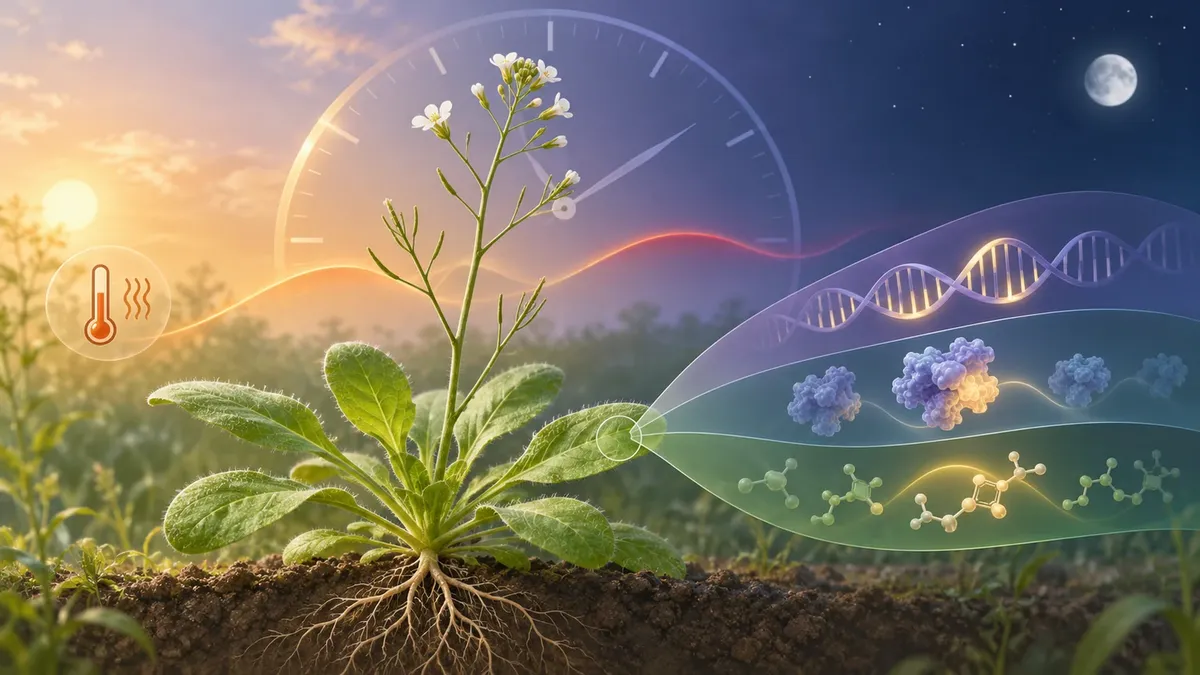
A plant’s internal clock may influence how it responds to heat at different times of day. A bioRxiv preprint examines two clock components in Arabidopsis and reports changes across gene, protein and metabolic responses.
Why study heat and the clock?
Plants have a circadian clock, an internal timing system that coordinates biological processes with the day-night cycle. Heat can be harmful to crops, and the authors note that heat events at night can be particularly damaging to yield. But how the clock shapes heat responses across different levels of biology is not fully understood.
This study focused on CCA1 and LHY, two components of the Arabidopsis clock. The researchers investigated how altered expression of these components relates to responses after a short-term heat stress.
Following responses across layers
The team used clock mutants with altered CCA1 and LHY expression and collected time-resolved measurements of the transcriptome, proteome and metabolome after heat treatment. These refer, respectively, to RNA transcripts, proteins and metabolites—small molecules involved in biological processes.
The available source is the abstract, which does not give the experimental schedule, sample sizes, heat conditions or detailed statistical results. Those details therefore cannot be assessed here.
What the study reports
The authors identified regulatory connections they associate with CCA1 and LHY, some shared with other clock components linked to heat responses. They also report connections to genes that do not show daily cycles, suggesting the clock may be linked to a broader set of heat-responsive genes.
Processes associated with CCA1 and LHY included sulfur assimilation and the scavenging of reactive oxygen species, or ROS. The authors suggest these processes may contribute to differences in heat tolerance by time of day; the abstract does not establish that they directly cause such differences.
In the double mutant, cca1lhy, heat responses were dampened in both the transcriptome and proteome. The authors interpret this as suggesting that circadian regulation may shape responses through transcriptional and post-translational processes. They also report altered metabolic responses in the mutant and propose a role for clock regulation of starch degradation in thermotolerance. The abstract does not specify the direction or size of those metabolic changes.
What remains uncertain
The findings connect CCA1 and LHY with heat responses across several biological layers in Arabidopsis. They offer candidates for further study, but do not show that changing these clock components would improve crop yields or establish a crop-engineering strategy. Results in a model plant do not by themselves demonstrate how crops will respond in fields.
This account is based on the preprint abstract, rather than the full methods and results, so important details for evaluating the findings are unavailable. The work is posted on bioRxiv; its conclusions should be regarded as provisional pending further assessment and research.
- Arabidopsis
- circadian clock
- CCA1
- LHY
- heat stress
- plant biology
- thermotolerance
- metabolism
Reviewed cross-references
These connections were reviewed by a model, not independently fact-checked by a human. Similarity does not imply agreement; consult the original papers and the evidence below.
An RNA quality-control pathway has opposing roles in plant heat recovery
Supporting evidence: Both preprints point to post-transcriptional regulation as relevant to Arabidopsis heat responses: Strout et al. infer a possible post-transcriptional contribution from transcriptome–proteome differences after short heat treatments, while Abbas et al. report that NMD-deficient plants show altered heat recovery and thermomemory. This supports the bounded idea that post-transcriptional processes can affect heat responses, not that the studies identify the same pathway or test comparable heat timing or treatments; both are preprints.
Model review: · openai-codex/gpt-6-luna
Evidence and provenance
Selected excerpts, not complete papers. PDF extraction can omit figures or damage equations, tables and reading order; sources may be preprints.
2026.11.19.767892v1 — Original paper
Excerpt reference:
static/papers/2026.11.19.767892v1.md:368-471
Basis: Paper text
Source SHA-256:f3df78c6523f5996f7431dd65363b28d635e84bf50e097cc68ff15894e13d4ef2026.10.30.763111v1 — Original paper
Excerpt reference:
static/papers/2026.10.30.763111v1.md:12-66
Basis: Paper text
Source SHA-256:84aeccd1b6c645d7089766bdd7a091b275d9532ec3818ad98bef4181274ea8d5
Related reading
Automatically matched by shared topic keywords. These links do not imply that the sources agree or establish a consensus.
An RNA quality-control pathway has opposing roles in plant heat recovery
Source published
Shared keywords: heat stress
RNA decay protein helps regulate Arabidopsis’s circadian clock
Source published
Shared keywords: circadian clock
Chromatin proteins link a plant clock gene to flowering time in Arabidopsis
Source published
Shared keywords: circadian clock
How heat changes tomato pollen—and how researchers tracked it
Source published
Shared keywords: heat stress
A cellular switch helps plants close their leaf pores
Source published
Shared keywords: plant biology