TRANSMISSION // 2026.11.19.767889v1
A newly named Gabon shrub may face future flooding
Source published
Botanists describe *Ardisia tchimbele* from three historical specimens collected in Gabon’s Crystal Mountains. Its provisional Critically Endangered assessment reflects a small known range and possible flooding from future hydroelectric projects.
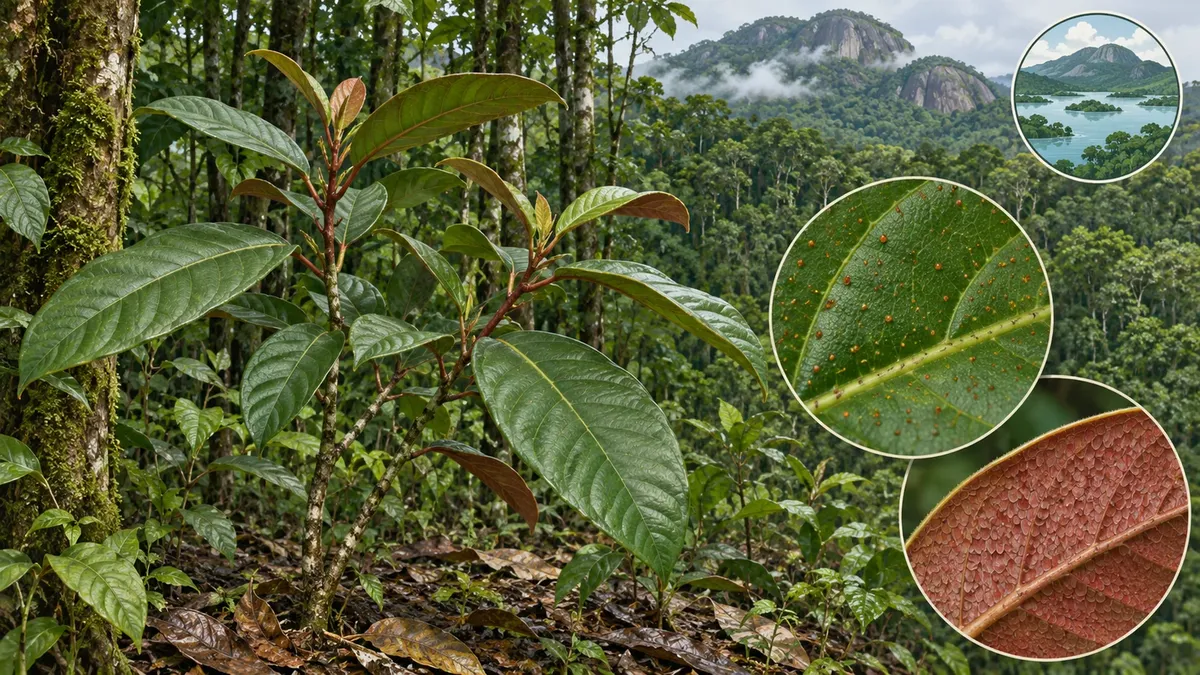
Three specimens collected in 1989, 1990 and 1994 underpin the description of a forest shrub from Gabon. The authors warn that future hydroelectric projects could flood its known sites, but say surveys are needed to establish the plant’s range, population and threats.
A species recognized from historical specimens
A shrub in Gabon’s Crystal Mountains has been formally described as Ardisia tchimbele. Botanists Harry Murdoch and Martin Cheek based the description on three specimens collected near Tchimbélé in 1989, 1990 and 1994. The paper asks whether the plant’s characteristics distinguish it from known African Ardisia species, and what conservation concerns follow from its limited known records.
The authors treat it as a new species, distinguishing it from its closest described lookalike, Ardisia mildbraedii. But another possible relative, known as Ardisia sp. 1, remains unresolved. The authors’ assessment of the plant’s conservation status is also provisional.
How the plant was identified
The researchers examined herbarium specimens and recorded physical features, following protocols from earlier work on the genus. They compared the specimens with described African Ardisia species and with Ardisia sp. 1, an informally described plant from the Crystal Mountains noted by botanist André Taton in 1979.
Among the features described for A. tchimbele are relatively large, oblong leaves and conspicuous oil glands that appear bright orange-red when viewed with transmitted light. Its lower leaf surfaces bear dense reddish scales. In comparison with A. mildbraedii, the authors report that A. tchimbele has denser oil glands, longer leaf stalks, wider leaves and more lateral veins.
These are comparisons of visible botanical characteristics, not results from genetic testing. The paper presents a taxonomic description based on specimens and their physical features; it does not resolve every question about similar plants in the region.
Why the authors raise a conservation concern
All three accepted collection sites lie downstream of the Tchimbélé hydroelectric dam. The authors warn that further hydroelectric development could create reservoirs that submerge one or more of the sites. Using georeferences from the specimen labels, they estimate the plant’s area of occupation at 4 square kilometres under the IUCN method they apply. Because the three sites are close together and face the same potential threat, they count them as one threat-based location.
On this basis, the authors provisionally assess A. tchimbele as Critically Endangered under the IUCN criteria. This is an assessment based on the limited known records and the possibility of future flooding—not evidence that flooding is certain or that the plant has already disappeared. The authors recommend a field survey to determine its range, population size, regeneration and more detailed threats, information that could help guide conservation planning.
An unresolved specimen could change the assessment
Taton’s Ardisia sp. 1 record comes from Nkam, about 37 kilometres from the known A. tchimbele sites. The brief description largely matches the new species, but an image of the specimen shows an undulate leaf margin, whereas A. tchimbele is described as having an entire margin. The authors have not studied that specimen’s oil glands or lower-surface scales, so they cannot settle whether the two records represent the same species.
If Ardisia sp. 1 proves to be A. tchimbele, it would add a second location, and the authors say the threat assessment would likely be lowered to Endangered. This possibility shows why further specimen study and fieldwork matter to the conservation estimate.
The paper also describes the Crystal Mountains as a region with distinctive plant diversity. Parts of the range are protected, but the authors say the area known to host A. tchimbele is not. They recommend surveying the shrub and considering options including an Important Plant Area and conservation outside its natural habitat.
What remains uncertain
This taxonomic description is not a population survey or a study measuring dam impacts. The plant’s full range and current abundance remain unknown, and the flooding threat is prospective. Both the conservation assessment and the relationship to Ardisia sp. 1 could change with additional evidence.
The report is a bioRxiv preprint posted on November 24, 2026, and is marked as not certified by peer review. The authors specifically recommend fieldwork to refine knowledge of the plant and its threats. For now, the paper documents a named species, explains why its known sites may be vulnerable, and identifies questions that further research could answer.
- Ardisia tchimbele
- Gabon
- Crystal Mountains
- plant taxonomy
- hydroelectric projects
- forest conservation
- IUCN assessment
- bioRxiv preprint
Related reading
Automatically matched by shared topic keywords. These links do not imply that the sources agree or establish a consensus.
Palm flower shapes offer clues, not clear boundaries, to Peruvian species
Source published
Shared keywords: plant taxonomy
Green algae show varied hydrogen responses when light returns after anoxia
Source published
Shared keywords: biorxiv preprint
Can easing grapevine defenses aid mildew control?
Source published
Shared keywords: biorxiv preprint
Rice study explores ancestral protein sites and disease resistance
Source published
Shared keywords: biorxiv preprint
A second kind of oxidative burst may help plants detect danger
Source published
Shared keywords: biorxiv preprint