TRANSMISSION // 2026.11.19.767855v1
Grass roots reshape their water-carrying channels as they grow
Source published
A study finds that adventitious roots in several grasses produce fewer metaxylem files as they develop. Gene-expression analyses offer candidate clues, while computer models suggest possible effects on water transport.
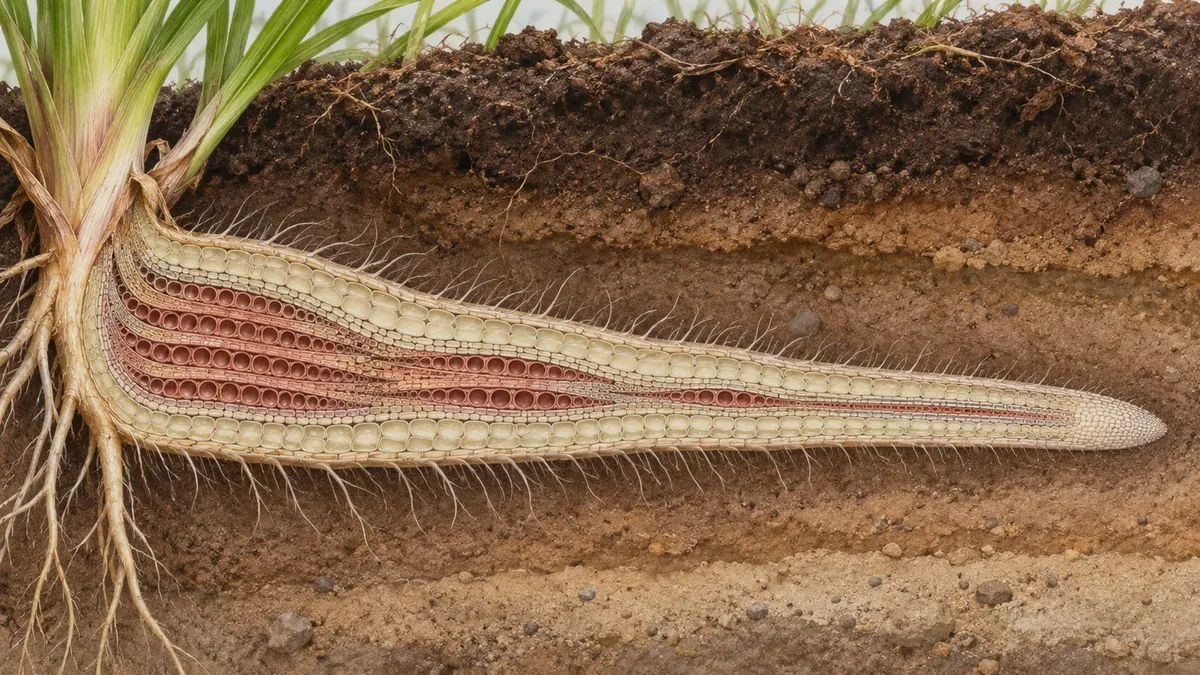
A root’s water-conducting tissue may change along its length. In a bioRxiv preprint, researchers report that adventitious roots of several temperate grasses produce progressively fewer metaxylem files, eventually reaching a pattern resembling that of seminal roots. The team combined root anatomy, wheat gene-expression data and hydraulic modelling to examine the shift and its possible consequences.
A changing pattern inside the root
Plants move water from soil to shoot through xylem, a network of vessels running through roots and stems. In cereal roots, metaxylem vessels are major channels for this upward flow. Their number and size are often treated as features that distinguish one root type from another. But roots develop over time, and their anatomy can vary along their length.
A bioRxiv preprint asks whether the metaxylem arrangement in grass roots stays fixed as a root grows. Researchers examined cross-sections from different positions along roots. Because cereal roots do not add vascular tissue through secondary growth, the anatomy along a mature root can offer clues to what its growing tip produced at different stages.
In wheat, adventitious roots—those that emerge from the plant’s stem rather than from the embryo—began with several metaxylem files, or rows of vessels. Farther along the root, the number of files declined until a single central file remained. Seminal roots, which emerge from the embryo, generally had one central file. The authors describe this as convergence in vascular anatomy between the two root types.
The pattern was found in wheat, barley, rye, oat and Brachypodium. It was not observed in the maize and sorghum sampled: their adventitious roots retained multiple metaxylem files along the lengths examined. The researchers also report the pattern in wheat grown in different settings, including field trials, suggesting it was not limited to one growth environment.
Looking for developmental clues
To explore what might accompany the change, the team studied wheat root tips at different stages. They built a cell-resolved spatial transcriptomic atlas, which maps gene activity to locations in tissue, and combined it with bulk RNA sequencing of whole root tips. The spatial dataset included 6,685 annotated cells across eight sections; the bulk analysis compared four groups of root tips, with four biological replicates per group.
The researchers filtered genes across the two datasets to focus on candidates whose expression aligned with the changing metaxylem state and was concentrated in metaxylem cells. The candidates included genes associated with meristem activity—the growth region at the root tip—vascular patterning and lignification, which strengthens vessel walls. These are leads for future research, not proof that particular genes cause the shift. The authors say the results point to multiple processes rather than one established master regulator.
What models suggest about water flow
The team used computer models to test how different vessel arrangements might affect water transport. The simulations varied the number and size of metaxylem files and the distance over which their arrangement changed. They suggested that a transition from several files to fewer, wider vessels can maintain or increase whole-root axial conductance—the capacity to carry water along the root—even when total vessel area declines. The outcome depended on the configuration and position of the change.
This is a model-based result, not a direct demonstration that the observed pattern improves water transport in living plants. The authors propose that multiple files near the root base could provide robustness, while fewer vessels farther along could maintain transport efficiency. They also suggest the pattern may suit changing hydraulic conditions along roots. These proposed benefits remain provisional: the functional evidence comes from modelling, not direct tests of water transport or vessel failure under different soil conditions.
Important questions remain. The study does not establish the cellular mechanism behind the reduction in metaxylem files. The authors suggest vessel-forming cells might change their division patterns, be eliminated, or both. Nor does the sampling establish how widespread the pattern is across grasses beyond the species examined. The paper discusses possible ecological explanations for differences between groups, but does not demonstrate what caused them.
The work is a bioRxiv preprint and has not been certified by peer review, so its findings and interpretations remain provisional. The candidate genes need functional testing, and the hydraulic predictions need experimental validation. The study nevertheless raises a useful question for root research: anatomy measured at one position may not capture how a root’s transport system changes as it develops.
- plant roots
- xylem
- metaxylem files
- grass development
- wheat
- spatial transcriptomics
- plant hydraulics
Reviewed cross-references
These connections were reviewed by a model, not independently fact-checked by a human. Similarity does not imply agreement; consult the original papers and the evidence below.
Wheat roots differ by position, not just size
Supporting evidence: Both preprints report position-associated variation in wheat root anatomy: the origin describes metaxylem-file changes along adventitious roots, while the target finds anatomical differences among nodal roots that persist after adjustment for root cross-sectional area. These concern different positional scales and outcomes, so the target supports only the bounded point that wheat root anatomy varies with position, not the same remodeling process or mechanism.
Model review: · openai-codex/gpt-6-luna
Evidence and provenance
Selected excerpts, not complete papers. PDF extraction can omit figures or damage equations, tables and reading order; sources may be preprints.
2026.11.19.767855v1 — Original paper
Excerpt reference:
static/papers/2026.11.19.767855v1.md:1294-1403
Basis: Paper text
Source SHA-256:81a7fdc561370ca29b263019b9aed082371f064b30fd0428735e62228246de152026.11.16.766962v1 — Original paper
Excerpt reference:
static/papers/2026.11.16.766962v1.md:141-252
Basis: Paper text
Source SHA-256:79130c20c13e1ddb98c422f63698cce3695e433597f2dc3ab62ea277fa64e558
Related reading
Automatically matched by shared topic keywords. These links do not imply that the sources agree or establish a consensus.
An image-editing model explores gene and shape signals in kidney cells
Source published
Shared keywords: spatial transcriptomics
How an avocado stalk makes room for more sugar-carrying tubes
Source published
Shared keywords: plant hydraulics
Rice roots may register soil pH through changes in iron availability
Source published
Shared keywords: plant roots