TRANSMISSION // 2026.11.19.767829v1
Auxin shapes the proportions of a hibiscus bullseye
Source published
A study of Hibiscus trionum reports that auxin signalling helps preserve the proportions of its petal bullseye pattern, but does not initiate the pattern’s boundary.
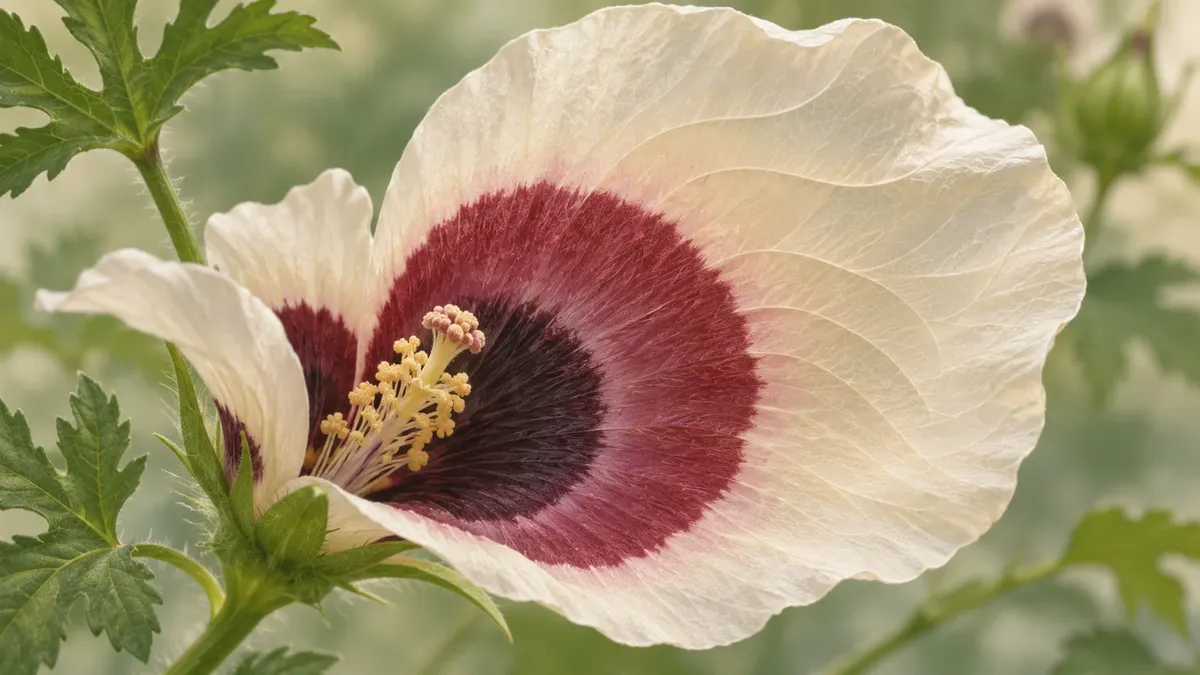
How does a developing petal acquire a bullseye pattern? A study of Hibiscus trionum suggests that auxin, a plant growth hormone, helps regulate the pattern’s proportions after its early layout is established.
Pattern formation in a petal
Flower patterns form as cells in different parts of a petal develop contrasting chemical or structural features. Researchers have identified some factors involved in producing pigments and shaping cells, but the signals that divide a developing petal into distinct regions are less well understood. Salvi and colleagues asked whether auxin helps establish the bullseye pattern of Hibiscus trionum or instead affects its development after an initial layout forms.
A role in proportions, not initiation
The authors report that auxin does not initiate the bullseye boundary during the pre-patterning phase. Instead, auxin signalling is important for regulating cell behaviour in the petal’s distal region and preserving the proportions established in young petal primordia—the early structures that develop into petals.
In other words, the reported role is not to set the initial boundary, but to help maintain the relative dimensions of the pattern. The authors suggest that, by modulating the growth of different petal regions, auxin could shift bullseye dimensions over evolutionary timescales. That is a proposed implication, not a finding that the study directly observed evolutionary change.
What remains uncertain
This account is based on the paper’s abstract, not its full methods and results. The supplied information does not describe the experimental procedures, sample sizes, interventions or measurements, so it is not possible here to assess those details or the strength and scope of the evidence. The abstract also does not identify what initiates the boundary, or establish that auxin is the only influence on pattern proportions or that the proposed evolutionary effects occur in natural populations.
The study is identified as a bioRxiv preprint. The supplied source information does not establish whether this particular manuscript has undergone peer review. Its conclusions should be read with that limitation in mind. The central result is that, in this hibiscus study, auxin appears to help preserve bullseye proportions, while the signal that first establishes the pattern’s boundary remains unresolved.
- Hibiscus trionum
- auxin
- flower development
- petal patterning
- bullseye pattern
- plant hormones
- preprint
Reviewed cross-references
These connections were reviewed by a model, not independently fact-checked by a human. Similarity does not imply agreement; consult the original papers and the evidence below.
Where auxin is sensed helps shape an Arabidopsis root
Supporting evidence: Both preprints report spatially localized auxin effects on plant growth: in Hibiscus petals, auxin signaling regulates cell behavior in the distal region and bullseye proportions, while in Arabidopsis roots, boosting auxin sensitivity in elongating cells strongly inhibits root growth. This supports the bounded point that auxin’s growth effects can depend on where signaling occurs; the studies concern different organs, species, and outcomes, so they do not establish a shared mechanism.
Model review: · openai-codex/gpt-6-luna
Evidence and provenance
Selected excerpts, not complete papers. PDF extraction can omit figures or damage equations, tables and reading order; sources may be preprints.
2026.11.19.767829v1 — Original paper
Excerpt reference:
static/papers/2026.11.19.767829v1.md:205-251
Basis: Paper text
Source SHA-256:654a26cc651e2f6f48a6d272fba01629dbbd03b83e0858d0ea6740c5a79481a62026.11.18.767646v1 — Original paper
Excerpt reference:
static/papers/2026.11.18.767646v1.md:936-1126
Basis: Paper text
Source SHA-256:fcf7292b8a4bde42d72096e13e472ad10287f9fa2082f798f44ad68ea069f7d3
Related reading
Automatically matched by shared topic keywords. These links do not imply that the sources agree or establish a consensus.
How water stress reshapes seed germination signals
Source published
Shared keywords: plant hormones
How Arabidopsis balances heat and hunger
Source published
Shared keywords: plant hormones
Inside larger soybean seeds: bigger cells, more oil and altered hormone signals
Source published
Shared keywords: plant hormones