TRANSMISSION // 2026.11.19.767801v1
Wheat Rust Study Maps Candidate Regulatory RNAs
Source published
A computational analysis identifies candidate long non-coding RNAs in wheat responses to leaf rust, but its four unreplicated samples limit confidence in expression comparisons.
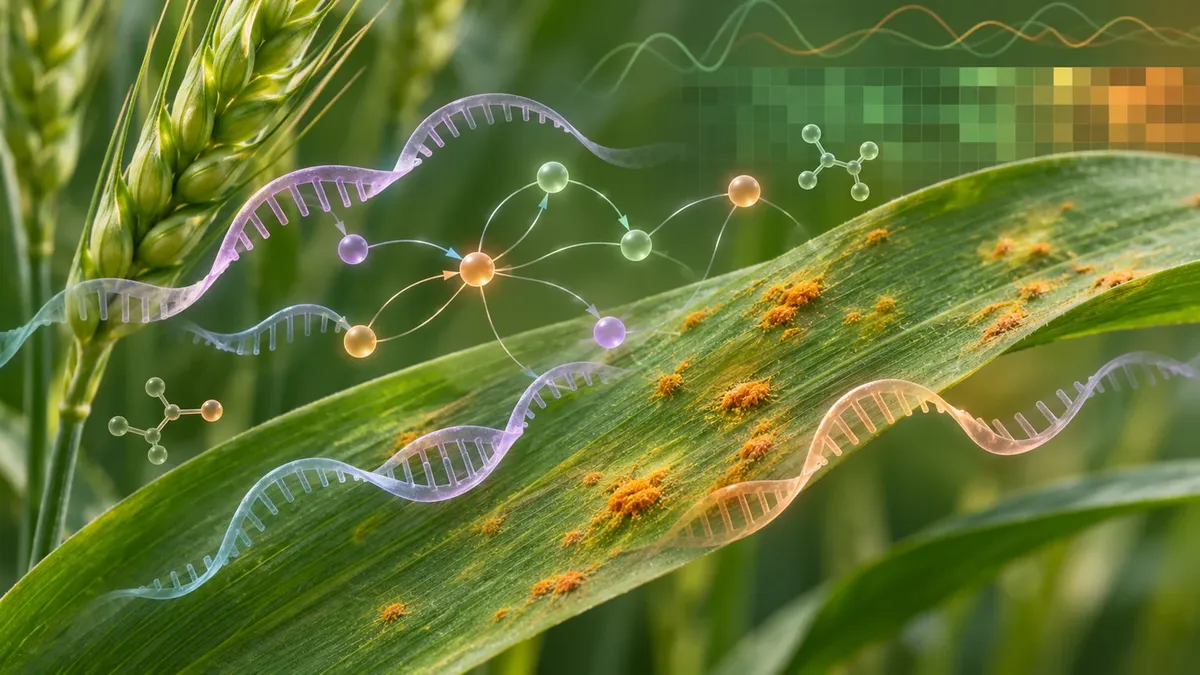
A preprint uses archived wheat RNA-sequencing data to search for long non-coding RNAs that may be involved in responses to leaf rust. The results offer candidates for future study, not evidence that these RNAs cause resistance.
Why look at long non-coding RNA?
Leaf rust, caused by the fungus Puccinia triticina, is a disease of wheat that can damage crops. Plants respond to infection by changing the activity of many genes. Some of that regulation may involve RNA molecules that do not encode proteins. Long non-coding RNAs, or lncRNAs, are transcripts generally defined as longer than 200 nucleotides. They may affect gene activity or interact with other RNAs.
This study asks which lncRNAs appear in wheat samples associated with leaf-rust infection, and whether any might connect to microRNAs (miRNAs), another class of regulatory RNA. The researchers used computational analysis of existing sequencing data. They did not test whether candidate lncRNAs directly affect infection or resistance.
From sequencing reads to candidates
The analysis used four archived RNA-sequencing samples: a susceptible wheat cultivar and a resistant near-isogenic line carrying the resistance gene Lr28, each sampled before infection and 96 hours after inoculation. A near-isogenic line is intended to differ from its comparison line mainly at a particular genetic region. The reads were checked for quality, aligned to a wheat reference genome, and assembled into transcripts.
The researchers filtered out short transcripts and several known RNA classes, then used two computational tools to assess whether the remaining transcripts were likely to encode proteins. A further database search was used to remove sequences resembling protein-coding genes. The team then compared expression across sample pairs and used psRNATarget to predict possible lncRNA–miRNA interactions.
The pipeline yielded 7,390 transcripts classified as presumed lncRNAs. The paper reports that 5,496 were differentially expressed across its comparisons. It also reports predicted connections involving lncRNAs and 59 miRNAs. Some of those miRNAs have previously been linked to plant defence-related genes, including SPL and NAC transcription-factor families and several wheat cyclophilins.
What the results do—and do not—show
These findings are a computational catalogue of candidates. “Differentially expressed” means that the analysis identified differences in transcript abundance between compared samples; it does not establish that a transcript helps wheat resist the fungus. Likewise, a predicted miRNA interaction is a hypothesis about possible binding, not a confirmed molecular interaction. The paper’s references to defence-related targets describe prior reports about the miRNAs, not experimental proof that the newly identified lncRNAs regulate those targets during leaf rust infection.
A major limitation is that there were no biological replicates for the conditions. The authors therefore used NOISeq’s simulated-replicate approach for pairwise comparisons. Without replicate samples, it is difficult to estimate natural variation between plants, so the expression results should be treated cautiously and independently validated. The design also offers only two time points and one resistant line, limiting what can be concluded about how responses change over time or across wheat varieties.
There is also an internal reporting inconsistency. The paper identifies 7,390 presumed lncRNAs, but its sub-genome distribution lists 7,680 for sub-genome A, 8,868 for B, and 8,150 for D—a total of 24,698. The discrepancy makes those distribution figures difficult to interpret without clarification. It does not by itself establish whether the main candidate list is sound, but it underscores the need to check the analysis and reporting.
The work is a bioRxiv preprint, posted in November 2026, and the source states that it had not been certified by peer review. The RNA-sequencing data are public, which may help other researchers examine the pipeline and findings. Still, the results are best viewed as a starting point: replicated experiments, direct tests of RNA interactions, and functional studies would be needed to establish whether particular lncRNAs contribute to wheat’s response to leaf rust.
- wheat
- leaf rust
- long non-coding RNA
- microRNA
- plant immunity
- bioinformatics
Reviewed cross-references
These connections were reviewed by a model, not independently fact-checked by a human. Similarity does not imply agreement; consult the original papers and the evidence below.
A viral warning signal triggers two layers of plant defense
Shared method: Both studies use RNA-seq to analyze differential gene expression in plant defense contexts: the wheat rust preprint analyzes expression in susceptible and resistant wheat lines, while the dsRNA study examines responses in COI1-silenced Nicotiana benthamiana. This is a methodological connection, not evidence that the studies share mechanisms or findings; both are preprints.
Model review: · openai-codex/gpt-6-luna
Evidence and provenance
Selected excerpts, not complete papers. PDF extraction can omit figures or damage equations, tables and reading order; sources may be preprints.
2026.11.19.767801v1 — Original paper
Excerpt reference:
static/papers/2026.11.19.767801v1.md:109-148
Basis: Paper text
Source SHA-256:1a4d20d0678791fc2404f426c6284432da1fbbe7c229b993bc0669af072d10f92026.10.29.762747v1 — Original paper
Excerpt reference:
static/papers/2026.10.29.762747v1.md:17-103
Basis: Paper text
Source SHA-256:c4e303b6e03cfb38ae1a3b12d61363cad56374274e3d737ba9e9a083e715ff58
Related reading
Automatically matched by shared topic keywords. These links do not imply that the sources agree or establish a consensus.
A conserved immune-receptor domain across wheat species
Source published
Shared keywords: plant immunity
A second kind of oxidative burst may help plants detect danger
Source published
Shared keywords: plant immunity
Two cellular delivery routes help plants block pathogen entry
Source published
Shared keywords: plant immunity
Systemin signals uncovered in tobacco relatives
Source published
Shared keywords: plant immunity
A viral warning signal triggers two layers of plant defense
Source published
Shared keywords: plant immunity