TRANSMISSION // 2026.11.18.767721v1
A New Map for Pollen’s Tiny Surface Patterns
Source published
A preprint uses persistent homology to describe pollen ornamentation with three measurements, then tests the framework on pattern counts, pollination modes and Asteraceae evolution.
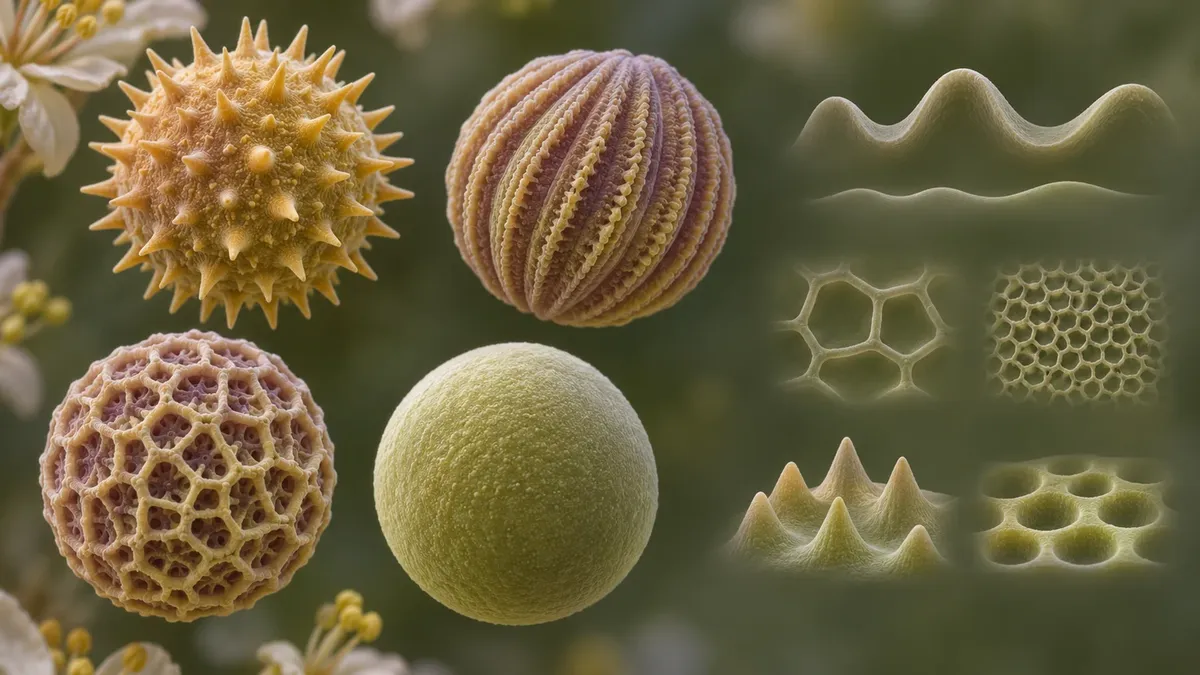
Pollen grains can be smooth, spiky or netted, but those labels may miss variation within each category. Researchers propose three continuous measurements to map the sculpture of the pollen wall—and explore what this map can reveal.
Pollen’s outer wall can be smooth, spiny, ridged or net-like. These familiar categories are useful, but they divide a range of forms into discrete labels and can depend on an observer’s judgment. Qianzhi Deng and Keisuke Ishihara propose a more continuous way to describe this ornamentation: a three-axis map based on pollen-surface features.
The method uses persistent homology, a mathematical approach that tracks how features in data appear and disappear as a threshold changes. Imagine raising or lowering a level across a pollen grain’s surface. Depressions form pools and protrusions emerge as islands; as the level shifts, these features merge. The method records their persistence—the range over which each remains distinct—and uses that information to calculate three descriptors.
Intensity represents the average prominence of the relief. Density describes how finely the ornamentation is patterned, based on how persistence is distributed across features. Polarity indicates whether protrusions or depressions dominate. Together, these measurements place a grain in a “morphospace”: a shared coordinate system for comparing ornamentation.
Testing the map
The researchers applied their approach to three-dimensional pollen meshes, representing each surface as distances from the grain’s center in different directions. They analyzed 162 near-spherical angiosperm grains from the 3D Pollen Library. This restriction matters: because the method measures surface variation relative to a sphere, an elongated grain’s overall shape could otherwise be mistaken for ornamentation.
In this sample, the three descriptors were only weakly correlated, suggesting they capture largely distinct aspects of surface structure. Common ornamentation categories also tended to occupy different parts of the map: spiny grains generally had prominent protrusions, while net-like grains tended toward finer patterns and more prominent depressions. These are patterns in the analyzed collection, not rules that every grain must follow.
The team checked whether the measurements could recover known pattern counts. In theoretical grains generated by a pattern-formation model, the estimated pattern wavenumber differed from its specified value by 6.1% on average. For 19 real, spiny Asteraceae grains, predicted spine counts differed from manual counts by 11.9% on average. This offers a test against known values, though the real-grain check covers one particular pollen type and a limited number of specimens.
What the comparisons showed—and did not show
To examine pollination, the researchers compared 95 insect-pollinated species with 21 wind-pollinated species, accounting statistically for relatedness among species. After this phylogenetic correction, the groups differed significantly only in intensity: insect-pollinated pollen had more pronounced relief. The analysis did not find significant differences in density or polarity. This is an association; it does not establish that pollination mode caused the surface differences or that ornamentation alone determines how pollen is transported.
A separate analysis placed 28 Asteraceae species and estimated ancestral values in the same morphospace. The three subfamilies appeared to shift in different directions from their estimated common ancestor. These ancestral positions are model-based estimates, not direct observations of ancient pollen. Within this family, density showed a significant phylogenetic signal; the other two axes did not show significant signals in the reported tests.
The authors note limits to both the data and the method. The available three-dimensional pollen sample has limited size and taxonomic coverage, and larger, more balanced datasets are needed. Measurements may be sensitive to mesh resolution; the pipeline treats apertures as depressions and does not capture the shape or spatial arrangement of ornamental features. Its assumption of near-spherical grains also restricts its application: for markedly non-spherical pollen, overall shape could be mistaken for ornamentation.
This study is a bioRxiv preprint and has not been certified by peer review, so its findings should be considered provisional. If further tested, the framework could offer researchers a shared set of continuous measurements for comparing pollen ornamentation, alongside the traditional categories.
- pollen
- pollen ornamentation
- persistent homology
- morphospace
- plant biology
- pollination
Reviewed cross-references
These connections were reviewed by a model, not independently fact-checked by a human. Similarity does not imply agreement; consult the original papers and the evidence below.
Could the shape of word connections help evaluate AI reasoning?
Shared method: Both studies use persistent homology, but on different data and with different constructions: Deng and Ishihara apply zero-dimensional persistence to pollen-surface filtrations, whereas Kapulkin and Kershaw apply one-dimensional co-occurrence persistence to text using sentence order. This is a methodological connection, not evidence that their findings are comparable.
Model review: · openai-codex/gpt-6-luna
Evidence and provenance
Selected excerpts, not complete papers. PDF extraction can omit figures or damage equations, tables and reading order; sources may be preprints.
2026.11.18.767721v1 — Original paper
Excerpt reference:
static/papers/2026.11.18.767721v1.md:164-238
Basis: Paper text
Source SHA-256:09c0df739b47210b9bb373487a898c83be02d1700ded204ca6b701fbd8a65bde2611.03739v1 — Original paper
Excerpt reference:
static/papers/2611.03739v1.md:68-109
Basis: Paper text
Source SHA-256:7fb1441bfce2094c3d557f3d20ebf3e01d4a336772f0a802305506f652334c22
Related reading
Automatically matched by shared topic keywords. These links do not imply that the sources agree or establish a consensus.
Climate and arsenic conditions shift cadmium and zinc in rice grain
Source published
Shared keywords: plant biology
Root microbes shape how a legume responds to higher CO₂
Source published
Shared keywords: plant biology
A cellular switch helps plants close their leaf pores
Source published
Shared keywords: plant biology
What Can the Shape of Neural Network Weights Tell Us About Learning?
Source published
Shared keywords: persistent homology
A graph-learning method updates its view as connections appear
Source published
Shared keywords: persistent homology