TRANSMISSION // 2026.11.18.767685v1
How LORELEI variation may shape pollen tube reception
Source published
A bioRxiv preprint reports that LORELEI sequence variation modulates pollen tube reception in Arabidopsis ovules, with effects depending on the pollen species.
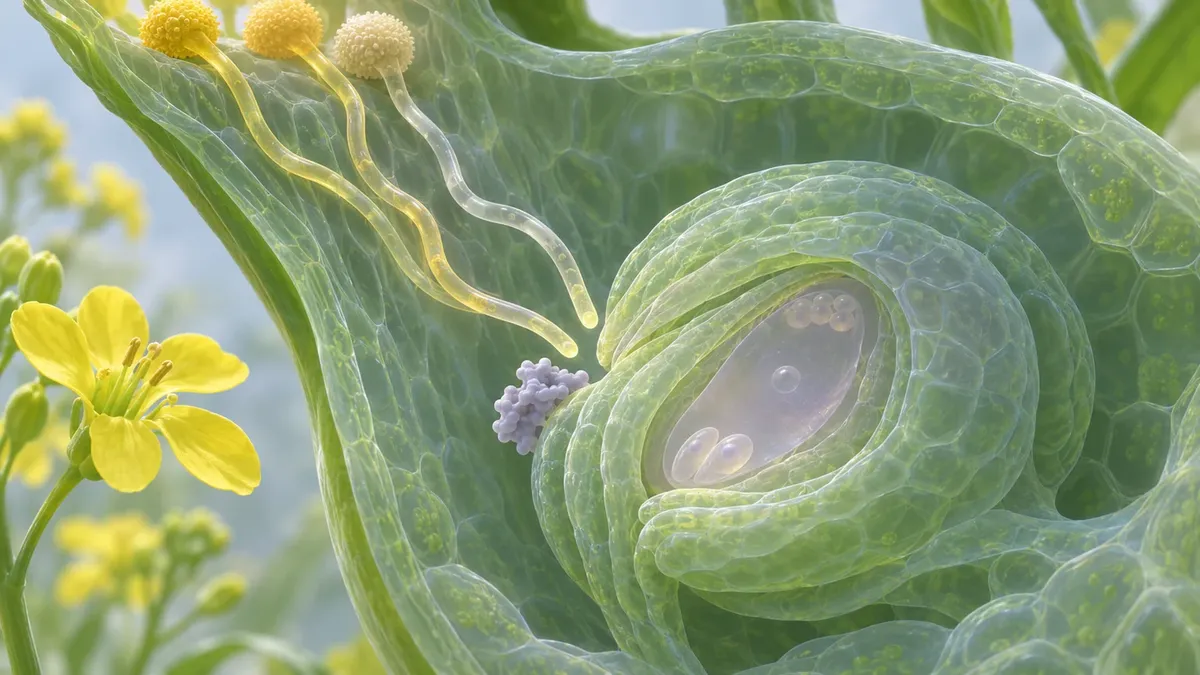
Pollen tube reception is a crucial step in flowering-plant fertilization, and it can act as a barrier between species. A bioRxiv preprint examines whether variation in the female-side protein LORELEI influences how Arabidopsis ovules receive pollen tubes from related species.
A compatibility question at the ovule
For fertilization to proceed, an ovule must receive an arriving pollen tube. When pollen comes from another species, reception can fail: the tube may continue growing beyond its target. This step can therefore contribute to a barrier between species, though it is only one part of reproduction.
Jong and colleagues investigate whether sequence variation in LORELEI (LRE) helps shape this process in Brassicaceae, the mustard family. The abstract identifies LRE and FERONIA (FER) as core female components that mediate pollen tube reception with pollen from the same species. Their roles in reception with pollen from other species are less clear.
Comparing pollen sources and protein variants
The study examined Arabidopsis thaliana ovules pollinated with pollen from two other species: Arabidopsis lyrata and Sisymbrium irio. The authors also investigated outcomes following loss of LRE or FER, and tested complementation of lre ovules with LRE orthologs—related versions of the gene from other species. The abstract does not give detailed protocols or sample sizes, so those aspects cannot be assessed from the available evidence.
The researchers additionally report evolutionary analyses of LRE and its paralog, LLG1, as well as tests of specific amino-acid substitutions. These are changes in individual building blocks of the protein. The abstract reports relaxed purifying selection in the LRE lineage relative to LLG1: in broad terms, evolutionary changes in LRE may have been less strongly constrained. It does not specify the analytical details.
Effects varied with pollen species
Pollen tube reception often failed when Arabidopsis ovules received A. lyrata or S. irio pollen. Loss of LRE or FER further increased pollen tube overgrowth, with the effect depending on the pollen species.
The LRE versions tested in lre ovules also had donor-dependent effects. AlyLRE and SiLRE—versions from A. lyrata and S. irio—gave modest and variable improvements in reception of A. lyrata pollen. With S. irio pollen, SiLRE reportedly improved reception more consistently and markedly.
Evolutionary analyses nominated amino-acid positions 47 and 120 as possible contributors to functional differences. The Lineage II-associated R120T substitution enhanced reception of S. irio pollen, while partly reducing reception of same-species pollen. The authors also tested an E47P-R120G combination, which they designate as ancestral-state. It improved reception of S. irio pollen without a measurable compromise to same-species reception in the reported tests.
Together, these results indicate that LRE sequence differences can modulate pollen tube reception, but their effects are not the same for every pollen source or protein variant. The abstract does not provide numerical effect estimates, so the size and precision of the reported changes cannot be judged here.
What remains uncertain
The authors suggest that LRE diversification could affect how signals from pollen tubes are sensed or transmitted during reception. This is a proposed explanation; the abstract does not establish the underlying mechanism. Nor does it show how the reported reception outcomes translate into fertilization, hybrid formation, or later plant development. The findings concern specific experimental crosses and should not be taken as a general account of compatibility across Brassicaceae or in natural populations.
This article is based on the preprint abstract rather than the full paper. The source record identifies it as a bioRxiv preprint but does not provide a peer-review status, so no claim about review or approval is made here. Access to the full methods and results would be needed to evaluate the experiments in detail and understand how broadly the conclusions apply.
- plant reproduction
- pollen tube reception
- LORELEI
- Brassicaceae
- Arabidopsis
- pollen compatibility
Reviewed cross-references
These connections were reviewed by a model, not independently fact-checked by a human. Similarity does not imply agreement; consult the original papers and the evidence below.
Waterlily study links pollen rejection to reactive oxygen and two interacting proteins
Shared method: Both preprints report using aniline blue staining to assess pollen behavior: the LORELEI study scores pollen-tube outcomes in Arabidopsis ovules, while the waterlily study observes pollen germination on stigmas. This is a shared method, not evidence that the distinct species, reproductive stages, or outcomes are directly comparable.
Model review: · openai-codex/gpt-6-luna
Evidence and provenance
Selected excerpts, not complete papers. PDF extraction can omit figures or damage equations, tables and reading order; sources may be preprints.
2026.11.18.767685v1 — Original paper
Excerpt reference:
static/papers/2026.11.18.767685v1.md:782-899
Basis: Paper text
Source SHA-256:27786ac549c436b6d4e7d051d802163f3114a79ae91f075dc474d1cde915cdfb2026.10.28.762668v1 — Original paper
Excerpt reference:
static/papers/2026.10.28.762668v1.md:210-322
Basis: Paper text
Source SHA-256:96ca3d627036d2fb7d3a0ac806e8e994ba3ecfd705ccdb38220cff670b544902