TRANSMISSION // 2026.11.18.767659v1
Alfalfa’s salt response may show up in its leaves over time
Source published
A controlled study of nine alfalfa cultivars links salt-stress resilience with photosynthetic recovery, lower leaf sodium and preserved starch—but field testing remains essential.
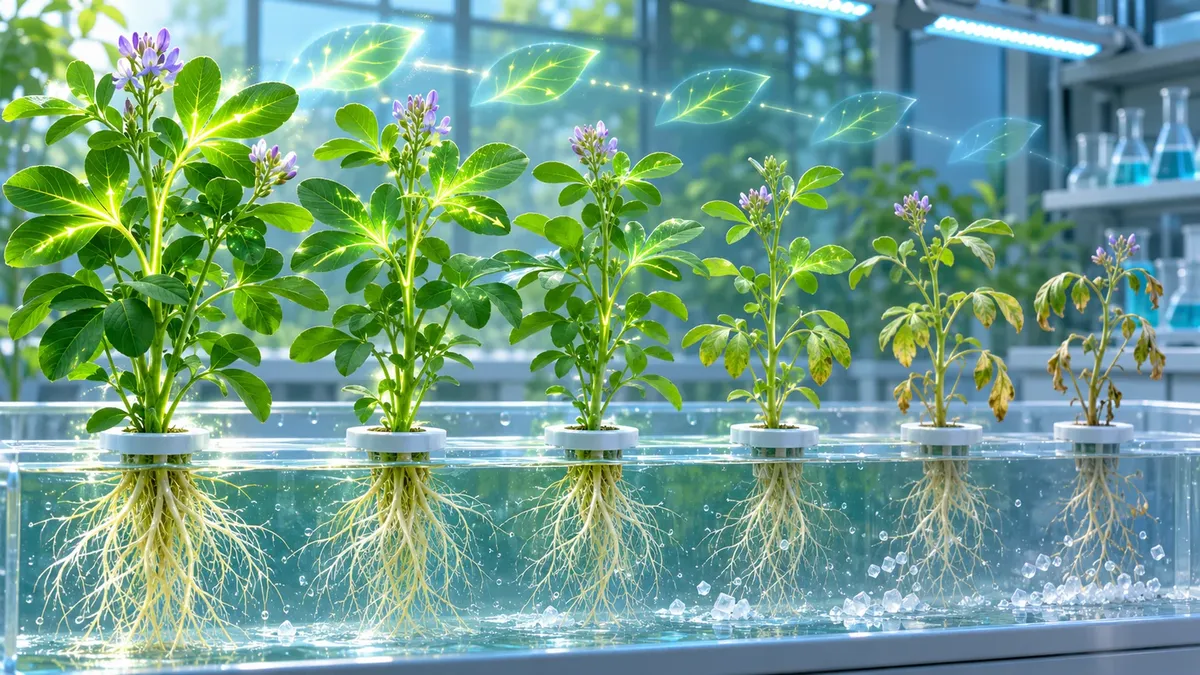
When salt stresses a plant, an early response may be protective rather than a sign of failure. A bioRxiv preprint tracking nine alfalfa cultivars suggests that how photosynthesis changes over time may help distinguish plants that retain biomass from those that struggle. The results are promising for screening, but they come from a short, controlled hydroponic experiment—not a field test.
Salt in soil can make it harder for plants to take up water and, over time, can disrupt the balance of nutrients and damage photosynthesis. For alfalfa, a valuable forage crop, breeders need ways to identify plants that can keep growing in salty conditions without overlooking the quality of the forage they produce.
A new bioRxiv preprint examines whether several kinds of plant measurements—growth, leaf chemistry, carbohydrates and photosynthetic activity—can help describe that resilience. The researchers studied nine alfalfa cultivars in a controlled hydroponic setup and exposed them to a strong 200 millimolar salt treatment. They followed photosynthesis-related signals at one, seven and 14 days, and measured growth and other traits at the end. Their measurements included leaf sodium and potassium, sugar and starch, and forage-quality estimates made using near-infrared spectroscopy.
The response changed with time
The cultivars did not respond alike. Kumen and Ameristand 801S retained the most shoot biomass under salt in this experiment; Chenini and MSI038 also showed comparatively strong short-term response profiles. Prosementi and Monarca had more pronounced growth reductions. For example, Prosementi’s shoot dry weight fell by 32% relative to its control plants. These are results from this particular treatment and setup, not universal rankings for every growing environment.
Photosynthesis-related measurements helped show why a single snapshot could be misleading. Chlorophyll fluorescence is a way to track how leaves use or release energy captured from light. The researchers measured several fluorescence-derived traits, including the effective yield of photosystem II, a component of the photosynthetic machinery, and the total performance index, a summary measure of photosynthetic performance.
Some cultivars showed early changes in photosynthetic activity but later recovered part of that function. By day 14, Kumen and Chenini had particularly strong preservation of photochemical performance; Ameristand 801S and MSI038 had smaller remaining impairments. In contrast, Prosementi and Monarca showed sustained declines in several measures. Across the cultivars, performance index and light-adapted photosystem II efficiency at day seven were positively associated with final biomass retention; fluorescence signals for regulated and non-regulated energy dissipation were negatively associated. These patterns suggest that continued performance later in the stress period may be more informative than the first response alone.
One result illustrates why timing matters: regulated energy dissipation, which can help protect leaves from excess light, was positively associated with biomass retention at day one, but negatively associated at days seven and 14. The authors suggest that an early increase may reflect a protective adjustment, while sustained dissipation could accompany ongoing stress. That is an interpretation of the observed association, not proof that the fluorescence response caused either outcome.
Salt, starch and forage quality
Plants that retained more biomass generally accumulated less sodium in their leaves and maintained more stable photosynthetic activity. The authors also report links between sodium accumulation and carbohydrate changes. Several of the less tolerant cultivars showed substantial declines in leaf starch. But the patterns were not uniform: cultivars differed in both their sugar and starch responses, so no single metabolic profile explains every response.
Forage quality shifted too, but not in one consistent direction. Crude protein estimates increased significantly under salt in six cultivars, while fiber measures changed differently among cultivars. Non-structural carbohydrates—the measured soluble sugars and starch combined—declined in all nine. An increase in crude protein alone therefore does not establish that forage quality improved overall: fiber, carbohydrates and biomass also matter.
What the evidence can—and cannot—say
The study combined 52 measured traits in a principal component analysis, a method that summarizes patterns across many variables. Its first component was associated with biomass retention across the nine cultivars. This supports the idea that resilience involves several linked traits rather than one simple marker. However, the experiment had only nine cultivar-level observations for this analysis. The authors also describe several individual fluorescence–biomass relationships as exploratory; those associations did not remain significant after correction for the many comparisons made. Correlation does not establish cause.
The salt treatment was a short, acute shock in hydroponics, not the changing conditions of a field. The authors note that the experiment’s cultivar rankings did not fully match results reported from earlier multi-year field evaluations; MSI037, for instance, performed better in saline fields than in this acute assay. The authors call for field validation across more diverse cultivars and environments, considering forage yield and nutritional quality together.
This work is a bioRxiv preprint, posted in November 2026 and not certified by peer review. Its findings are best treated as candidate indicators for further testing—not as a validated breeding tool or a guide to choosing a field cultivar today.
- alfalfa
- salinity stress
- chlorophyll fluorescence
- plant physiology
- forage quality
- crop breeding
Related reading
Automatically matched by shared topic keywords. These links do not imply that the sources agree or establish a consensus.