TRANSMISSION // 2026.11.18.767649v1
A tomato meiosis tweak produces unreduced gametes
Source published
A modified SlTDM1 gene led some tomato plants to produce unreduced gametes and polyploid offspring, but the effect varied between lines and did not persist reliably.
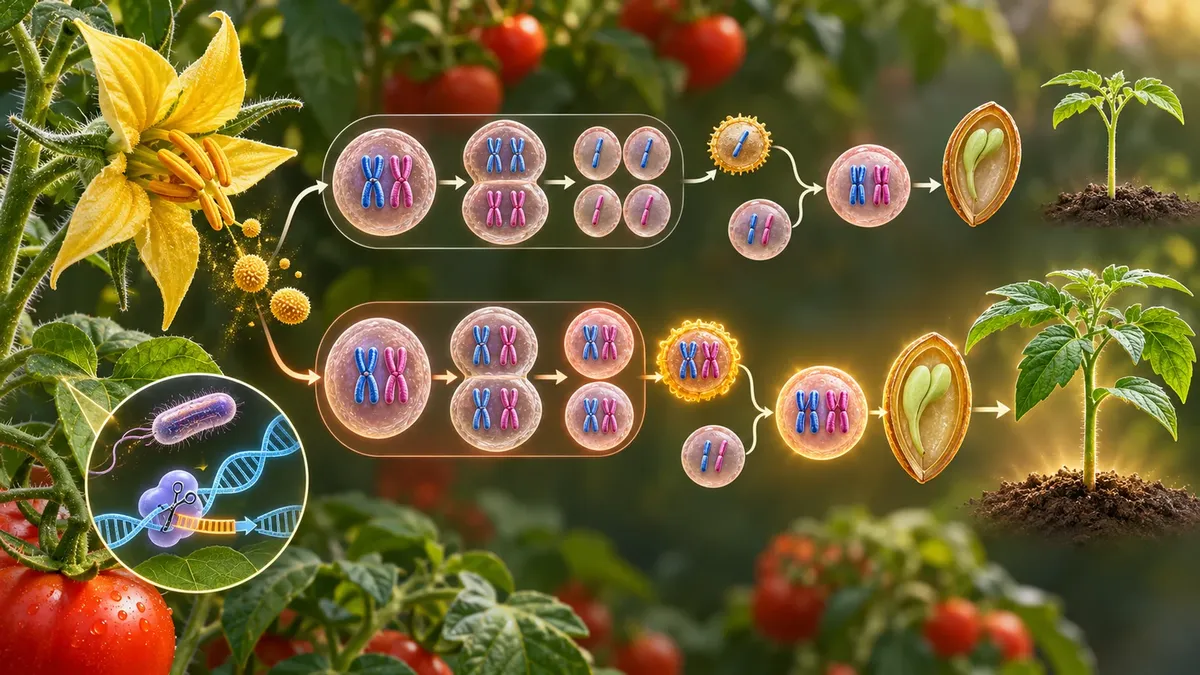
Could changing one gene help plants make clonal seeds? Researchers tested a modified tomato gene involved in ending meiosis. Some engineered plants produced gametes with unreduced chromosome sets, and some offspring had extra chromosome sets. The results are promising, but inconsistent gene activity and silencing remain important hurdles.
Why change meiosis?
Meiosis is the cell-division process that normally halves chromosome number to make reproductive cells. But for clonal seed production, researchers aim to produce gametes that retain the parent’s full chromosome complement. In a strategy called “Mitosis instead of Meiosis,” or MiMe, altered meiosis can produce unreduced gametes that may help preserve a plant’s genetic combination.
MiMe approaches use different genes in different species. This study asks whether tomato’s version of TDM1, a gene involved in ending meiosis, could be modified to stop the second meiotic division and generate unreduced gametes.
What the researchers did
The team introduced transgenes into the Micro-Tom tomato variety. One encoded a tomato TDM1 variant, SlTDM1-P19L, with a change expected to interfere with phosphorylation—a chemical modification that can affect a protein’s activity. They also tested a corresponding altered TDM1 gene from Arabidopsis.
Researchers examined pollen size and viability, measured chromosome-set numbers in offspring using flow cytometry, and viewed meiotic cells under a microscope. They also measured gene expression in a line where pollen development was severely disrupted.
A mixed result across plant lines
Several engineered lines produced pollen in two size classes, consistent with a mixture of ordinary haploid pollen and larger, unreduced diploid pollen. The researchers found tetraploid offspring from two diploid SlTDM1-P19L parent lines: 28% of the offspring assessed from one line and 2% from another. One triploid offspring was also identified in the line with the higher tetraploid proportion. These findings are consistent with functional unreduced gametes, although offspring chromosome counts alone do not establish every detail of how each gamete formed.
Pollen viability in lines showing varied pollen sizes ranged from 57% to 83%, compared with 94% in wild type. The authors describe fertility effects as mild in the line with the highest tetraploid proportion, but results varied between lines. Other tested lines did not show the same evidence of unreduced pollen or tetraploid offspring.
A separate line illustrated the risk of disrupting the pathway too far. There, the transgene appeared to suppress the plant’s own SlTDM1 gene. Researchers observed abnormal, hyper-reduced meiotic products called polyads, reduced pollen viability, and nearly absent SlTDM1 expression in the tested plants. This resembles effects of losing TDM1 function, rather than the intended controlled termination of meiosis.
What it may mean—and what remains uncertain
The findings support a role for TDM1 in controlling meiotic progression in tomato, and suggest that SlTDM1-P19L can promote unreduced gametes in some lines. That makes TDM1 a candidate for further work on MiMe systems. It does not demonstrate a dependable method for producing clonal tomato seeds: unreduced gametes are not automatically clonal, and the study did not establish a complete, stable clonal-seed system using this variant.
The main practical limitation is inconsistency. Effects differed among independent plant lines, and the researchers observed transgene silencing in later generations. They suggest more stable genome-engineering approaches as a possible next step, but did not test them here. The experiments used one tomato variety and a limited set of engineered lines, so they do not establish how broadly the effect would work across tomato varieties or other crops.
This article describes a bioRxiv preprint posted in November 2026. The source states that it had not been certified by peer review. The findings are therefore preliminary; independent replication and peer-reviewed evaluation will help clarify how robust and useful the approach is.
- tomato
- meiosis
- TDM1
- unreduced gametes
- polyploidy
- MiMe
- plant genetics
Related reading
Automatically matched by shared topic keywords. These links do not imply that the sources agree or establish a consensus.
Extra lobes on morning glory leaves point to a more complex genetic story
Source published
Shared keywords: plant genetics
Wheat roots differ by position, not just size
Source published
Shared keywords: plant genetics
Why two maize genes share the work of growth
Source published
Shared keywords: plant genetics
A barley gene changes which parent’s copy is active as grain develops
Source published
Shared keywords: plant genetics
A seed color switch tracks what happens to DNA delivered into plants
Source published
Shared keywords: plant genetics