TRANSMISSION // 2026.11.18.767646v1
Where auxin is sensed helps shape an Arabidopsis root
Source published
A targeted auxin-sensing system and computer model suggest that outer root tissues and elongating cells play especially strong roles in coordinating root growth.
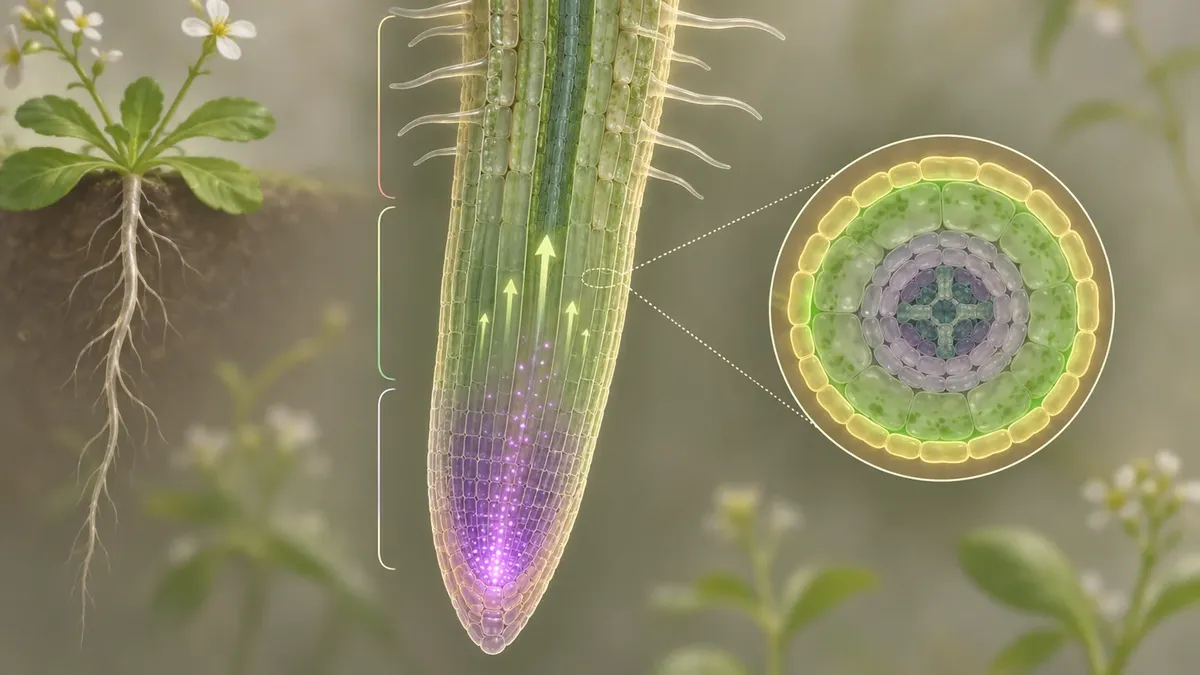
A growing root is not one uniform column of cells: some divide, others elongate, and others differentiate. A bioRxiv preprint uses a synthetic system to activate auxin signaling in selected parts of Arabidopsis roots, asking how the location of that response affects growth.
A root grows in zones
The primary root of Arabidopsis thaliana grows through coordinated changes in cells along its length. Near the tip, cells divide in the meristem. Farther up, they elongate, then differentiate. Auxin, a plant hormone, helps regulate these processes. But finding auxin in a tissue is not the same as knowing where cells perceive it or how that perception shapes growth.
To investigate, Dubey and colleagues used an engineered auxin-perception system. It lets researchers activate the plant’s own auxin-signaling machinery in selected tissues using a matching synthetic chemical, without directly changing auxin transport. The team targeted regions associated with dividing or elongating cells, and different tissues across the root’s inner and outer layers. They measured root growth and developmental zones, including with time-lapse imaging. They also built a two-dimensional computer model of root growth to test how different assumptions about auxin sensitivity could account for the observations.
Elongating cells and outer layers stand out
When the researchers boosted auxin signaling in elongating cells, root growth slowed strongly. Boosting signaling in cells associated with the dividing meristem had a weaker, temporary effect on growth rate. In tracked cells, the elongating-cell treatment reduced cell movement, while the meristem-targeted treatment did not significantly change the measured elongation velocity. The authors suggest that meristem-targeted signaling may instead lead cells to leave the elongation phase sooner, but say further evidence is needed to establish that explanation.
Activating signaling in outer tissues—especially the epidermis and cortex—also produced stronger short-term growth inhibition than activating it in the inner tissues tested. The broad PIN2-targeted domain, which includes epidermis, cortex and lateral root cap, had the strongest effect among the tissue-specific treatments described, though activating signaling throughout the root produced a more severe response. This points to a combined contribution from multiple tissues, rather than a single layer acting alone.
The position of the boundary between dividing and elongating regions also shifted after synthetic signaling was activated. Experiments and simulations indicated that signals in dividing cells and mechanical effects involving the lateral root cap can contribute to boundary organization. The model did not reproduce every experimental outcome, however, so it is a tool for testing explanations—not proof of a complete mechanism.
What the experiment does—and does not—show
The central conclusion is about the response to experimentally boosted auxin signaling: growth effects depend on where that response is activated, and the outer tissues and elongating regions have particularly strong roles in the conditions tested. It does not mean that inner tissues are irrelevant, or that auxin has one simple effect everywhere. The preprint’s results instead suggest that distinct zones and layers interact as the root grows.
There are important limits. The engineered system increases signaling in selected domains; it does not simply map normal auxin perception under every growth condition. The authors note that different promoters may produce different amounts of the engineered receptor, complicating comparisons between tissues. In some cases, a promoter’s expression spans more than one position or tissue, and the researchers observed signal extending into lateral root cap cells in one line. The modeling required assumptions about tissue sensitivity and mechanics, and did not fully match some observations.
The methods report two to four biological replicates for the study overall; this describes independent experimental replicates, not the number of roots or cells in every analysis. Individual measurements used varying sample sizes—for example, the short-term tissue-specific growth analysis included dozens of roots in several groups, while some cell-tracking comparisons involved fewer roots. Sample sizes therefore differ by experiment and should be considered when interpreting particular results.
This is a bioRxiv preprint, posted in November 2026, and has not been certified by peer review. Its findings should be treated as provisional. Further work could test how these engineered responses relate to normal root development and clarify the molecular basis of differences in sensitivity. For now, the study offers a way to examine a basic developmental question: not just how much auxin signaling occurs, but where in a growing root it is received.
- auxin
- Arabidopsis
- root growth
- plant development
- tissue-specific signaling
- preprint
Reviewed cross-references
These connections were reviewed by a model, not independently fact-checked by a human. Similarity does not imply agreement; consult the original papers and the evidence below.
A neighboring cell layer may help rice stems respond to gravity
Supporting evidence: Both preprints associate spatially localized auxin responses with growth outcomes: the Arabidopsis study reports that boosting auxin sensitivity in elongating root cells strongly inhibits root growth, while the rice study describes an asymmetric auxin-response domain accompanying stem bending. The comparison is limited to this broad relationship; the species, organs, stimuli and experimental systems differ, so it does not establish a shared mechanism.
Model review: · openai-codex/gpt-6-luna
Evidence and provenance
Selected excerpts, not complete papers. PDF extraction can omit figures or damage equations, tables and reading order; sources may be preprints.
2026.11.18.767646v1 — Original paper
Excerpt reference:
static/papers/2026.11.18.767646v1.md:936-1126
Basis: Paper text
Source SHA-256:fcf7292b8a4bde42d72096e13e472ad10287f9fa2082f798f44ad68ea069f7d32026.10.31.763306v1 — Original paper
Excerpt reference:
static/papers/2026.10.31.763306v1.md:499-602
Basis: Paper text
Source SHA-256:5129391972a2b83f18e79124c807aac24018856fe2b3d2155838d0e15ee098742026.10.31.763306v1 — Original paper
Excerpt reference:
static/papers/2026.10.31.763306v1.md:819-925
Basis: Paper text
Source SHA-256:5129391972a2b83f18e79124c807aac24018856fe2b3d2155838d0e15ee09874
Related reading
Automatically matched by shared topic keywords. These links do not imply that the sources agree or establish a consensus.
A neighboring cell layer may help rice stems respond to gravity
Source published
Shared keywords: plant development
How an iron-response protein helps plant roots cope with salt
Source published
Shared keywords: root growth
How two genes shape protoxylem development
Source published
Shared keywords: plant development
Why two maize genes share the work of growth
Source published
Shared keywords: plant development
One liverwort regulator, two distinct roles
Source published
Shared keywords: plant development