TRANSMISSION // 2026.11.18.767598v1
A geometric model explores leaf architecture costs
Source published
A stochastic geometry model reconstructs spongy leaf tissue from 40 plant species and links porosity and cell-arm patterns with modeled cell-wall construction cost.
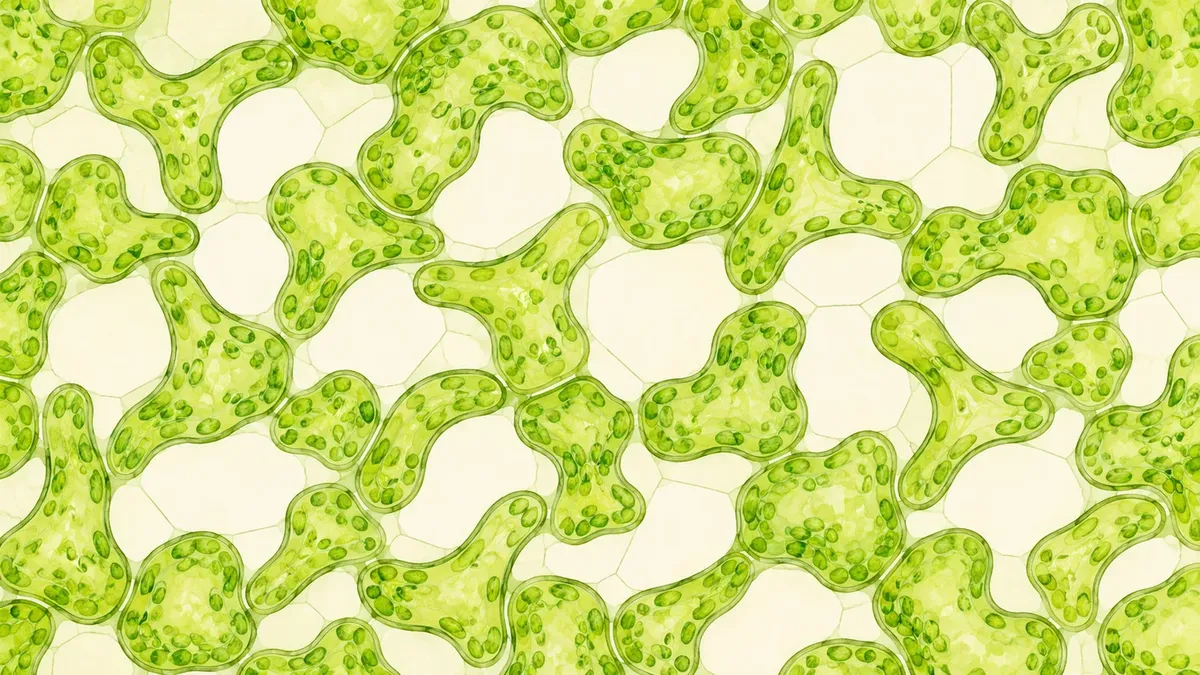
Leaf interiors vary in their arrangement of cells and air spaces. A new computational study asks whether a geometric model can reproduce patterns in spongy mesophyll and help explain how porosity and cell shape relate to the estimated cost of building cell walls.
Why model the inside of a leaf?
Leaf mesophyll architecture matters for plant functions, including photosynthesis, but the principles behind its growth, stability and variation among species remain unclear. The authors ask whether a compact geometric model can reproduce observed tissue patterns and reveal a possible relationship between leaf structure and construction cost.
The study focuses on two-dimensional paradermal slices of spongy mesophyll. Rather than tracking how a leaf develops, the model uses stochastic space tessellation: a way to generate arrangements of shapes according to probabilistic rules. The authors use it to simulate slices resembling those measured in plants.
How the model works
The framework was applied across 40 vascular plant species using three data-derived parameters: leaf porosity, cell-arm length and cell-arm diameter. The abstract names these measurements but does not define their precise measurement procedures.
The authors assessed whether the simulated slices preserved six biological, topological and cell-level traits. They also compared idealized cell geometries, including circular cells and cells with one to three arms. The abstract reports that the framework reconstructed leaf slices while preserving the six traits, and that one- to three-armed geometries generally performed better than circular cells.
The researchers also developed a theoretical model based on stochastic geometry and compared it with the simulations. This let them examine how porosity and cell-arm statistics relate to cell-wall construction cost within the model.
What the study reports
The main finding is that leaf porosity strongly influences modeled cell-wall construction cost, while cell-arm statistics shape that relationship. The abstract does not specify the direction or size of the relationship, so it does not support saying that greater porosity necessarily raises or lowers cost.
The authors present the model as a basis for exploring leaf architecture in terms of carbon dioxide uptake and cell-wall construction costs. That is not the same as showing that plants actively optimize these factors. The abstract does not report direct measurements of carbon dioxide uptake, experiments that alter leaf structure, or evidence that the modeled relationship determines photosynthetic performance in living plants.
What remains uncertain
The available evidence here is the paper’s abstract, not its full methods and results. It does not explain how the six traits were measured, how closely simulations matched observations, what assumptions the theoretical model makes, or how uncertainty was quantified. These details would help readers judge the strength of the reconstruction and how well it might apply beyond the modeled slices and species.
The work is a bioRxiv preprint; the supplied source does not establish that it has undergone peer review. Its conclusions should therefore be treated as provisional. The model offers a way to connect measured features of leaf tissue with theoretical estimates of construction cost, but further scrutiny and empirical testing would be needed to establish how broadly the relationship applies or what it means for plant function.
- leaf mesophyll
- plant architecture
- stochastic geometry
- leaf porosity
- cell-wall construction
- photosynthesis
Reviewed cross-references
These connections were reviewed by a model, not independently fact-checked by a human. Similarity does not imply agreement; consult the original papers and the evidence below.
How a chloroplast transporter helps shape the air inside a leaf
Supporting evidence: Both studies connect mesophyll cell architecture with intercellular air-space patterns, but examine different tissues and systems: the origin study models spongy-mesophyll slices across 40 species, while Locke Beviá et al. report altered palisade air-space expansion and cell division in Arabidopsis re-6 mutants. This is complementary evidence for a bounded link between cell architecture and air-space patterning, not evidence that the same mechanism operates in both tissues.
Model review: · openai-codex/gpt-6-luna
Evidence and provenance
Selected excerpts, not complete papers. PDF extraction can omit figures or damage equations, tables and reading order; sources may be preprints.
2026.11.18.767598v1 — Original paper
Excerpt reference:
static/papers/2026.11.18.767598v1.md:224-280
Basis: Paper text
Source SHA-256:977e4ea805fbc3f79cddf6e720c216c351629bc68ee3e3e2f50e6e84919122042026.11.03.759069v1 — Original paper
Excerpt reference:
static/papers/2026.11.03.759069v1.md:42-65
Basis: Paper text
Source SHA-256:bab613caaba90b92d2d3ccb64c64bdf56296bb881d4a789e5f24df1914f44637