TRANSMISSION // 2026.11.18.767592v1
Banana diversity reveals candidates for TR4 resistance
Source published
In controlled tests, eight of 21 banana accessions had less TR4-related corm discoloration than Dwarf Cavendish. The findings point to candidates for further study, not proven field resistance.
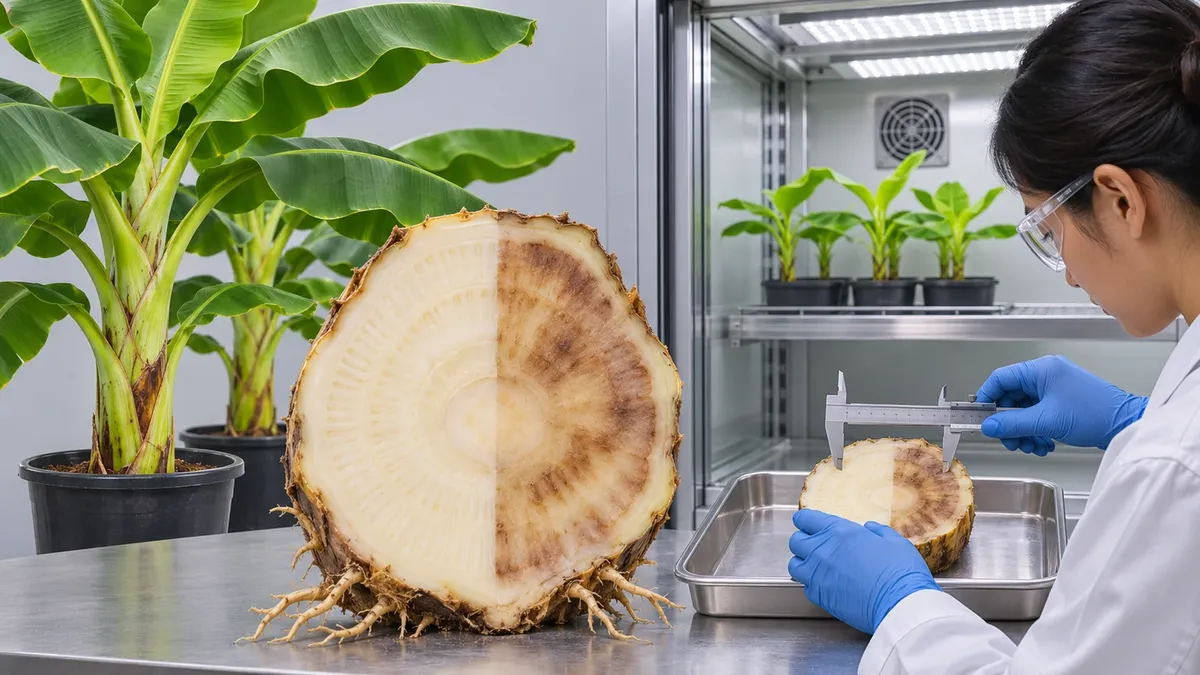
Fusarium wilt caused by tropical race 4 (TR4) threatens banana production. Researchers compared internal corm damage in 21 banana and plantain accessions and found several that could merit further study in breeding and disease research.
Fusarium wilt of banana is caused by Fusarium oxysporum f. sp. cubense. Tropical race 4 (TR4) is a form of this pathogen that threatens banana production. The disease can discolor a plant’s roots and rhizome; external symptoms such as wilting and yellowing leaves appear after the pathogen has colonized the rhizome. Finding banana plants that show less disease could help researchers identify material for future breeding.
The study, available as a bioRxiv preprint, tested 21 accessions: distinct samples of wild Musa species, cultivated bananas and plantains, and breeding hybrids. Researchers grew the plants under controlled conditions and inoculated them with the TR4 isolate UK0001. Mock-inoculated plants served as controls, and susceptible Dwarf Cavendish plants were included in every experiment for comparison.
The team ran six independent inoculation experiments between 2023 and 2025. Six weeks after inoculation, they cut the pseudostem 10 centimeters above the corm, removed the roots, and split the remaining section lengthwise to expose the corm tissue. Photographs were analyzed to estimate the proportion of tissue that remained healthy rather than discolored. Statistical models accounted for differences between experiments and among the cabinet’s four quadrants. This adjustment mattered: healthy corm area in Dwarf Cavendish varied considerably from one experiment to another.
Eight accessions had significantly more healthy corm tissue than Dwarf Cavendish. The researchers classified five as resistant: Musa itinerans, M. schizocarpa, FHIA-02, FHIA-21 and the plantain Curare. To receive this classification, an accession had to differ significantly from the control and have more than 80% healthy area in every measured corm half. Three others—M. ornata, Pelipita and Mai’a Maoli Koa’e—were classified as tolerant. They also differed significantly from the control, but at least some corm halves did not meet the 80% healthy-area threshold. These labels describe the study’s scoring rules; they do not establish immunity.
The remaining 13 accessions fell into two categories. Eleven were classified as susceptible because they did not differ significantly from Dwarf Cavendish under the study’s comparison rule. That lack of a detected difference does not show that their responses were equivalent to the control. Two accessions had significantly less healthy corm area than Dwarf Cavendish and were classified as very susceptible.
External symptoms broadly aligned with the corm results. From week four onward, susceptible and very susceptible groups had significantly more yellow leaves than mock-inoculated plants. Resistant and tolerant groups did not differ significantly from mock plants in yellow-leaf percentage at any week during the assay.
The findings also invite closer examination of banana ancestry. Some cultivated bananas carry A genomes, others B genomes, or combinations of both. Five of the seven tested accessions with at least one B genome were classified as resistant or tolerant. But genome type alone did not determine the outcome: the B-containing accessions Pome and Silver Bluggoe were susceptible or very susceptible, while three resistant or tolerant wild species carried neither A nor B genomes. The authors suggest that B-genome backgrounds merit wider screening—not that a B genome guarantees resistance.
The results are specific to the plants and conditions tested. The experiment used young plants, one TR4 isolate and a six-week endpoint; slower infections or field conditions could produce different outcomes. Some accessions had few plants: M. itinerans and Curare were each represented by three inoculated plants. The panel also lacked wild M. balbisiana (BB) and AB hybrids. The authors caution against generalizing from one accession to an entire genetic group and note that studies have sometimes reported different responses for the same clone.
The work identifies candidates for further evaluation, not ready-to-use replacements for commercial bananas. Field trials, tests with additional isolates and research into the genetic basis of resistance are needed. Three authors are employed by Tropic Biosciences, the industrial partner of the studentship; the company also supplied two Cavendish reference lines. The paper notes that details of the company’s tissue-culture media are proprietary and were not disclosed. This bioRxiv preprint has not been certified by peer review, so its conclusions should be regarded as provisional.
- banana
- Fusarium wilt
- TR4
- Musa
- corm discoloration
- plant disease resistance
- banana breeding
Related reading
Automatically matched by shared topic keywords. These links do not imply that the sources agree or establish a consensus.