TRANSMISSION // 2026.11.18.767528v1
A conserved immune-receptor domain across wheat species
Source published
Computational comparisons of three wheat immune-receptor proteins find strong sequence and predicted-structure conservation, especially in an integrated WRKY domain. Its precise role in defence remains to be tested.
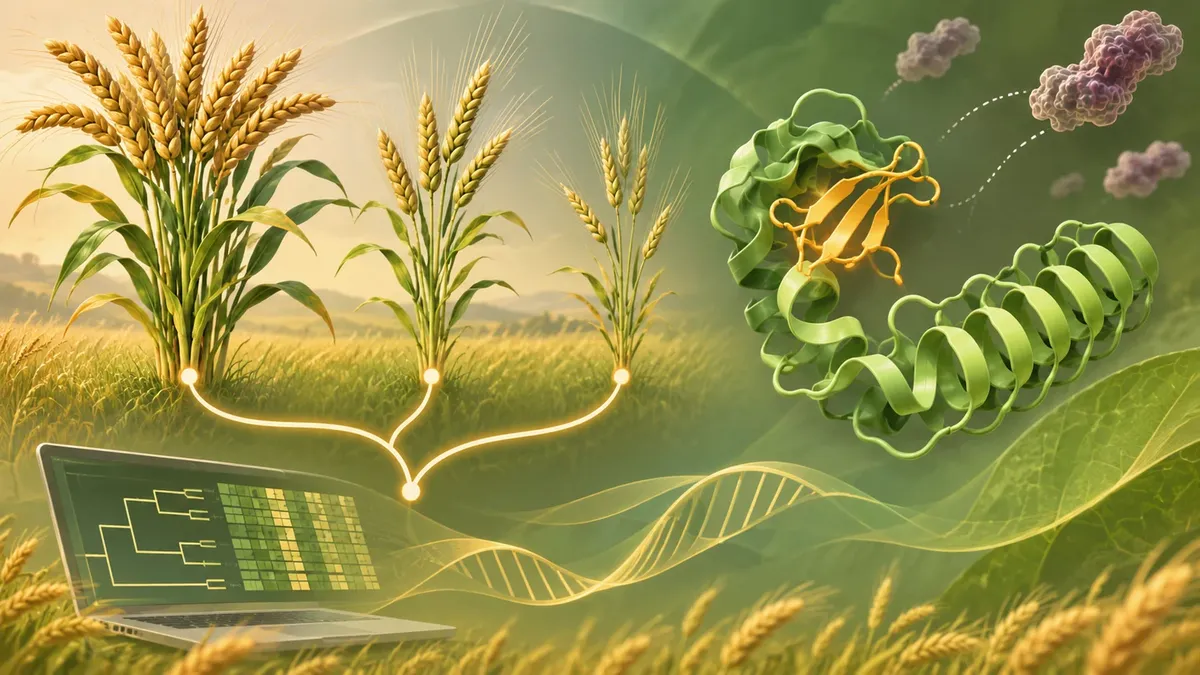
How have wheat immune receptors changed over evolutionary time, and what might those changes mean for pathogen detection? A bioRxiv preprint compares three related proteins using sequence, evolutionary and predicted-structure analyses. The results point to a notably conserved WRKY domain, but do not show what the proteins recognize or how they function in living plants.
A built-in clue for detecting pathogens
Plants use immune receptors called NLRs to respond to invading pathogens and pests. Some NLRs carry an extra segment resembling part of another plant protein. This integrated domain can act as a “decoy”: if a pathogen effector targets or alters the plant-like segment, the receptor may detect that interference and help trigger defence. This model is supported in some plant systems, but the roles of ankyrin–NLR–WRKY proteins in wheat remain less clear.
In this bioRxiv preprint, Naledi Mkhize and Eduard Venter compare three related proteins: TaADNR1 from bread wheat (Triticum aestivum), TRIDC5AG050380 from tetraploid wheat (T. dicoccoides), and YrU1 from diploid wheat (T. urartu). The authors ask how similar these proteins are and whether their predicted structures offer clues to their evolutionary history.
Earlier studies cited by the authors linked TaADNR1 to resistance to Russian wheat aphid and associated YrU1 with stripe-rust resistance. Those are prior findings, not outcomes tested here. The present study is a computational comparison, not a new experiment on resistance or receptor activity.
Comparing sequences and predicted shapes
The researchers retrieved protein sequences from EnsemblPlants, identified domains including ankyrin repeats, the NLR’s NB-ARC region and the integrated WRKY domain, and aligned the sequences. They built evolutionary trees to examine relationships among the wheat proteins and similar proteins in other grasses. They also used AlphaFold2 to predict three-dimensional structures and compare the models. To investigate the WRKY domain’s possible evolutionary relatives, they compared it with wheat WRKY transcription factors and selected Arabidopsis WRKY proteins.
The sequence comparisons showed strong similarity. The ankyrin and NB-ARC regions were identical among the three wheat proteins in the reported alignments. TaADNR1 and the tetraploid protein were also identical across the reported LRR region, while YrU1 had several amino-acid differences there. All three retained the WRKY DNA-binding motif, WRKYGQK, and the zinc-finger-like motif. The WRKY domain sequences were identical between TaADNR1 and the tetraploid protein; YrU1’s domain differed, although those core motifs remained intact.
The evolutionary analyses placed the three wheat proteins together in a supported group, consistent with shared ancestry. The authors infer that the WRKY domain was integrated into an ancestral NLR before wheat polyploidization, in a diploid progenitor. This is an interpretation of sequence and tree comparisons, not a directly dated evolutionary event. The analyses also identified several T. urartu WRKY proteins, including WRKY41- and WRKY46-like candidates, as close relatives of the integrated domain. They are possible clues to the donor lineage, not proof of the exact gene-fusion history.
AlphaFold2 models showed similar predicted folds: pairwise comparisons of the full-length models had reported RMSD values below 0.75 Å, and the isolated WRKY domains were especially similar. But these are computational predictions, not experimentally determined structures. Confidence also varied across the models. Average pLDDT scores for the full-length proteins ranged from 68.32 to 71.91, compared with 78.48 to 82.27 for the isolated WRKY domains. The authors report moderate average confidence for the full-length models and higher average confidence for the isolated WRKY regions; the large, multi-domain receptors may include flexible regions that are harder to predict reliably.
What conservation can—and cannot—tell us
Together, the results suggest that the overall architecture and WRKY domain have been maintained across these wheat relatives. The authors propose that this conservation may reflect an important role in receptor function. They also suggest that differences in YrU1 could affect regulation or recognition. These remain hypotheses: sequence similarity and predicted shape cannot establish which effectors a receptor detects, whether its integrated WRKY domain binds DNA in this receptor context, or how it activates defence.
The study examines three selected proteins using computational methods; it does not test their activity in plants or determine whether their sequence differences change disease responses. Earlier work provides functional context—TaADNR1 has been linked to aphid resistance, and YrU1 to stripe-rust resistance—but those findings do not answer the questions tested by this comparison. Experiments will be needed to clarify the roles of the domains and the candidate evolutionary relatives.
This article describes a bioRxiv preprint that has not been certified by peer review. Its sequence comparisons and predicted structures offer an evolutionary framework, while conclusions about mechanisms and functional consequences should be regarded as provisional.
- wheat
- plant immunity
- NLR receptors
- WRKY domain
- protein structure prediction
- evolution
Reviewed cross-references
These connections were reviewed by a model, not independently fact-checked by a human. Similarity does not imply agreement; consult the original papers and the evidence below.
How rice reveals hidden defenses against wheat blast
Supporting evidence: The wheat preprint reports conserved WRKY domains in predicted wheat ANK-NLR-WRKY proteins and proposes a possible role in effector recognition, while the rice preprint experimentally identifies an effector recognized by a linked NLR quartet. Together they support the bounded idea that NLR-mediated effector recognition is relevant in grasses; the rice result does not validate the wheat proteins or establish a shared WRKY-dependent mechanism, and both reports are preprints.
Model review: · openai-codex/gpt-6-luna
Evidence and provenance
Selected excerpts, not complete papers. PDF extraction can omit figures or damage equations, tables and reading order; sources may be preprints.
2026.11.18.767528v1 — Original paper
Excerpt reference:
static/papers/2026.11.18.767528v1.md:12-136
Basis: Paper text
Source SHA-256:0638af161562a7f79c818087033408f031a434c5bc01d597280c75f3e66128e22026.11.14.766612v1 — Original paper
Excerpt reference:
static/papers/2026.11.14.766612v1.md:18-131
Basis: Paper text
Source SHA-256:9d958bead98d51ea5dab331b4810ade475c83973c881f6babf500abff7e8f3be
Related reading
Automatically matched by shared topic keywords. These links do not imply that the sources agree or establish a consensus.
How rice reveals hidden defenses against wheat blast
Source published
Shared keywords: nlr receptors
Wheat Rust Study Maps Candidate Regulatory RNAs
Source published
Shared keywords: plant immunity
A second kind of oxidative burst may help plants detect danger
Source published
Shared keywords: plant immunity
Two cellular delivery routes help plants block pathogen entry
Source published
Shared keywords: plant immunity
Systemin signals uncovered in tobacco relatives
Source published
Shared keywords: plant immunity