TRANSMISSION // 2026.11.18.767244v1
How a small DNA module may shape rice panicles
Source published
Genome editing links two regulatory DNA motifs near rice APO1 to graded changes in panicle branching. Comparative patterns suggest repeated modification in grasses, but do not prove evolutionary causation.
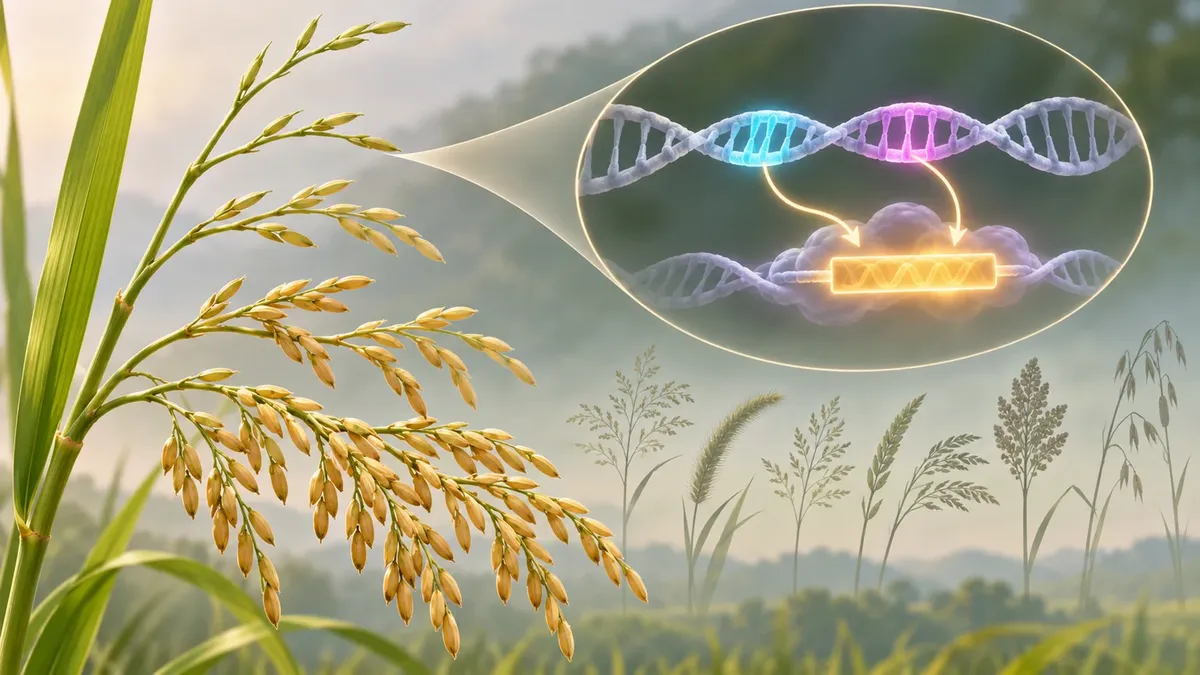
A rice panicle’s branching pattern depends partly on when developing meristems keep branching and when they become spikelets. Researchers edited a short regulatory region near the APO1 gene and found that changes to two DNA motifs altered branching in different degrees and positions. They also compared this region across grasses, where its variation was associated—but not conclusively linked—with branched inflorescences.
A regulatory dial near a branching gene
Grass seed heads come in different forms, from relatively simple spikes to branching panicles. These shapes arise as reproductive meristems—the growing points that produce branches and spikelets—change identity during development. The gene APO1 helps regulate these transitions in rice, and its expression level is known to matter. But which nearby DNA sequences help tune that expression has been less clear.
In this bioRxiv preprint, Makino and colleagues focus on a conserved noncoding sequence near rice APO1, called CNS3. Noncoding DNA does not encode a protein, but can contain instructions that influence when or how strongly a gene is expressed. CNS3 contains two short motifs called CArG boxes, which can be recognized by MADS-family transcription factors.
Editing the sequence, then counting branches
The team used CRISPR/Cas9 to make changes in three conserved noncoding regions around APO1. They produced 34 independent edited lines and measured features of mature rice panicles, including primary branches, secondary branches and spikelets. For the central question, they compared how much secondary branching occurred relative to the number of lateral organs—structures that can develop either as a secondary branch or as a directly attached spikelet.
They also examined where secondary branches appeared along the panicle, measured APO1 RNA in young panicles from eight genotypes, and used electrophoretic mobility shift assays (EMSAs) to test whether selected MADS proteins could bind CNS3 DNA. Finally, they compared the APO1 regulatory region and inflorescence form across grass species using genomic sequences and a phylogenetic analysis. This last step tests whether DNA differences track with branching across evolutionary lineages; it cannot by itself establish what caused those differences.
Two motifs, different effects
The clearest effects came from CNS3. Deletions affecting both CArG boxes produced the strongest increase in relative secondary branching; across seven lines, the average was 3.4 times the wild-type level. Deletions restricted to CArG box 1 produced smaller increases, statistically significant in three of four lines. A single line with a CArG box 2 deletion showed a different pattern: more primary branches and spikelets, but no significant increase in relative secondary branching. Because that result comes from one line, the authors say it needs confirmation with additional alleles.
The changes also affected branch position. In wild-type plants, secondary branches were concentrated toward the middle and upper parts of the panicle, and were absent from the most basal primary branch. Lines with both motifs deleted formed secondary branches farther down the panicle. The mean position where secondary branching began shifted from 0.47 in wild type to 0.17 in these lines; CArG-box-1 deletions showed an intermediate mean of 0.35.
More secondary branches did not simply mean more lateral organs. In the double-motif deletion lines, some organs that would otherwise have become direct spikelets instead developed as secondary branches. Yet spikelet totals were maintained or increased in the measurements reported, because secondary branches carried spikelets of their own. No tertiary branches were observed in the 821 panicles examined.
Across eight genotypes, higher APO1 transcript abundance was associated with more primary branches, more secondary branching relative to lateral organs, and more total spikelets. This is a correlation across genotypes, not proof on its own that expression changes caused each trait. In EMSAs, MADS15 and MADS34 together bound CNS3 most strongly among the tested combinations. Disrupting either motif reduced binding in the assay; disrupting both eliminated detectable binding under those conditions.
An evolutionary pattern, with limits
Across 24 grass species, the researchers found that branched species tended to have greater divergence in a set of five regulatory features, including motif changes and alterations in the structure or spacing of CNS regions. The association remained in analyses that accounted for shared ancestry. It was not absolute: some branched grasses retained an apparently intact configuration, and the authors explicitly note that the comparative results do not demonstrate causation in other grasses.
Several mechanistic questions remain open. The binding experiments were performed outside the plant, so direct repression of APO1 by MADS15–MADS34, and binding at CNS3 inside developing rice tissue, have not been demonstrated. The study also does not separate the effects of DNA sequence from spacing and other structural changes in some edited alleles. Natural regulatory versions have not been functionally tested in their native grasses.
The work therefore identifies a plausible regulatory module and shows that editing it can reshape rice panicles in a graded way. It does not show that these edits increase grain yield: yield and possible trade-offs involving fertility, grain filling or panicle number were not evaluated. The report is a bioRxiv preprint and has not been certified by peer review, so its results should be treated as provisional.
- rice
- APO1
- panicle branching
- cis-regulation
- CArG boxes
- grass evolution
- genome editing
Reviewed cross-references
These connections were reviewed by a model, not independently fact-checked by a human. Similarity does not imply agreement; consult the original papers and the evidence below.
An RNA brake may help a plant keep putrescine in balance
Shared method: Both preprints use genome editing to perturb noncoding regulatory sequences and examine phenotypes. The rice study edits CNS3 near APO1 and reports changes in panicle branching; the Arabidopsis study deletes ADC2 5′-UTR elements and reports growth effects and, in the more severely affected line, increased putrescine. This is a methodological parallel, not evidence of shared mechanisms or outcomes; the studies concern different genes, species, and traits, and both are preprints.
Model review: · openai-codex/gpt-6-luna
Evidence and provenance
Selected excerpts, not complete papers. PDF extraction can omit figures or damage equations, tables and reading order; sources may be preprints.
2026.11.18.767244v1 — Original paper
Excerpt reference:
static/papers/2026.11.18.767244v1.md:12-80
Basis: Paper text
Source SHA-256:0934059566c3afdb735e811379d423a87ba3c82be27beb83cdd1e0648e102ca62026.10.31.763274v1 — Original paper
Excerpt reference:
static/papers/2026.10.31.763274v1.md:81-152
Basis: Paper text
Source SHA-256:1d32423c85eec5bd2f2c8b5501c9c62f284501838950631b05370b67491f23e2
Related reading
Automatically matched by shared topic keywords. These links do not imply that the sources agree or establish a consensus.