TRANSMISSION // 2026.11.17.767468v1
Sunflowers and Buckwheat Give Off Different Ultrasound Signals
Source published
A small greenhouse study found that drought was associated with more airborne ultrasonic events in sunflower and buckwheat, while the sounds’ frequency spectra helped distinguish the species. The findings are preliminary, and the signals need testing across more plants and conditions.
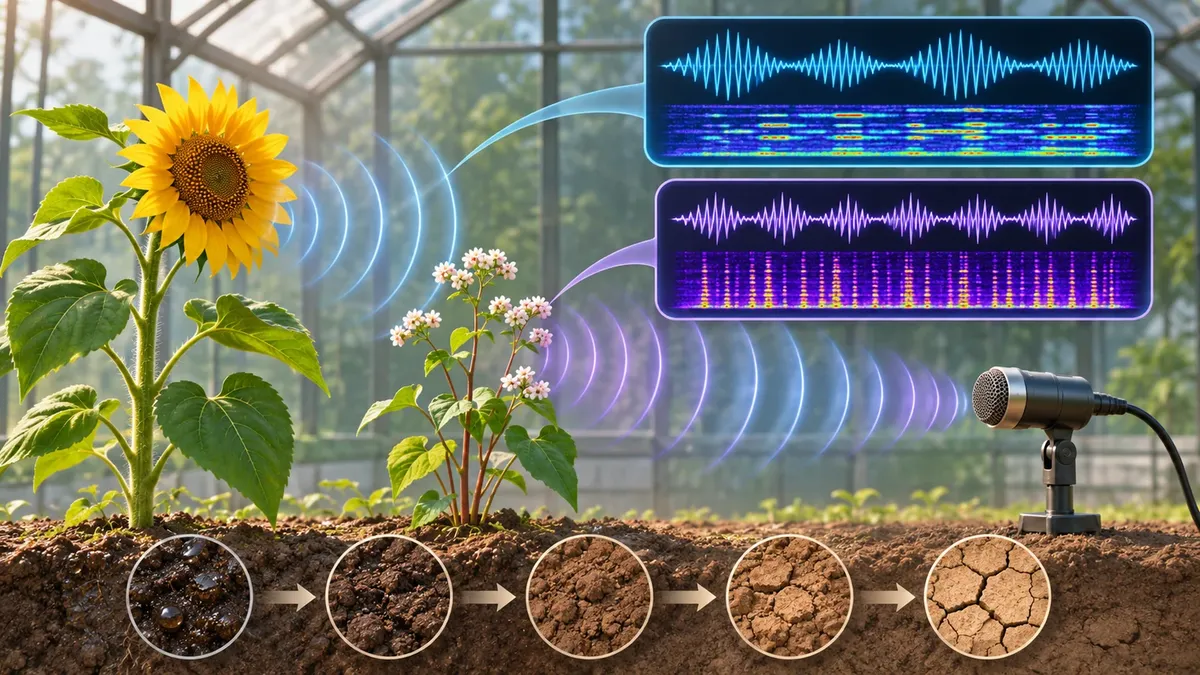
Plants make sounds too high for people to hear. In a small greenhouse experiment, researchers recorded airborne ultrasound from drought-stressed and watered sunflowers and buckwheat. They found clues in both how often events occurred and how their sound energy was distributed across frequencies—but the results are not yet a ready-made drought detector.
Two possible clues in plant ultrasound
Could a microphone detect that a plant is drying out without touching it? Plants under water stress can produce brief ultrasonic acoustic emissions—sounds above the range of human hearing. Some may arise when water columns in the plant’s water-conducting tissue break, though emissions can have other sources too.
In a bioRxiv preprint, Bedabrata Saha and colleagues examined two crops: sunflower (Helianthus annuus) and common buckwheat (Fagopyrum esculentum). They asked whether drought changed how often airborne sound events were recorded, whether the two species’ sounds differed in their frequency content, and whether those differences could identify a plant left out of classifier training.
Recording sounds alongside plant measurements
The researchers grew plants in a greenhouse and stopped watering a group of plants while continuing to water controls. They placed three plants of one treatment in a foam-lined chamber, with ultrasonic microphones near the two plants at the ends of the row. The microphones recorded in repeated 30-minute sessions. Across the experiment, the authors report 119 recordings, alongside measurements of gas exchange and chlorophyll fluorescence on the same plants.
Those measurements included stomatal conductance, which reflects how open the leaf pores are, and indicators of photosystem II, part of the machinery plants use to capture light for photosynthesis. The researchers also tracked pot weight as a rough measure of substrate water. They processed the recordings to identify sound events and compared spectral features—how event energy was distributed across frequencies—at similar loudness. For a proof-of-concept classification test, they left one plant out at a time and trained a logistic-regression model on the others.
Event rates rose, but not uniformly
Over the recording series, each drought-treated end plant emitted more events than the watered plants of its species. The reported drought-to-control rate ratio reached 107 for sunflower on one recording day and 5.3 for buckwheat on another. These are day-specific estimates, not a single stable multiplier: rates varied substantially between plants and over time. In some individual plants, rates later fell even as the pots continued drying.
Higher event rates coincided with low stomatal conductance in both species. In sunflower, emissions were already raised on the first recording day, when maximum PSII quantum yield was numerically similar between drought and watered plants. That does not establish that sound reliably appears before photosynthetic changes: measurements were limited, and other fluorescence indicators changed too. The study also found that a low event rate could describe either a watered plant or a drought-stressed plant past its apparent emission peak.
The authors suggest a possible explanation: if some events mark water-conducting channels losing function, event rates might rise during part of the drying process and then decline as vulnerable channels are used up. This is a hypothesis, not a demonstrated mechanism. The study did not directly measure plant water potential or embolism, and the authors note that not every acoustic event necessarily comes from cavitation.
A spectral difference between the two crops
At similar loudness, sunflower events carried a median 24% of their energy in the 40–80 kilohertz band, compared with 2% for buckwheat. Yet events from both species peaked near 30 kilohertz. In this experiment, the share of energy above 40 kilohertz distinguished the species better than peak frequency did.
In the classifier test, five events from a held-out plant identified its species correctly in 96% of random draws on average; accuracy for the least well-classified plant was 85%. That promising result came from just four end plants per species, representing one cultivar of each, in one chamber. The same spectral feature did not distinguish drought from watered plants within either species. Instead, the authors propose that spectrum might help identify the crop, while a changing event rate might provide information about water stress.
Important limits before any sensor is used
The number of independent plants was small: two drought and two watered end plants per species formed the main treatment comparison. Repeated recordings do not replace independent plants, so statistical estimates are exploratory and some confidence intervals are wide. Drought and control plants were usually recorded at different times of day, a potential confound the authors say future work should avoid. Some buckwheat recordings also had elevated electrical background, making one later-day result less certain.
The species were recorded in separate series, and the observed spectral difference could reflect plant properties, sound transmission through the plant, recording geometry, or changes in the recording chain. The study cannot identify which factor produced it. A low event count may also be ambiguous, and microphone performance itself would need checking.
The authors call for studies with more plants, simultaneous or alternating treatment recordings, and direct measurements of water potential and stem anatomy. The work is a preprint posted on bioRxiv and was not certified by peer review at the time of posting. Its results are an early demonstration in controlled conditions—not proof that airborne ultrasound can yet monitor drought reliably in fields.
- plant ultrasound
- drought stress
- sunflower
- buckwheat
- acoustic emissions
- plant monitoring
Related reading
Automatically matched by shared topic keywords. These links do not imply that the sources agree or establish a consensus.