TRANSMISSION // 2026.11.17.767367v1
A genomic map of pepper diversity, from heat to color
Source published
A 48-genome Capsicum study links genetic variation to traits including pungency and fruit color, while mapping patterns in domestication and potential breeding targets.
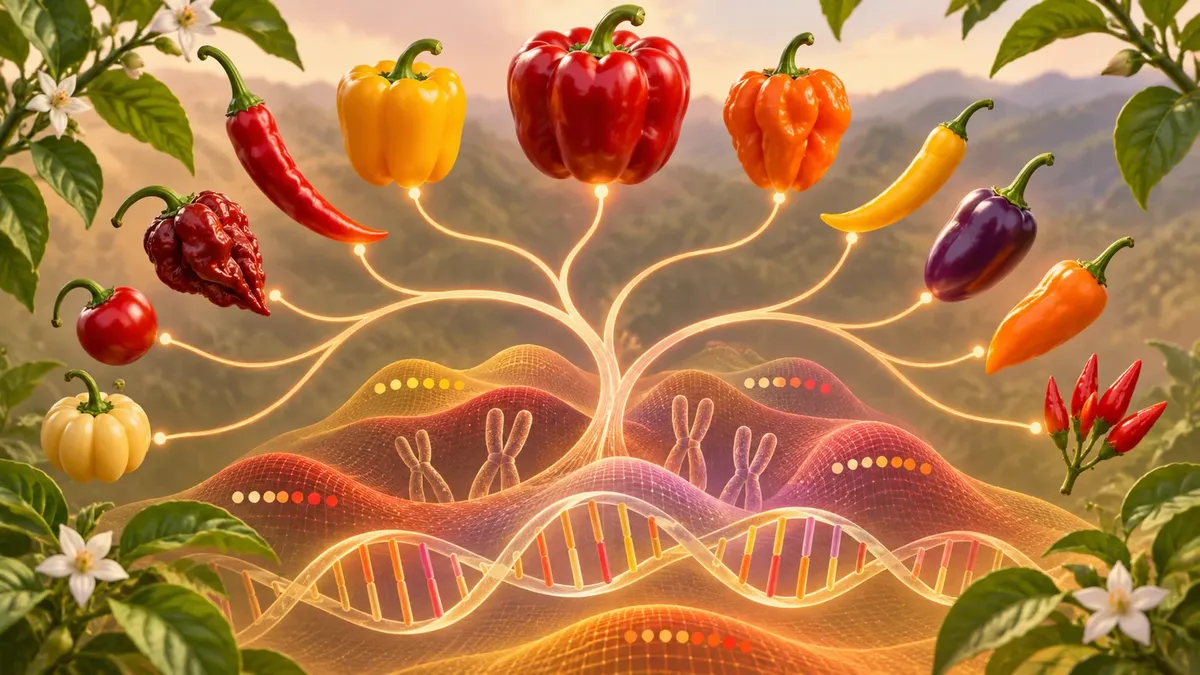
One pepper genome cannot represent all the genetic differences across the genus. Researchers combined dozens of genomes with measurements of pepper traits, whose coverage varied by trait, to investigate how gene content and chromosome-scale variation relate to that diversity.
Why look beyond one pepper genome?
Peppers differ in fruit shape, color, pungency and other traits. Their genetic diversity is also of interest to breeders seeking disease resistance and fruit quality. A single reference genome can leave out genes or larger DNA changes present in other varieties and wild relatives.
In a bioRxiv preprint, Zhao and colleagues present a “super-pangenome” intended to capture more of this variation. A pangenome combines genetic information from multiple individuals. The team used this resource to examine differences in genes and chromosome structure across Capsicum, and to explore how genetic variation relates to measured traits.
Building a broader map
The researchers combined 38 newly assembled chromosome-scale genomes with 10 previously published genomes, spanning the five domesticated taxa and wild relatives. They analyzed genetic variation in a collection of 500 accessions—distinct samples of the genus—and assembled measurements covering 130 traits. Coverage varied by measurement: the traits included morphology and growth, while fruit-metabolite analyses covered accessions that produced sufficient material. The metabolite measurements included four capsaicinoids, carotenoids and 93 fruit volatile compounds.
Two approaches captured different kinds of variation. A gene-based pangenome grouped related genes across the 48 genomes. A graph-based representation incorporated 46 genomes to identify structural variants, including insertions and deletions. The team then tested associations between genetic variants and traits, and assessed prediction using cross-validation. To investigate one candidate gene, they used virus-induced gene silencing, reducing its activity in plants and measuring the results.
The gene-based analysis identified 72,687 gene families. Most were not found in every genome: 77% were classified as “shell” genes, meaning they occurred in some but not all accessions. This indicates substantial variation in the genes peppers carry. The researchers also catalogued NLR genes, a class of plant immune receptors involved in disease resistance. In two comparisons between wild relatives and domesticated peppers, domesticated groups generally had fewer NLR genes. That pattern is consistent with a shift in the resistance-gene repertoire during domestication, but does not establish why it happened or how it affects disease resistance in the field.
Connecting genetic variation to pepper traits
The study identified genetic associations for 107 of the 130 traits examined. These are statistical links, not proof that each associated variant directly causes a trait. The results nevertheless helped identify candidates for further testing.
One candidate, RAP2, was associated with capsorubin, a red carotenoid. When the researchers silenced RAP2, fruits became orange-red. Capsanthin and capsorubin levels fell, while several upstream carotenoid compounds increased. This experiment supports a role for RAP2 in regulating carotenoid metabolism and the accumulation of downstream red pigments. It does not establish every step in the gene’s action or show how its effects vary across varieties and growing conditions.
For pungency, the team examined genes involved in capsaicinoid biosynthesis, including duplicated genes at the Pun1 locus. The researchers describe evolutionary changes involving gene duplication, loss and altered expression. They also report a chromosome rearrangement around pAMT genes and find that key pungency-associated genes are expressed in a specific cell layer of the fruit placenta. These observations suggest that gene copies and their regulation have changed over pepper evolution; they do not show that one rearrangement alone determines whether a pepper is hot.
A separate association linked the volatile compound ylangene to a structurally complex terpene-synthase region. Comparisons among genomes showed differences in gene copy number and chromosome arrangement in this region. The study’s combined SNP and structural-variant analyses provided additional detail about the associated locus, but do not prove which change produces differences in ylangene.
What the results can—and cannot—tell us
The researchers also tested genomic prediction across the 130 traits. In five-fold cross-validation, models combining SNPs—single-letter DNA changes—and structural variants had a mean correlation of 0.78 between predicted and observed trait values, with results varying by trait. Adding structural variants improved prediction for 36 traits. Their contribution was therefore trait-dependent. Performance in this study does not establish how well the models would work in new breeding populations or environments.
The findings have limits. The 48 assembled genomes represent a broad range of Capsicum, but not every variety or wild population. The structural-variant graph excluded two highly divergent genomes, and short-read variant calls can be difficult in repetitive regions. Some metabolite measurements were available only for accessions that produced enough fruit. Although the study includes a functional test of RAP2, many other findings are associations or evolutionary interpretations that need further investigation.
This article describes a bioRxiv preprint that had not been certified by peer review when posted. Its findings should be treated as provisional. The genomic resource offers a starting point for studying pepper diversity and candidate breeding targets, not a guarantee that any candidate will improve crops in practice.
- Capsicum
- pepper genomics
- pangenome
- structural variation
- capsaicinoids
- carotenoids
- plant domestication
Related reading
Automatically matched by shared topic keywords. These links do not imply that the sources agree or establish a consensus.