TRANSMISSION // 2026.11.17.767326v1
When carbon fixation falters, an alga turns to cellular recycling
Source published
A bioRxiv preprint reports that blocking carbon fixation in Chlamydomonas triggers light-dependent oxidative stress and autophagy, which may help protect cells and support recovery.
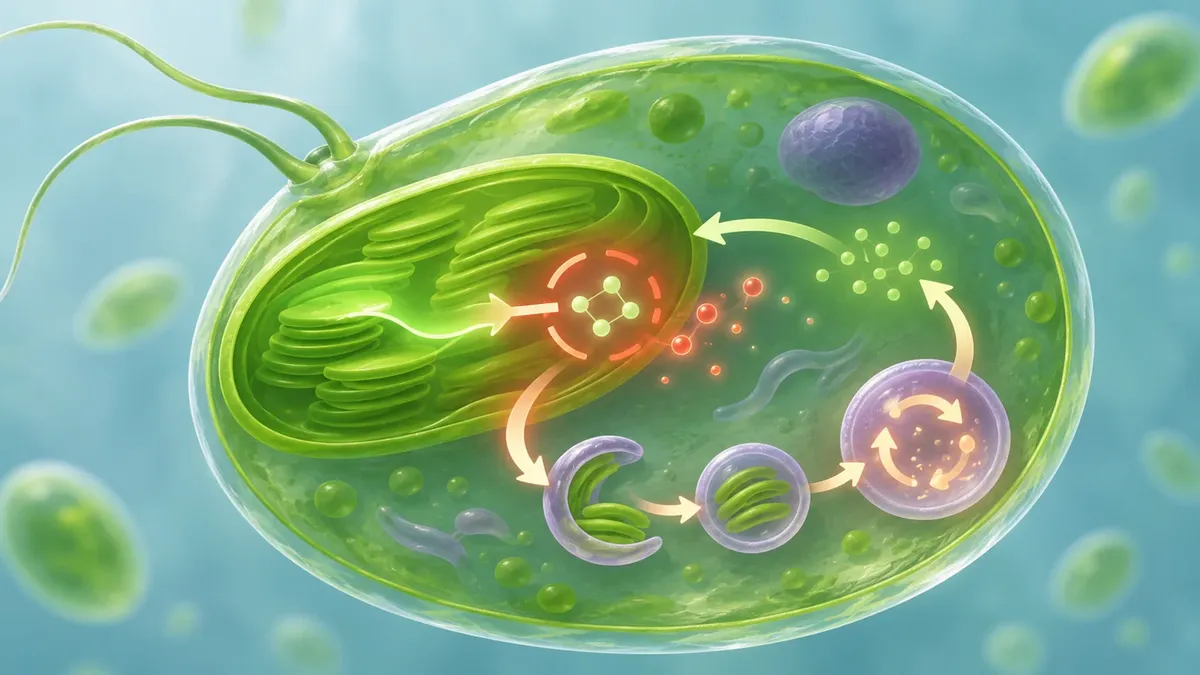
Photosynthesis supplies carbon for growth, but what happens when carbon fixation is disrupted in the light? A bioRxiv preprint reports that the green alga *Chlamydomonas reinhardtii* responds with reactive oxygen species and autophagy, a cellular recycling process. The findings suggest autophagy may help cells cope with this stress.
Photosynthetic cells use light energy to turn carbon dioxide into compounds needed for growth. In a bioRxiv preprint, researchers ask what happens when this carbon-fixing process is interrupted in the single-celled green alga Chlamydomonas reinhardtii. Their findings connect the disruption to reactive oxygen species (ROS) and autophagy, a cellular recycling process.
The study focuses on phosphoribulokinase, or PRK, an enzyme in the Calvin–Benson–Bassham cycle, which helps incorporate carbon into compounds the cell can use. The researchers inhibited PRK with a drug and also examined algae genetically lacking the enzyme.
According to the abstract, drug-based PRK inhibition caused chloroplast stress, ROS accumulation and autophagic flux—the ongoing activity of the recycling process—specifically in the light. Genetically PRK-deficient algae also showed light-dependent ROS accumulation and autophagy activation. The abstract does not specifically attribute chloroplast stress to the genetic loss.
In PRK-deficient cells, carbon limitation strengthened autophagy, while scavenging ROS reduced it. These observations support a connection between ROS and autophagy, but do not establish all the steps in the signaling pathway.
To investigate autophagy’s possible role, the team studied mutants lacking ATG8, a protein involved in autophagy, including a double mutant lacking both ATG8 and PRK. When carbon fixation was inhibited, loss of ATG8 was associated with greater ROS accumulation, worse photosynthetic function and more cell death. The authors interpret this pattern as evidence that autophagy helps protect cells from light-driven metabolic stress.
The recovery results offer another clue. Both PRK-deficient cells and the double mutants could not grow under high light. After transfer to permissive conditions, only the PRK-deficient cells resumed growth. This suggests autophagy contributes to recovery after prolonged impairment of photosynthetic carbon metabolism, though the abstract does not show that autophagy alone determines whether cells recover.
Overall, the findings link carbon fixation, redox balance and cellular recycling in C. reinhardtii. They suggest that autophagy can limit some harmful effects of impaired carbon fixation and may support recovery. The evidence described here comes from the paper’s abstract, not a full examination of methods, figures or statistical analyses. Details such as treatment doses, sample sizes and measurement procedures are therefore not available in this account. The results concern this alga and the experimental conditions studied; their relevance to other organisms remains uncertain. The source is a bioRxiv preprint, so these findings should be read as a proposed stress-response link rather than a settled general explanation.
- Chlamydomonas reinhardtii
- autophagy
- carbon fixation
- photosynthesis
- reactive oxygen species
- chloroplast stress
Reviewed cross-references
These connections were reviewed by a model, not independently fact-checked by a human. Similarity does not imply agreement; consult the original papers and the evidence below.
A plant enzyme may help cells recycle damaged mitochondria
Supporting evidence: Both preprints implicate ATG8-related autophagy in plant stress homeostasis: the Chlamydomonas study reports greater oxidative and photosynthetic damage without ATG8 and impaired recovery after high light, while the Arabidopsis study proposes a GSNOR1–VDAC3–ATG8 route for mitochondrial turnover and reports stress sensitivity in mutants. This is a broad functional parallel, not evidence for the same mechanism; the organisms, stresses, and autophagy outcomes differ, and both reports are preprints.
Model review: · openai-codex/gpt-6-luna
Evidence and provenance
Selected excerpts, not complete papers. PDF extraction can omit figures or damage equations, tables and reading order; sources may be preprints.
2026.11.17.767326v1 — Original paper
Excerpt reference:
static/papers/2026.11.17.767326v1.md:141-269
Basis: Paper text
Source SHA-256:18fb7a68e4e851f24bf3e2246069843b4c179cf6b37a6a19ac73257c07cd85202026.10.28.758855v1 — Original paper
Excerpt reference:
static/papers/2026.10.28.758855v1.md:12-146
Basis: Paper text
Source SHA-256:919bf60e3d4e238ff00d45ec0d98424b92abef995e8e57122cea621dbda3f8792026.10.28.758855v1 — Original paper
Excerpt reference:
static/papers/2026.10.28.758855v1.md:1678-1803
Basis: Paper text
Source SHA-256:919bf60e3d4e238ff00d45ec0d98424b92abef995e8e57122cea621dbda3f879
Related reading
Automatically matched by shared topic keywords. These links do not imply that the sources agree or establish a consensus.
C4 leaf cells show distinct chloroplast-to-nucleus signalling
Source published
Shared keywords: reactive oxygen species
A familiar alga may carry two mitochondrial genome configurations
Source published
Shared keywords: chlamydomonas reinhardtii
How water stress reshapes seed germination signals
Source published
Shared keywords: reactive oxygen species
A second kind of oxidative burst may help plants detect danger
Source published
Shared keywords: reactive oxygen species
How an iron-response protein helps plant roots cope with salt
Source published
Shared keywords: reactive oxygen species