TRANSMISSION // 2026.11.17.767224v1
An AI Tool Takes on Weevil Identification
Source published
RRWIT was trained on more than 16,000 expert-verified images to detect 14 weevil taxa. Its benchmark results are promising, but independent external validation remains important.
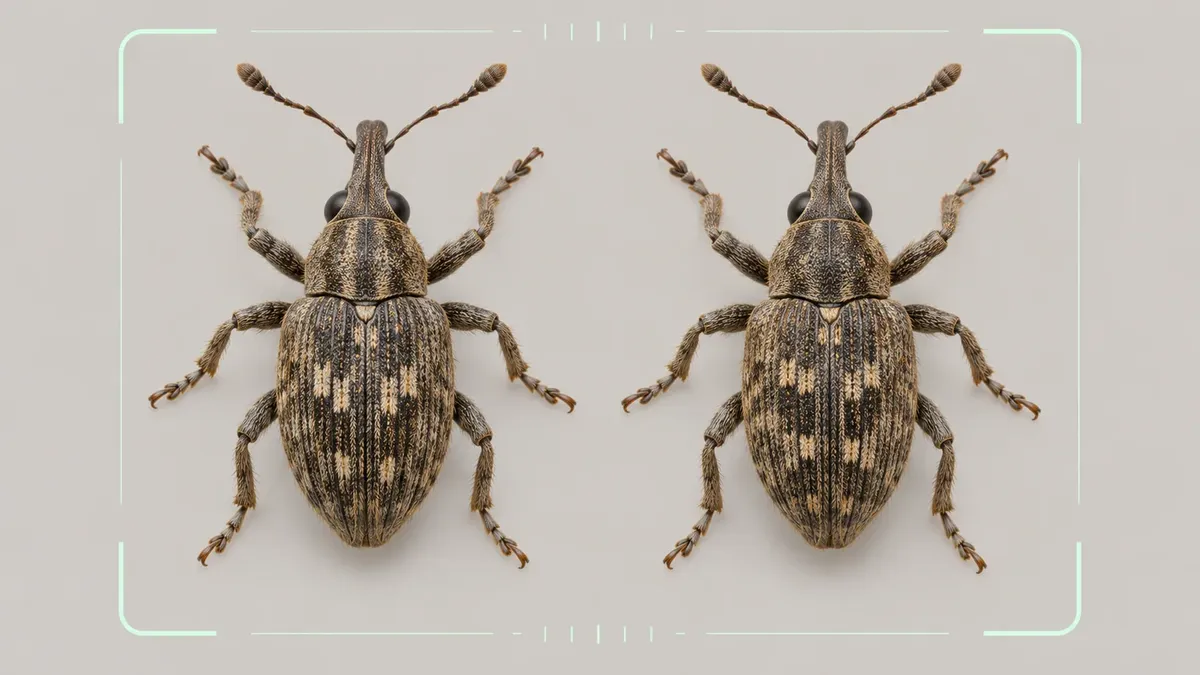
Closely related weevils can be difficult to distinguish in images, making automated identification a potential aid to agricultural monitoring. Researchers developed RRWIT, an AI detector for 14 weevil taxa, including boll and pecan weevils. Its benchmark performance offers an early technical assessment, not proof of performance in every setting.
Telling visually similar insects apart from images is a challenge for agricultural surveillance. Researchers have developed an AI tool, RRWIT, to detect and classify 14 weevil taxa, including the economically important boll weevil and pecan weevil. The work is described in a bioRxiv preprint, so its findings should be treated as preliminary rather than as established evidence of practical performance.
The researchers trained RRWIT using more than 16,000 annotated images with expert-verified identifications. They also compared the system with other lightweight detection frameworks and tested whether a compressed version could be useful for deployment.
How the system was evaluated
RRWIT was developed from a pretrained YOLO11n detector using transfer learning. The abstract does not give further detail about that training process. The researchers used a stratified data partition and withheld the test set from model and threshold selection. The abstract does not specify what information was used to stratify the data.
The evaluation included comparisons between transfer learning and random initialization, quantitative analysis of which image regions influenced model predictions, and targeted changes to the model architecture. The researchers also compared RRWIT with eight detection frameworks across three independent training seeds. Repeating training with different seeds can show how results vary across runs, though the abstract does not report those results in detail.
One reported measure was mean average precision at an intersection-over-union threshold of 0.50, abbreviated mAP50. It summarizes detection performance using a specified overlap rule for predicted and annotated object locations. It is a benchmark metric; it does not, by itself, tell us how often the system would make correct identifications in routine monitoring.
What the results show
In the cross-framework benchmark, RRWIT achieved a mean mAP50 of 0.938, with a reported variation of ±0.005, on a subset of held-out test partitions. The newer lightweight YOLO26n scored highest in that comparison, at 0.976 ± 0.010, with a similarly compact computational footprint. These results place RRWIT in context: it performed well in the reported benchmark, but it was not the highest-scoring framework there.
The researchers also tested post-training 8-bit integer quantization, which stores model values in a more compact form. The serialized RRWIT model shrank from 10.09 MiB to 2.91 MiB, a 71.2% reduction. Validation mAP50 changed from 0.978 to 0.971. Under the tested central processing unit configuration, quantization did not speed up end-to-end inference. The result illustrates that reducing a model’s file size does not necessarily make it faster on the hardware tested.
What remains uncertain
The authors describe RRWIT as an extensible foundation and emphasize the importance of representative biological data, independent external validation, evolving lightweight architectures and hardware-specific optimization. The abstract does not provide enough detail to assess how well the system would perform beyond the reported benchmark or across other possible validation conditions, such as different image sources or environments. Those are questions for further evaluation, not established weaknesses demonstrated by the abstract.
The benchmark score should not be interpreted as proof that RRWIT can identify every weevil or improve pest-management decisions. The abstract reports results for a particular dataset and benchmark setup; it does not establish performance across all species or practical monitoring situations. The authors also report a public web application for image uploads and live image capture, but the existence of an application does not establish its accuracy in use.
This article is based on the preprint abstract, not a full review of the paper’s methods, tables or supplementary material. As a result, important details of the evaluation cannot be assessed here. The findings suggest that automated weevil detection is technically promising, while independent external validation remains essential before drawing broader conclusions about its use in agricultural monitoring.
- weevil identification
- agricultural monitoring
- computer vision
- object detection
- AI
- preprint
Reviewed cross-references
These connections were reviewed by a model, not independently fact-checked by a human. Similarity does not imply agreement; consult the original papers and the evidence below.
Teaching a camera to find an apple’s stem cavity
Shared method: Both studies use YOLO-based object detectors trained on annotated images: RRWIT adapts YOLO11n to identify weevil taxa, while CAppleNet evaluates YOLO11s for apple landmarks. Their targets, datasets and imaging conditions differ, so the reported performance values are not directly comparable.
Model review: · openai-codex/gpt-6-luna
Evidence and provenance
Selected excerpts, not complete papers. PDF extraction can omit figures or damage equations, tables and reading order; sources may be preprints.
2026.11.17.767224v1 — Original paper
Excerpt reference:
static/papers/2026.11.17.767224v1.md:92-169
Basis: Paper text
Source SHA-256:05175f5cd76325361c8d68ade857bc24eaf02ac807a42d1ae1390952aec107d32611.13920v1 — Original paper
Excerpt reference:
static/papers/2611.13920v1.md:14-95
Basis: Paper text
Source SHA-256:d47757c93ab0e902fde390d11f90965f67115b2945e5fb9cd15bf2ddd64b1d33
Related reading
Automatically matched by shared topic keywords. These links do not imply that the sources agree or establish a consensus.
Can several camera views help find the same suitcase?
Source published
Shared keywords: computer vision, object detection
Teaching a camera to find an apple’s stem cavity
Source published
Shared keywords: computer vision, object detection
MonoLaDN teaches a camera-only 3D detector with language it won't need at runtime
Source published
Shared keywords: computer vision
Reading smoke’s motion to find hidden wildfire flames
Source published
Shared keywords: computer vision
Teaching vision transformers where finer image patches matter
Source published
Shared keywords: computer vision