TRANSMISSION // 2026.11.16.767051v1
A fragmented genome still reveals orchid metabolism clues
Source published
A draft genome of the North American orchid Tipularia discolor yielded candidate genes for several metabolic pathways, including two putative bibenzyl synthases. The findings suggest biochemical potential, not confirmed gene activity or metabolite production.
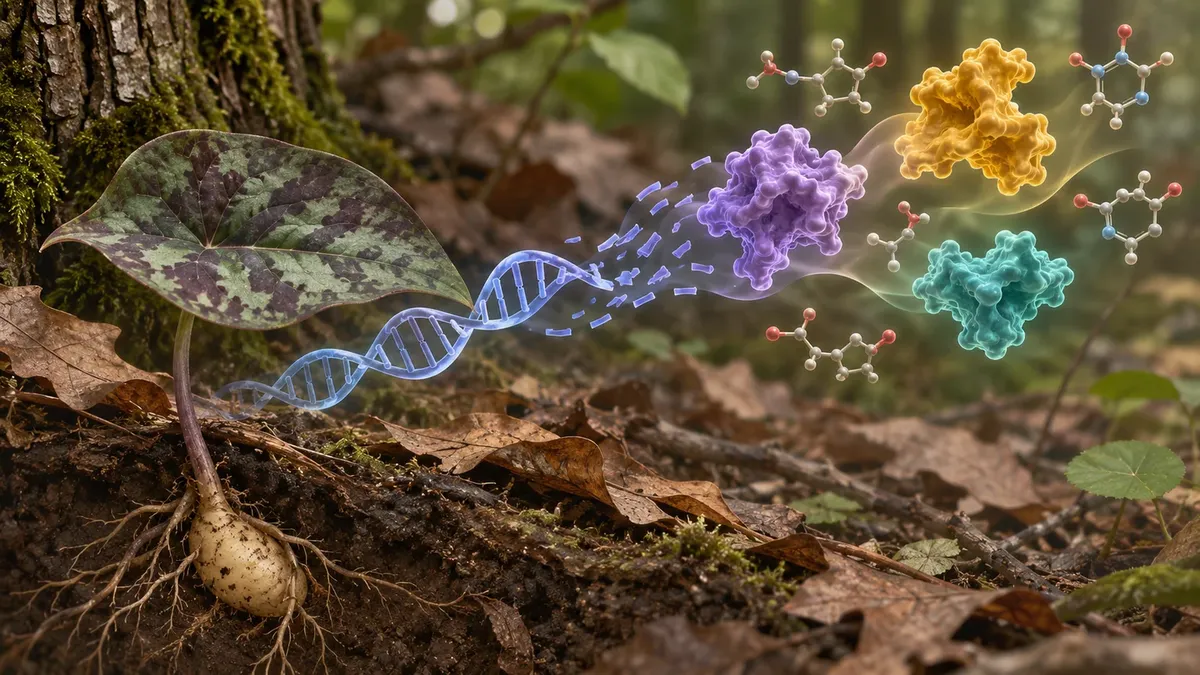
Orchid genomes cover only a small fraction of the family’s diversity. A new preprint tests whether even a highly fragmented genome from a North American terrestrial orchid can help researchers find genes worth studying.
What can a broken-up genome tell us?
Most sequenced orchid genomes come from Asian species, leaving much of the family’s genetic diversity unexplored. Genes can offer clues to how plants grow, interact with other organisms and adapt to their habitats. Jonathan I. Watkinson’s bioRxiv preprint examines whether useful clues can still be found when a genome assembly is far from complete.
The subject is Tipularia discolor, a terrestrial orchid widely distributed across the eastern half of the United States. The study searched for candidate genes involved in carbon metabolism and specialized metabolism—the pathways plants use to make compounds that can contribute to defense and ecological interactions. The author also describes a longer-term interest in how this orchid interacts with fungi, but the genome-mining study did not test those interactions directly.
Building and searching the draft
The researcher sequenced DNA from leaves using short-read Illumina technology. K-mer analysis—counting short DNA sequences in the reads—estimated a haploid genome size of about 1.67–1.70 billion DNA letters, with roughly 55–56% repetitive sequence. Repeated DNA can make it difficult to determine where short fragments belong, complicating genome assembly.
Two assembly programs produced highly fragmented results. The study used consensus contig objects from the MaSuRCA assembly: pieces of assembled DNA that could be searched even though they did not form a continuous, chromosome-level genome. In a standard completeness check, 62.1% of conserved plant genes were represented, but only 26% were complete; another 36.1% were partial. This suggests the assembly captured some useful gene regions while leaving many incomplete or absent.
To search for genes, the author compared contig sequences with reference proteins, favoring experimentally characterized examples where available. Candidate assignments were assessed using several kinds of evidence, including sequence alignment, expected protein domains and, for some candidates, conserved motifs. The study also compared predicted protein sequences in a phylogenetic tree to assess the identity of two possible bibenzyl synthases.
Candidate pathways, not confirmed chemistry
The search identified 68 consensus-contig objects containing whole or partial genes associated with sucrose and trehalose metabolism, terpenoid metabolism and phenylpropanoid metabolism. These are candidate sequences, not 68 experimentally verified, working genes: confidence varied, and many candidates were incomplete.
The most notable result was the identification of two putative bibenzyl synthase (BBS) homologs. Bibenzyl synthases belong to a family of enzymes involved in making specialized plant compounds. In the reported phylogenetic analysis, the predicted proteins grouped with characterized orchid BBS proteins, supporting the proposed identification. The study reports 90% support for the two T. discolor candidates grouping together and 94% support for their placement with orchid BBS sequences. These tree values support relationships among the predicted sequences; they do not demonstrate enzyme activity.
The result suggests the orchid may have the genetic capacity to produce bibenzyl compounds. But the study did not measure bibenzyl compounds in the plant or test whether either candidate enzyme is active. The author explicitly notes that both enzyme activity and the presence of corresponding metabolites remain to be demonstrated. This is a promising lead, not proof of production.
What the assembly cannot yet resolve
The work shows that a fragmented assembly can support targeted searches for particular gene families. It does not provide a complete genome or a reliable view of how genes are arranged across chromosomes. The author notes that this draft cannot reliably determine gene copy number, genomic organization, promoter structure, gene clusters or chromosome-level synteny. For some candidates, fragmentation also makes it difficult to tell whether separate pieces belong to one gene or to related members of a gene family.
Proposed next steps include functional tests of selected candidates and longer-read sequencing to build a more complete assembly. Researchers could then investigate gene activity and, separately, test for predicted compounds or study responses to fungi and other environmental factors.
This work is a bioRxiv preprint, posted November 20, 2026, and has not been certified by peer review. Its findings should be treated as preliminary. The study offers candidate genes and a draft resource for an orchid underrepresented in genome research—not a demonstration of what its genes do in living plants.
- Tipularia discolor
- orchid genome
- candidate genes
- bibenzyl synthase
- specialized metabolism
- genome assembly
Related reading
Automatically matched by shared topic keywords. These links do not imply that the sources agree or establish a consensus.