TRANSMISSION // 2026.11.16.767000v1
A cellular switch helps plants close their leaf pores
Source published
An Arabidopsis study finds that VAP27-4 helps remove the KAT1 potassium channel from guard-cell surfaces, influencing turgor and stomatal movement.
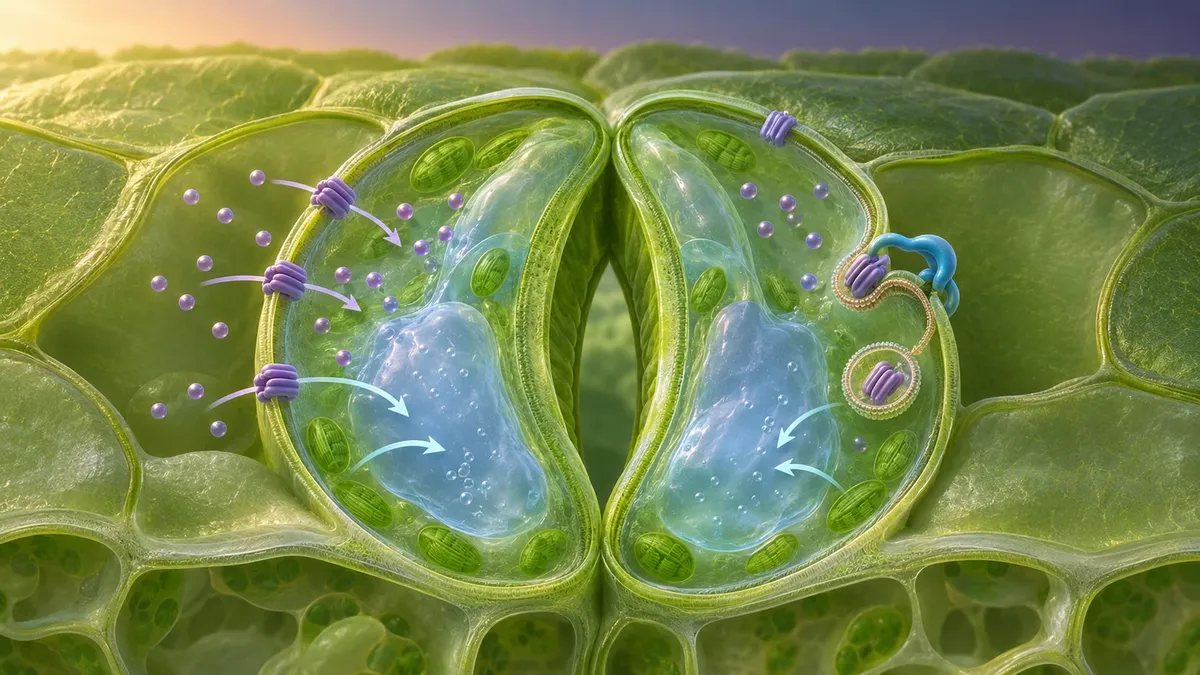
Plants must balance taking in carbon dioxide with losing water through tiny leaf pores called stomata. A new preprint traces part of that balancing act to VAP27-4, a protein that appears to help retrieve a potassium channel from the surface of the cells that control the pores.
Stomata are adjustable pores in a leaf’s surface. When they open, carbon dioxide can enter for photosynthesis, but water vapor escapes. Their opening and closing depends in part on guard cells: potassium and other dissolved substances move into or out of these cells, water follows, and the resulting change in pressure helps the cells bow apart or close the pore.
A study posted on bioRxiv asks how plants regulate KAT1, a potassium channel that helps guard cells take up potassium during stomatal opening. The researchers focus on VAP27-4, a member of a plant protein family associated with membrane organization and transport. Their proposed role for VAP27-4 is to help remove KAT1 from the cell surface through endocytosis—the process by which a cell draws portions of its outer membrane and embedded proteins inward.
From protein interaction to plant cells
The team first used a yeast protein-interaction screen to identify possible KAT1 partners. They then tested the connection in several ways, including interaction assays in plant tissue. In experiments using yeast and Xenopus laevis egg cells, co-expressing VAP27-4 with KAT1 reduced measures of KAT1 function, including potassium-channel currents in the egg cells. The researchers also report an interaction with KAT2, a related channel, so VAP27-4 may not act on KAT1 alone.
To examine trafficking in Arabidopsis, the researchers compared plants lacking VAP27-4 with plants engineered to produce more of it. After treatment with abscisic acid (ABA), a hormone involved in drought responses and stomatal closure, they used fluorescently tagged KAT1 to track its location. A chemical treatment that blocks recycling helped make internalized channel visible in intracellular compartments. In this assay, loss of VAP27-4 reduced KAT1 internalization, while overexpression increased it. Without ABA, the study reports no significant difference in internalization between the wild type and the VAP27-4 mutant.
The team also assessed guard-cell pressure using cavitation bubble manometry. A laser-created microbubble’s size serves as an indirect indicator: higher surrounding pressure constrains its expansion. Light exposure was associated with increased estimated guard-cell turgor across plants. In lines engineered to overexpress KAT1, pressure remained higher at a measurement taken after the lights went off; adding VAP27-4 alongside KAT1 shifted the measured pattern closer to that of the wild type. This supports a link between VAP27-4, KAT1 abundance, and guard-cell pressure, but the method estimates turgor rather than directly recording potassium flow or channel activity inside intact guard cells.
Finally, the researchers measured stomatal aperture in seedlings. Plants lacking VAP27-4 showed greater opening at two measured times during light exposure, while a line with VAP27-4 restored showed somewhat faster closure at one time. These observations are consistent with VAP27-4 helping limit KAT1-associated opening, though they do not establish that KAT1 is the only route through which VAP27-4 affects stomata.
What the results do—and don’t—show
Taken together, the experiments support a model in which VAP27-4 interacts with KAT1 and promotes its ABA-associated internalization, reducing the channel available at the cell surface. Less surface KAT1 could mean less potassium uptake, lower guard-cell turgor, and a greater tendency for stomata to close. The evidence spans interaction tests, channel assays in other organisms, fluorescent imaging, a pressure proxy, and aperture measurements in Arabidopsis. Each method addresses a different part of the proposed chain; none alone proves the whole mechanism.
Important questions remain. The researchers note that VAP27-4 might also affect channel activity directly, and that related channels such as KAT2 could contribute to the observed plant responses. The experiments do not establish how much this mechanism matters during drought in mature plants, or whether changing VAP27-4 would improve water use or crop performance. Those outcomes were not demonstrated in the reported work.
This article is based on a bioRxiv preprint, posted in November 2026, that has not been certified by peer review. Its findings should be treated as provisional pending further evaluation and replication. The study identifies a possible piece of the cellular machinery behind stomatal movement—not a demonstrated drought-tolerance strategy.
- plant biology
- stomata
- guard cells
- KAT1
- VAP27-4
- endocytosis
- abscisic acid
- Arabidopsis
Reviewed cross-references
These connections were reviewed by a model, not independently fact-checked by a human. Similarity does not imply agreement; consult the original papers and the evidence below.
An early cellular transport step helps tune plant stress-hormone sensitivity
Supporting evidence: In Arabidopsis, both preprints connect membrane trafficking or its disruption with stomatal regulation: the VAP27-4 study reports ABA-associated KAT1 endocytosis and altered stomatal opening dynamics, while the MAG5 study reports enhanced ABA responses and reduced stomatal aperture in mag5-3. These results support the bounded proposition that trafficking-related processes can affect stomatal behavior, but they concern distinct proteins and trafficking steps and do not establish a shared mechanism; both are preprints.
Model review: · openai-codex/gpt-6-luna
Evidence and provenance
Selected excerpts, not complete papers. PDF extraction can omit figures or damage equations, tables and reading order; sources may be preprints.
2026.11.16.767000v1 — Original paper
Excerpt reference:
static/papers/2026.11.16.767000v1.md:1732-1851
Basis: Paper text
Source SHA-256:6089204d42a6df510dc13a8f9e401f78a8a79cce6bceb160fae76c60fb37460a2026.11.16.767000v1 — Original paper
Excerpt reference:
static/papers/2026.11.16.767000v1.md:1500-1615
Basis: Paper text
Source SHA-256:6089204d42a6df510dc13a8f9e401f78a8a79cce6bceb160fae76c60fb37460a2026.11.06.761007v1 — Original paper
Excerpt reference:
static/papers/2026.11.06.761007v1.md:1878-1984
Basis: Paper text
Source SHA-256:8572203da9f07058475335854a8c4e2f016d5e3746a194a561a370af04ec8596
Related reading
Automatically matched by shared topic keywords. These links do not imply that the sources agree or establish a consensus.
An early cellular transport step helps tune plant stress-hormone sensitivity
Source published
Shared keywords: abscisic acid
Climate and arsenic conditions shift cadmium and zinc in rice grain
Source published
Shared keywords: plant biology
Root microbes shape how a legume responds to higher CO₂
Source published
Shared keywords: plant biology
How potato plants remember combined heat and drought
Source published
Shared keywords: abscisic acid