TRANSMISSION // 2026.11.16.766973v1
How chloroplast proteins help plants recover from intense light
Source published
Arabidopsis experiments link 2-Cys peroxiredoxins to fatty-acid changes in chloroplast membranes and recovery of photosystem II after high-light exposure.
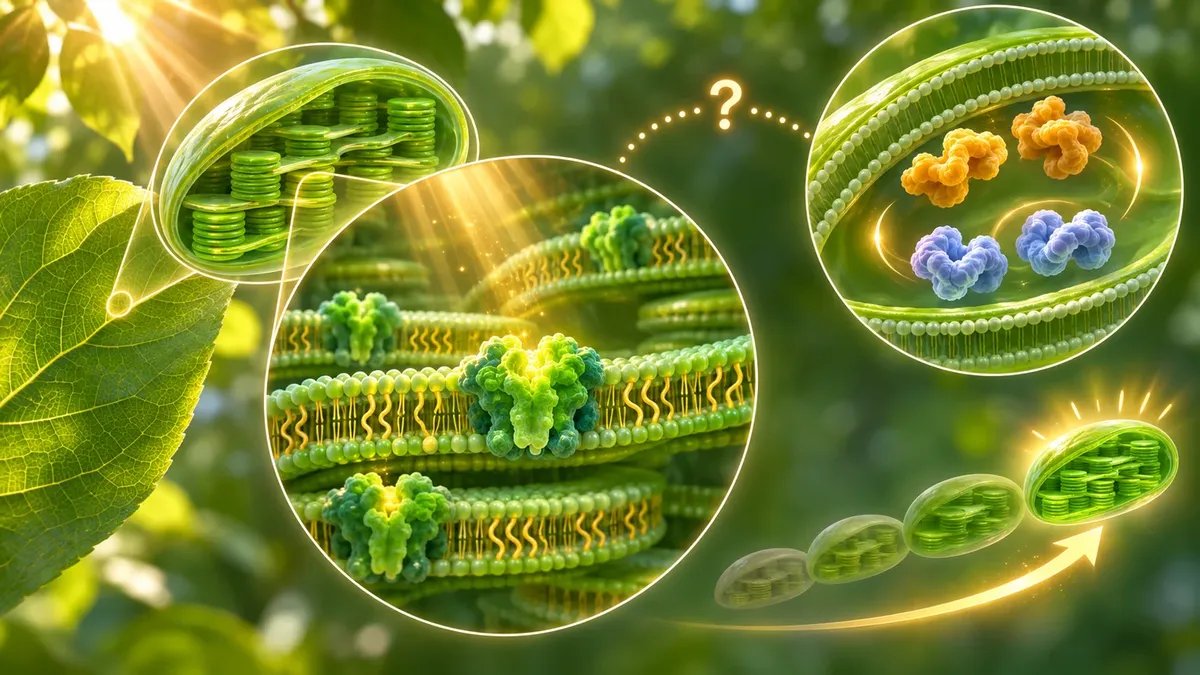
Plants need to repair the machinery that turns light into chemical energy when intense illumination damages it. A study in Arabidopsis suggests that chloroplast proteins called 2-Cys peroxiredoxins help tune membrane fats and support that recovery, though the precise mechanism remains unresolved.
Too much light can damage photosystem II (PSII), a protein complex that carries out an early step in photosynthesis. Plants can repair this machinery, which sits in thylakoid membranes inside chloroplasts. The membranes contain fats whose chemical makeup may affect how the photosynthetic machinery functions and is maintained.
A bioRxiv preprint by M. Luisa Hernández and colleagues asks how chloroplasts regulate these membrane fats, and whether that regulation matters under intense light. The researchers focused on 2-Cys peroxiredoxins (Prxs), proteins involved in chloroplast redox balance, and two enzymes, FAD7 and FAD8, that add a double bond to certain fatty acids. The resulting trienoic fatty acids include 18:3 and 16:3. The team paid particular attention to phosphatidylglycerol (PG), a lipid found in thylakoid membranes.
Testing the links in Arabidopsis
The researchers compared Arabidopsis thaliana plants with different combinations of mutations affecting 2-Cys Prxs, FAD7 or FAD8. Some combinations were produced using CRISPR gene editing. They separated leaf lipids into classes and measured their fatty acids by gas chromatography. To test whether the proteins associated with one another, they used co-immunoprecipitation and a yeast-based interaction assay. Chemical labelling was used to examine whether FAD7 changed its redox state under different conditions.
For the high-light experiment, plants were exposed to stronger illumination than their usual growing conditions. The team tracked PSII performance using Fv/Fm, a measure of its maximum quantum yield, and assessed fatty-acid levels. A separate group of plants experienced prolonged cold, allowing the researchers to examine another environmental condition.
The lipid measurements showed that removing 2-Cys Prxs reduced the efficient production of trienoic fatty acids in chloroplast lipids, particularly in PG. In mutant combinations retaining one of the desaturases, PG’s 18:3 level was lower than in the corresponding desaturase mutant without the Prx deficiency. Effects in other lipid classes varied between combinations. Overall, the findings point to a role for 2-Cys Prxs in supporting FAD7 and FAD8 activity, rather than a uniform effect on every chloroplast lipid.
The interaction tests detected associations between 2-Cys Prxs and both desaturases. However, the study found no corresponding change in FAD7’s redox state; the authors report the same for FAD8. This argues against regulation through the familiar cysteine-based redox switch. Interaction evidence does not, by itself, reveal how the association affects fatty-acid production. The authors propose that Prxs might help stabilize or position the desaturases, perhaps acting as scaffolds or chaperones. That remains a hypothesis. Their predicted protein structures had low confidence and cannot establish the arrangement.
High light, but not a simple lipid-only explanation
During the high-light treatment, all genotypes initially showed a decline in PSII performance. After 24 hours, the quadruple mutant lacking 2-Cys Prxs and both chloroplast desaturases showed especially poor recovery: many plants had very low Fv/Fm and visible bleaching. Other genotypes maintained photosynthetic activity more effectively. The results support the conclusion that Prxs and desaturases together contribute to PSII recovery under these experimental conditions.
But membrane fatty acids do not explain the whole result. The quadruple mutant performed worse than a desaturase double mutant even though their trienoic-fatty-acid levels were similar. The authors suggest that 2-Cys Prxs may also protect or support repair of PSII through other functions, such as antioxidant or chaperone activity. Those explanations need further testing.
The cold experiment adds a qualification: despite changes in lipid composition, combining loss of 2-Cys Prxs with loss of just one desaturase did not produce a clear additional decline in PSII performance under the tested conditions. The study therefore does not establish a general benefit across stresses. It examines laboratory-grown Arabidopsis under specific treatments; it does not demonstrate that the proposed mechanism applies to crops or field conditions.
This work is a bioRxiv preprint and has not been certified by peer review. It offers a testable link between membrane remodeling and photosynthetic recovery, while leaving the precise mechanism and its broader relevance open.
- Arabidopsis
- chloroplast
- photosynthesis
- photosystem II
- phosphatidylglycerol
- fatty acid desaturation
- peroxiredoxin
- high-light stress
Related reading
Automatically matched by shared topic keywords. These links do not imply that the sources agree or establish a consensus.