TRANSMISSION // 2026.11.16.766966v1
How water stress reshapes seed germination signals
Source published
An abstract-only bioRxiv preprint reports that water stress in Arabidopsis seeds is associated with altered hydrogen peroxide balance, hormone metabolism and slower germination.
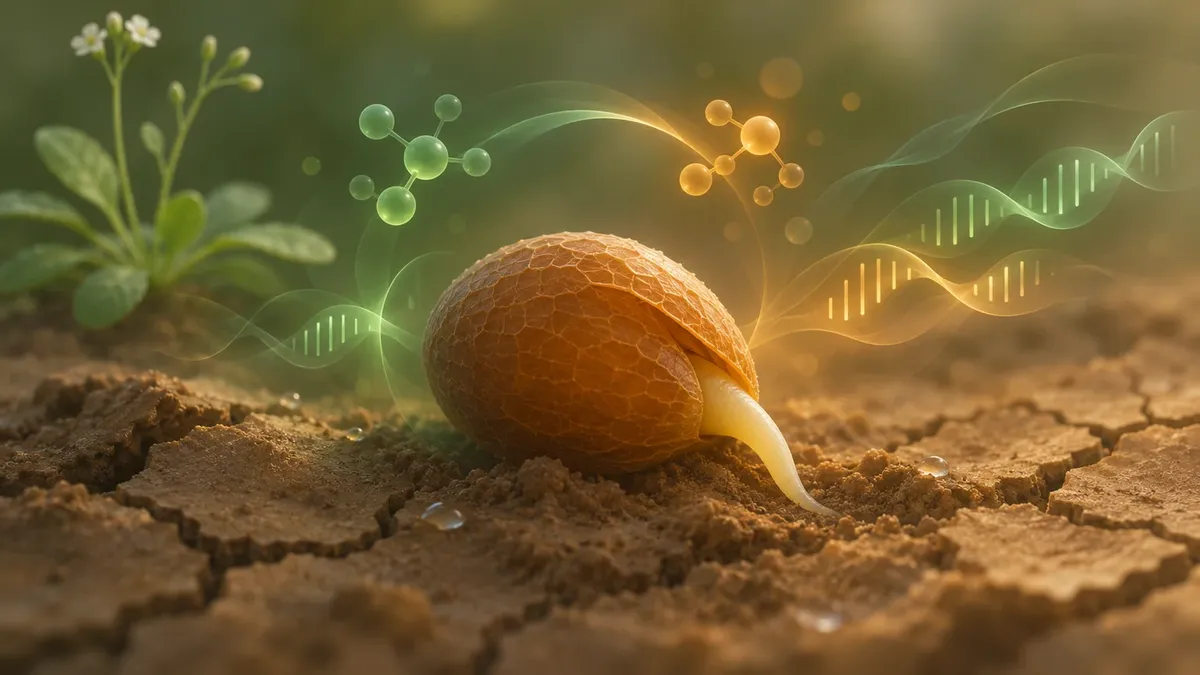
How does a seed respond when water is less available? An abstract-only preprint reports that water stress in Arabidopsis is associated with changes in hydrogen peroxide regulation and hormone metabolism during germination.
The question and approach
Seed germination is sensitive to water availability, but the molecular responses involved are not fully understood. The researchers studied Arabidopsis thaliana seeds under reduced water potential, using polyethylene glycol (PEG) to impose the condition reproducibly. They examined reactive oxygen species (ROS)—molecules that can also act in biological signaling—and used transcriptomic dynamics and weighted gene co-expression network analysis to investigate relationships among gene activity patterns.
What the abstract reports
The authors report that delayed germination under water stress was not simply a consequence of reduced water uptake. They describe coordinated changes that included altered hydrogen peroxide (H₂O₂) homeostasis, particularly in peroxisomes. The abstract says this regulation functionally mediates a rebalancing of abscisic acid (ABA) and gibberellin (GA) metabolism toward developmental slowdown.
The network analysis identified a gene hub associated with H₂O₂ production during germination. The authors also report that oxygen- and redox-related processes were strongly linked to transcriptional and translational attenuation—that is, reduced activity in making RNA and proteins. The abstract presents these findings as evidence that water stress responses involve interconnected redox, hormone and gene-regulatory changes.
What remains uncertain
This account is based on the abstract, not the full paper. It does not give the experimental conditions in detail, the number of seeds or replicates, the measurements used, or the statistical results. It also does not provide enough information to assess how the proposed links were tested. A gene-network association, as described in an abstract, should not by itself be read as proof that one gene directly controls another.
The study concerns Arabidopsis seeds treated with PEG. The abstract does not establish whether the same processes operate in crop seeds or under water stress in soil, or whether the findings point to a practical way to improve crop resilience.
The report is a bioRxiv preprint, which means it was shared before peer review. Its findings should therefore be treated as preliminary until assessed alongside the full study and further research.
- Arabidopsis
- seed germination
- water stress
- hydrogen peroxide
- reactive oxygen species
- plant hormones
- gene networks
Related reading
Automatically matched by shared topic keywords. These links do not imply that the sources agree or establish a consensus.
How an iron-response protein helps plant roots cope with salt
Source published
Shared keywords: hydrogen peroxide, reactive oxygen species
C4 leaf cells show distinct chloroplast-to-nucleus signalling
Source published
Shared keywords: reactive oxygen species
Helmet orchid seeds show uneven germination without fungi
Source published
Shared keywords: seed germination
Inside larger soybean seeds: bigger cells, more oil and altered hormone signals
Source published
Shared keywords: plant hormones
Waterlily study links pollen rejection to reactive oxygen and two interacting proteins
Source published
Shared keywords: reactive oxygen species