TRANSMISSION // 2026.11.16.766962v1
Wheat roots differ by position, not just size
Source published
A study of wheat found that nodal root anatomy varies along the stem even after accounting for root cross-sectional area, with genetic associations also changing after size correction.
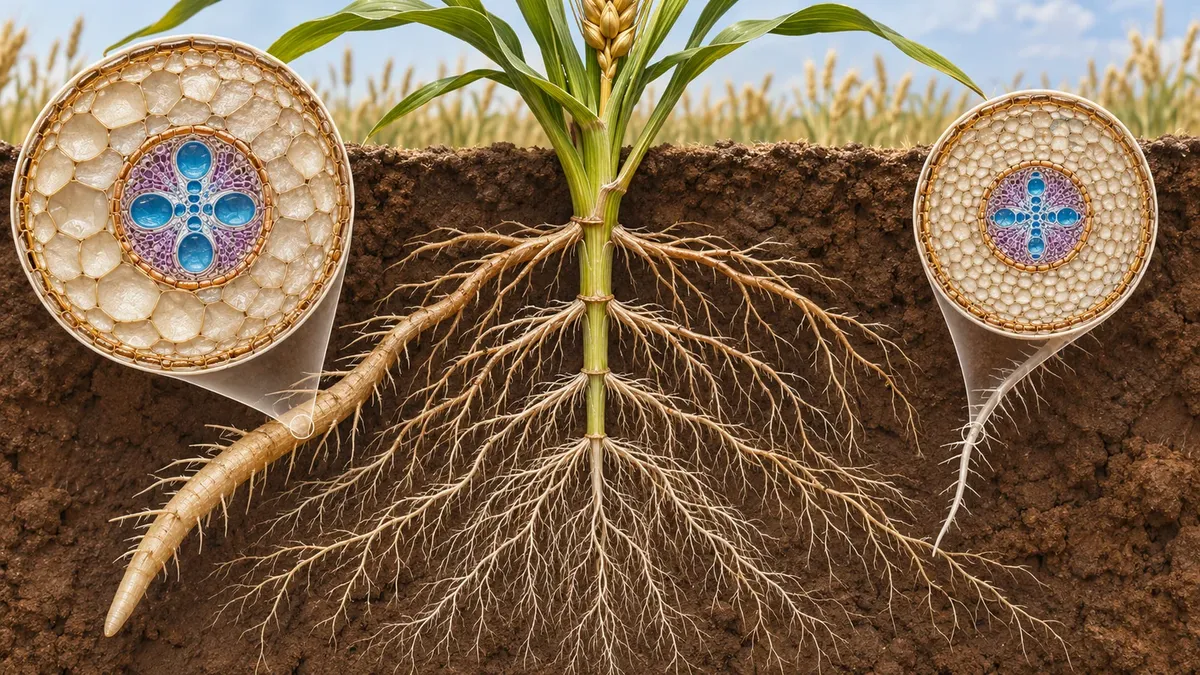
Roots emerging from different points on a wheat stem may look like one broad category, but their internal structure can vary. A preprint examining 190 wheat genotypes finds that root size alone does not explain those differences—and that accounting for size changes which genetic associations researchers detect.
A wheat plant’s roots do not all emerge from the same place. Nodal roots arise at points along the stem, or culm, and roots from lower and higher nodes may differ in how their tissues are arranged. The question for researchers is whether those differences reflect a distinct pattern linked to position, or simply the fact that some roots are larger than others.
That distinction matters because root anatomy is connected to how plants acquire resources and move water. It also matters for genetic studies: a gene association with a tissue measurement might reflect overall root size, the organisation of tissues within the root, or both.
Comparing roots across positions
The researchers measured anatomical traits in nodal roots from four positions along the main culm, from basal to apical, in 190 hexaploid wheat genotypes grown in field and greenhouse conditions. They recorded root cross-sectional area (RxA) alongside measurements of internal tissues, including the cortex and metaxylem, a water-conducting tissue.
To separate anatomy from size, they used an allometric correction. In plain terms, they adjusted anatomical measurements to a shared reference RxA within each environment, then compared the corrected traits across root positions. They also ran genome-wide association studies (GWAS)—analyses that look for statistical links between genetic markers and measured traits—using both the original measurements and the size-corrected ones.
Position still mattered after size correction
In the raw measurements, roots from more apical nodes had greater cross-sectional area and cortical area, but smaller metaxylem area, than roots from basal nodes. Some of that pattern could be explained by differences in overall root size. But after adjusting measurements to a common RxA, differences among nodal positions remained. In particular, roots from more apical positions had smaller stele and metaxylem areas.
The cortex findings also point to a difference in tissue organisation: changes in cortical area were mainly associated with the number of cortical cell layers, rather than a larger average diameter of individual cortical cells.
The GWAS results shifted with the correction, too. The study reports that genetic associations for raw and size-corrected anatomical traits were largely distinct, and that associations varied with root position and growing environment. The implication is methodological as well as biological: measuring anatomy without accounting for size can capture a mixture of overall scale and tissue arrangement. But correction does not make position or environment irrelevant; the reported patterns varied across both.
What the findings do—and do not—show
The results support the idea that wheat nodal roots are not anatomically interchangeable, and that cross-sectional area alone cannot account for their differences. They also suggest that genetic studies may identify different associations depending on whether they analyse raw traits or traits adjusted for root size. Such associations are statistical signals, not proof that a particular gene directly causes a tissue feature.
The evidence available for this account is the paper’s abstract, not its full text. It does not provide details needed to assess the measurements, statistical thresholds, individual genetic signals, or how results differed between field and greenhouse settings. Those details could affect how broadly the findings should be interpreted. The study also does not establish what the anatomical differences mean for crop performance, resource uptake, or stress tolerance; those are possible reasons the traits matter, not outcomes demonstrated by the abstract.
Finally, the work is a bioRxiv preprint, a research manuscript posted before formal peer review. Its findings should therefore be treated as provisional. The study raises a useful point for root research: to compare anatomy fairly, scientists may need to consider both where a root emerges and how its tissue measurements scale with its overall size.
- wheat
- nodal roots
- root anatomy
- allometry
- genome-wide association study
- plant genetics
Reviewed cross-references
These connections were reviewed by a model, not independently fact-checked by a human. Similarity does not imply agreement; consult the original papers and the evidence below.
Grass roots reshape their water-carrying channels as they grow
Supporting evidence: Both preprints report position-related variation in wheat root anatomy, but examine different axes: the origin study compares nodal roots and reports smaller metaxylem area in more apical nodes after RxA correction, while the target reports metaxylem-file changes along adventitious-root axes. Together they support considering sampling position when describing wheat root anatomy; they do not establish a shared mechanism or show that one positional pattern causes the other.
Model review: · openai-codex/gpt-6-luna
Evidence and provenance
Selected excerpts, not complete papers. PDF extraction can omit figures or damage equations, tables and reading order; sources may be preprints.
2026.11.16.766962v1 — Original paper
Excerpt reference:
static/papers/2026.11.16.766962v1.md:141-252
Basis: Paper text
Source SHA-256:79130c20c13e1ddb98c422f63698cce3695e433597f2dc3ab62ea277fa64e5582026.11.19.767855v1 — Original paper
Excerpt reference:
static/papers/2026.11.19.767855v1.md:12-132
Basis: Paper text
Source SHA-256:81a7fdc561370ca29b263019b9aed082371f064b30fd0428735e62228246de15
Related reading
Automatically matched by shared topic keywords. These links do not imply that the sources agree or establish a consensus.
Genetic study identifies candidate markers for Pakistani wheat variety testing
Source published
Shared keywords: genome wide association study, plant genetics
Field photographs reveal the diversity of buckwheat flowering
Source published
Shared keywords: genome wide association study
A tomato meiosis tweak produces unreduced gametes
Source published
Shared keywords: plant genetics
Why two maize genes share the work of growth
Source published
Shared keywords: plant genetics
A barley gene changes which parent’s copy is active as grain develops
Source published
Shared keywords: plant genetics