TRANSMISSION // 2026.11.16.766952v1
Can an Amino Acid Boost Crop Growth?
Source published
Net-house experiments report growth and yield gains after phenylalanine treatments in four crops, but the results need testing beyond these conditions.
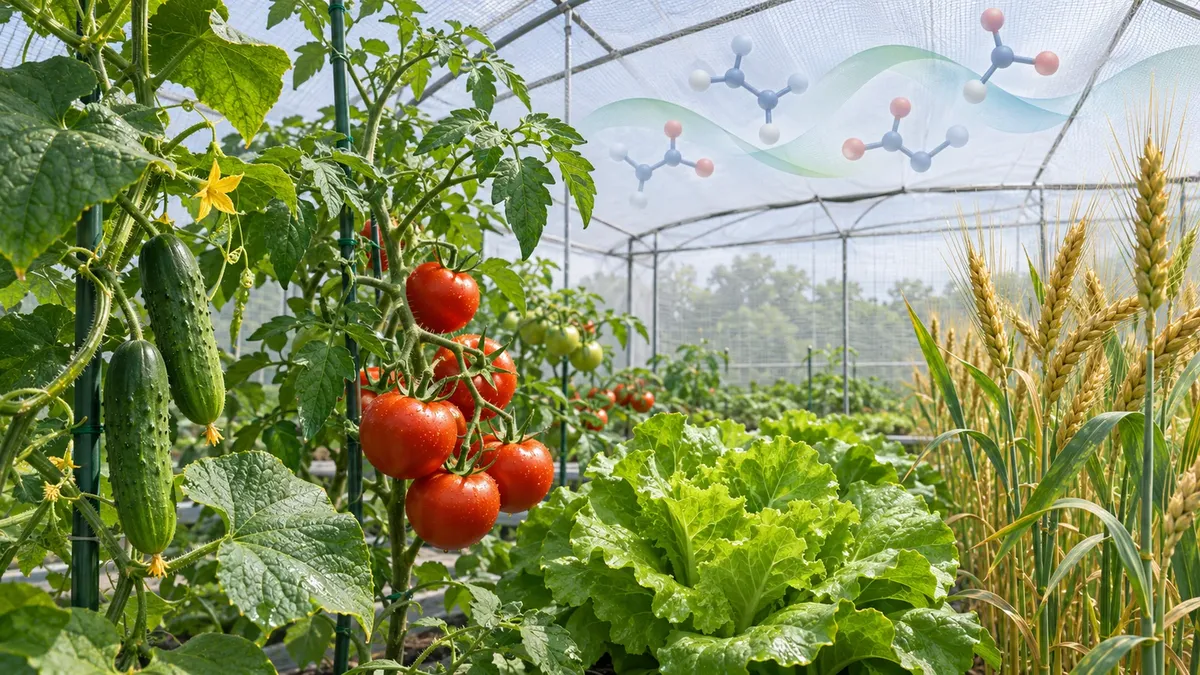
L-phenylalanine is an amino acid plants use as a precursor to compounds including flavonoids and lignin. A bioRxiv study reports that applying it to cucumber, tomato, lettuce and wheat was associated with larger plants and, in some crops, more or heavier produce—even without deliberate pathogen stress.
A familiar molecule, a different role
L-phenylalanine is an amino acid plants use to make secondary metabolites, including flavonoids and lignins involved in plant functions such as defence. Researchers asked whether applying it externally could also stimulate growth, rather than simply supply nutrients. They tested cucumber, tomato and lettuce, which are dicots, and wheat, a monocot. These broad botanical groups differ in features including the number of seed leaves.
The experiments took place in net houses in Israel under conditions the researchers describe as commercial-like. Plants received regular, complete NPK fertigation—a supply of nitrogen, phosphorus and potassium. The team applied phenylalanine solutions at different concentrations, either as a leaf spray or a drench around the roots. Treatment schedules and measurement periods varied by crop and experiment. Groups generally had five to ten biological replicates, and experiments were repeated.
What the experiments reported
The researchers observed growth responses across all four crops, although the measured traits differed. In cucumber and tomato, treated plants showed increases in measures such as height, node number and leaf area. In some experiments, plants also produced more flowers or set fruits, and total fruit number or weight increased. The paper reports at least 30% greater fruit yield per plant in certain cucumber and tomato comparisons. These are results from specific trials, not a forecast of what growers should expect in other settings.
In lettuce, the reported response was increased leaf area. In wheat, some treatments were associated with more tillers or spikes and greater fresh or dry plant biomass. The outcomes thus include both vegetative growth—leaves and stems—and reproductive measures such as fruit or spike production. The study does not show that every trait improved in every experiment or with every treatment.
Both application routes produced positive responses in the authors’ account, but the concentration pattern was not uniform across all results. The paper argues that growth enhancement generally required concentrations of at least 4 millimolar (mM). It also reports that applying 2 mM twice weekly did not match the gains from 4 mM once weekly in particular cucumber and tomato tests. However, some individual tomato results at lower concentrations were significant. The findings suggest concentration-sensitive responses, not a universal rule that lower doses never work.
Nutrition or stimulation?
Because phenylalanine contains nitrogen and carbon, it might contribute nutrients. The authors argue that this is unlikely to explain the observed growth: plants already received frequent, nutrient-rich fertigation, while the phenylalanine applications were relatively small. This supports their interpretation that the amino acid may act through physiological or metabolic stimulation rather than simply as fertilizer. The study did not directly identify the biological pathway, however. Proposed explanations, including changes in plant metabolism or interactions around the roots, remain hypotheses rather than demonstrated mechanisms.
What remains uncertain
These results come from net-house experiments, not a broad set of outdoor field trials. The work used particular crop varieties, growing media, treatment schedules and nutrient conditions; effects may differ with other varieties, soils, climates or farm practices. The experiments also had modest sample sizes and varied in design. The findings are a research lead, not proof that phenylalanine will reliably raise yields across commercial agriculture.
This report is based on a bioRxiv preprint, a manuscript posted before peer review. Independent evaluation may identify limitations or change how the results are interpreted. The study does not establish whether the treatments are cost-effective, how they perform at farm scale, or whether any yield gains persist across seasons. Further replicated field research and direct tests of the proposed mechanisms would help clarify how general and practical the effect is.
- L-phenylalanine
- plant growth
- crop yield
- biostimulants
- cucumber
- tomato
- wheat
- lettuce
Related reading
Automatically matched by shared topic keywords. These links do not imply that the sources agree or establish a consensus.
Which parts of wheat growth stay consistent across environments?
Source published
Shared keywords: plant growth
An orchid fertilizer trial finds a trade-off between yield and plant chemistry
Source published
Shared keywords: crop yield
How salt may slow plant growth at the cell wall
Source published
Shared keywords: plant growth
More leaves or more vitamin C? A fertiliser trial in Cameroonian nightshade
Source published
Shared keywords: crop yield
How a moss keeps its leaf-like organs flat
Source published
Shared keywords: plant growth