TRANSMISSION // 2026.11.16.766386v1
How Arabidopsis balances heat and hunger
Source published
In Arabidopsis, heat and low phosphate trigger distinct responses in roots and shoots. A preprint points to jasmonate signaling as one part of how plants balance acclimation and growth.
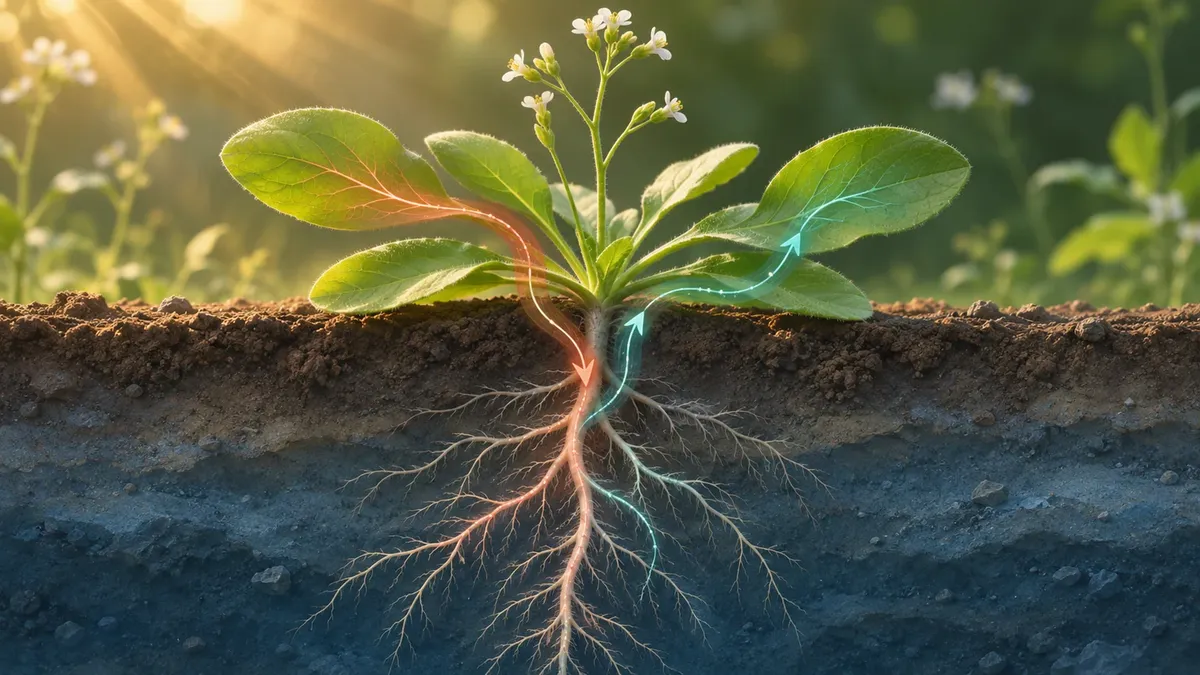
Plants do not experience heat and nutrient shortage as isolated problems. Experiments in Arabidopsis suggest that the jasmonate hormone pathway helps coordinate responses when hot shoots and phosphate-starved roots face stress at the same time.
A plant’s roots and shoots can face different challenges at once. During hot weather, leaves may be exposed to high temperatures while the surrounding soil stays cooler. At the same time, roots may struggle to find phosphate, a nutrient plants need for growth and energy use. How does a plant coordinate these separate stresses—and does its response to both differ from what happens under either one alone?
A bioRxiv preprint by Victoria Baca-González and colleagues investigates that question in Arabidopsis thaliana, a widely used plant research model. The team focused on jasmonates: plant hormones involved in stress responses and growth regulation. Their results suggest that jasmonate signaling helps shape the response to combined heat and phosphate shortage, but that its role differs between roots and shoots.
Recreating a warm shoot and cooler roots
The researchers compared plants under adequate or low phosphate, with and without elevated temperature. To better represent conditions in soil, they used a device that created a temperature gradient along the root zone. In one setup, shoots were exposed to 32°C while roots experienced temperatures ranging from 32°C at the top of the growth area to 24°C lower down. Other experiments compared this gradient with more uniform temperatures.
They measured minerals and plant hormones separately in roots and shoots, and analyzed gene activity in both organs. To test whether jasmonate signaling mattered, they also studied two mutant lines: jar1-1, which has reduced production of the active jasmonate JA-Ile, and jazQ, in which jasmonate signaling is constitutively released from repression. The researchers assessed growth both on laboratory plates and in soil.
The distinction between a temperature gradient and uniform heating mattered. Uniformly heating roots and shoots to 32°C strongly inhibited root growth. With warm shoots and a cooler root zone, roots grew more like those of plants kept under the milder gradient. The authors also report that phosphate levels in shoots were better maintained when roots were not uniformly heated. This highlights a limitation of treating air temperature as a stand-in for what roots experience.
A combined stress is not simply two stresses added together
The combined treatment produced mineral, hormone and gene-expression patterns that differed from those seen under heat or low phosphate alone. In shoots, the combination altered levels of several elements; in roots, it produced a distinct mineral profile. The gene-expression analysis likewise identified responses specific to the combination, rather than just a simple overlap of the individual-stress responses.
Jasmonates showed a particularly clear difference between organs. Under combined stress, JA-Ile increased in roots, while jasmonic acid (JA) declined in shoots. The jar1-1 and jazQ mutants also showed altered gene-expression, growth and leaf-temperature responses. Together, these observations support a role for jasmonate signaling in coordinating the plant’s response. They do not show that one jasmonate level is universally beneficial: the authors’ interpretation is that the pathway needs to be appropriately regulated, and that its effects depend on the organ and conditions.
The growth results also depended on the growing environment. For example, jar1-1 produced more shoot biomass than wild type in some laboratory conditions but less in soil under control conditions. The authors caution that a smaller percentage loss under stress can be misleading when a plant starts from a lower baseline. Mutant comparisons therefore do not establish a straightforward ranking of which jasmonate state is best.
What the results can—and cannot—tell us
These experiments provide evidence that heat and phosphate shortage interact in Arabidopsis, and that jasmonate signaling is associated with changes in gene activity and growth under that combination. But the proposed model—that rising jasmonate activity in roots and falling JA in shoots help connect nutrient and temperature signals—still needs direct testing. The authors specifically call for experiments manipulating jasmonates in particular organs and measuring processes such as transpiration and stomatal conductance to clarify the leaf-temperature results.
The work was conducted in one plant species, with controlled growth systems and a limited set of mutant lines. Findings in Arabidopsis do not establish how crops will respond in fields, where soils, weather, microbes and other stresses vary. The paper is a bioRxiv preprint and had not been certified by peer review when posted. Its conclusions should therefore be treated as provisional, not as established guidance for crop management.
- Arabidopsis
- jasmonate
- heat stress
- phosphate starvation
- plant hormones
- plant growth
Related reading
Automatically matched by shared topic keywords. These links do not imply that the sources agree or establish a consensus.
Inside larger soybean seeds: bigger cells, more oil and altered hormone signals
Source published
Shared keywords: plant hormones
How water stress reshapes seed germination signals
Source published
Shared keywords: plant hormones
An RNA quality-control pathway has opposing roles in plant heat recovery
Source published
Shared keywords: heat stress
How salt may slow plant growth at the cell wall
Source published
Shared keywords: plant growth
C4 leaf cells show distinct chloroplast-to-nucleus signalling
Source published
Shared keywords: heat stress