TRANSMISSION // 2026.11.15.766785v1
A maize photosynthesis mutation raises grain biomass in field trials
Source published
Reducing activity of a secondary photosynthetic enzyme altered leaf metabolism and was associated with greater grain biomass in maize field trials under both low and ample nitrogen. The mechanism behind the yield difference remains unresolved.
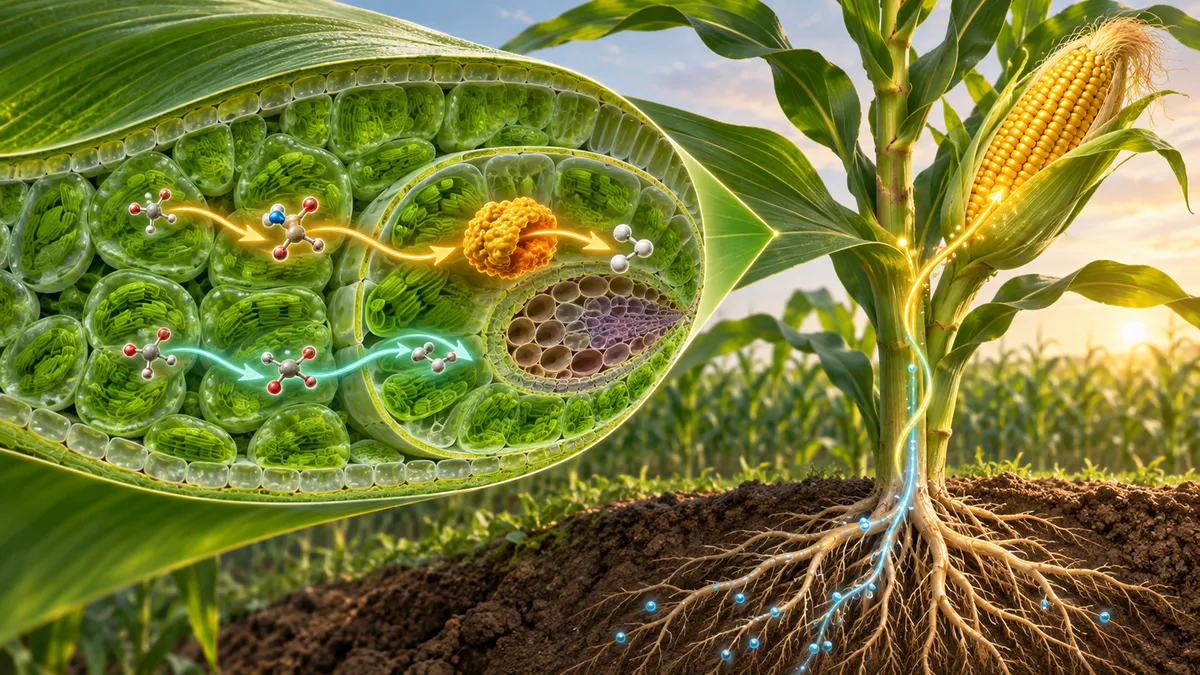
Maize mainly uses one route to concentrate carbon for photosynthesis, but researchers have long suspected it also uses a second route involving the enzyme PEPCK. A preprint tests that idea genetically—and reports an unexpected field result: maize plants with reduced PEPCK1 activity produced more grain biomass, even though measured leaf photosynthesis did not increase.
The question: does maize use a second carbon route?
Maize is a C4 plant: it first captures carbon dioxide into small molecules, then moves those molecules between leaf cells to concentrate carbon around the machinery that builds sugars. Most carbon in maize is thought to travel through a route involving the enzyme NADP-malic enzyme. A second route, involving phosphoenolpyruvate carboxykinase (PEPCK), has also been proposed. Earlier biochemical work suggested it operates, but genetic evidence in maize was lacking.
The distinction matters because these routes handle both carbon and, in the case of the PEPCK route, nitrogen-containing molecules. The researchers asked what would happen if they reduced the activity of PEPCK1, the main C4 form of the enzyme, and whether the effects would depend on nitrogen supply.
Mutant plants, metabolic tests and field trials
The team used a mobile DNA element, called Ds, to create two maize lines with insertions in the PEPCK1 gene. The insertions reduced gene activity, with one line showing a stronger reduction than the other. The plants were compared with W22, the inbred line used to generate them, making it possible to test the mutations in a closely matched genetic background.
To examine the pathway, researchers measured enzyme activity and the amounts of metabolites in leaves. They also supplied plants with carbon dioxide containing the heavier carbon isotope, carbon-13, and tracked how quickly the label appeared in molecules including aspartate and malate. These short-timescale measurements help reveal which carbon routes are active. Separate measurements assessed leaf photosynthesis, plant growth and grain production.
Field trials in Illinois compared plants receiving no added nitrogen with plants receiving nitrogen fertilizer. The paper reports trials across multiple growing seasons, from 2016 to 2022. Greenhouse experiments provided additional measurements under controlled conditions.
What changed—and what did not
In the more strongly affected mutant, aspartate accumulated in leaves, while alanine and pyruvate were lower. Carbon-isotope labeling also showed altered aspartate labeling, while malate labeling changed little. Together, these results support the idea that PEPCK1 helps process carbon carried as aspartate: reducing its activity disrupts that route. The findings provide genetic support for maize using both a dominant NADP-malic-enzyme route and a secondary PEPCK route.
In the field, both mutant lines produced more grain biomass than W22 under both nitrogen treatments. The stronger mutant also had greater stover biomass across nitrogen treatments, while cob biomass was significantly higher under ample nitrogen. Mutant plants accumulated more total nitrogen and more nitrogen in grain. However, the study did not find that total biomass production per unit of nitrogen increased in either mutant. The stronger mutant did show an increase in the study’s measure of nitrogen utilization: grain biomass divided by total plant nitrogen.
A striking qualification is that the grain increase was not accompanied by higher measured leaf photosynthetic rates or parameters. The authors suggest that reduced PEPCK activity may affect nitrogen use or carbon allocation, but the experiments do not establish why the mutants produced more grain. The study also did not find a significant difference in PEPCK activity in developing kernels, leaving that possible explanation unresolved.
What the results can—and cannot—tell us
The field results make this more than a laboratory observation, but they are not yet evidence that changing PEPCK1 will reliably raise yields in commercial maize. The work tests two transposon-derived mutations in the W22 background at one Illinois field site, not a range of modern hybrids and environments. And although results appeared under both nitrogen treatments, the study does not show that the mutants could replace fertilizer or reduce the amount needed for a given harvest.
The paper is a bioRxiv preprint and is explicitly marked as not certified by peer review. Its findings should therefore be treated as provisional. Further work would need to test the effect across diverse maize varieties and growing conditions, and clarify how a change in leaf metabolism translates into greater grain biomass without a detected rise in photosynthesis. For now, the study offers genetic evidence that PEPCK1 participates in maize’s secondary C4 pathway—and an intriguing, still-unexplained link between reducing that pathway and grain production.
- maize
- C4 photosynthesis
- PEPCK1
- nitrogen use
- crop biomass
- preprint
Related reading
Automatically matched by shared topic keywords. These links do not imply that the sources agree or establish a consensus.