TRANSMISSION // 2026.11.14.766679v1
How salt may slow plant growth at the cell wall
Source published
Experiments suggest salt can reversibly inhibit expansin, a wall-loosening protein, offering a possible direct link between salinity and slower plant-cell expansion.
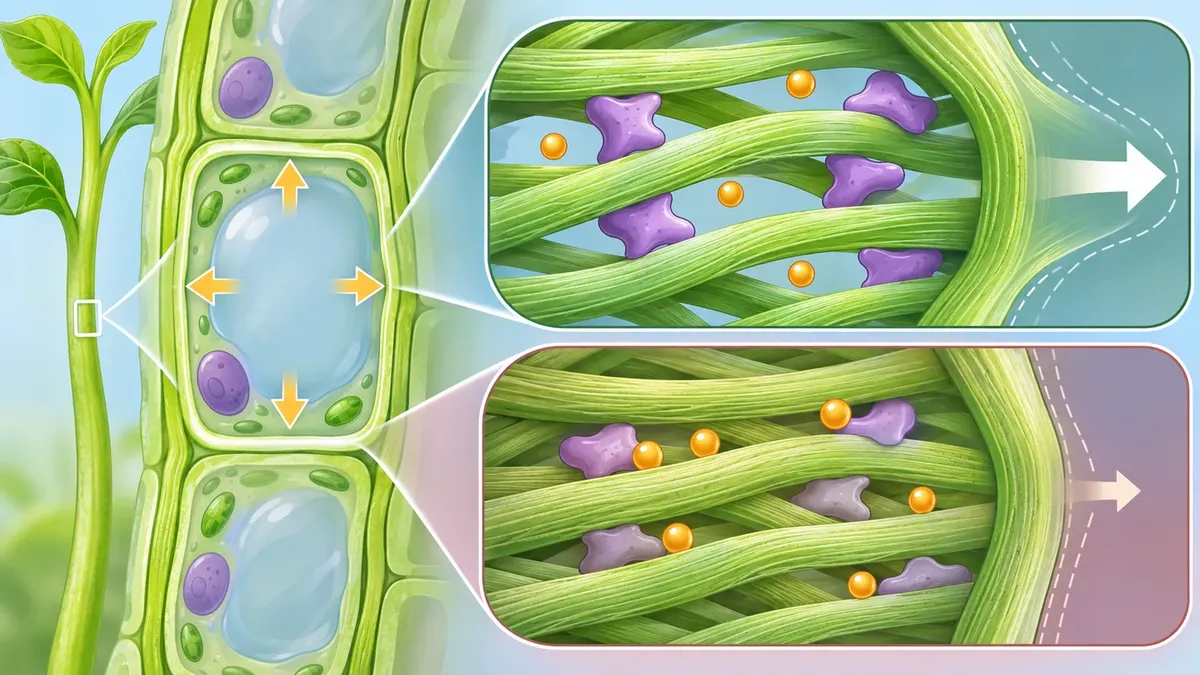
Plant cells grow as internal pressure pushes their walls outward. A bioRxiv preprint reports that salt can rapidly and reversibly reduce wall extension in several experiments, while measured tensile stiffness changed little under the conditions tested. The authors suggest salt may inhibit expansin, a protein that helps walls loosen; their proposed molecular explanation is supported by simulations, not direct observation in living plants.
Salt can make it harder for plants to grow, but its immediate effects on growing cells are difficult to disentangle. Salt can affect the cell wall, reduce the pressure pushing against it, and trigger cellular responses that later alter wall construction. Which effects can act directly on wall extension?
A bioRxiv preprint by Ke Zhou and Daniel J. Cosgrove investigates one possibility: salt inhibits expansins, proteins that help plant cell walls yield and extend. The findings suggest expansin activity could provide a fast, reversible link between salty conditions and slower cell growth. The preprint has not been peer reviewed.
Separating wall mechanics from cell responses
Plant cells expand when internal pressure, called turgor, pushes against a wall that can stretch. Expansins promote this stretching, or “creep,” particularly in an acidic environment. To examine salt’s direct effects, the researchers tested isolated, freeze-thawed plant tissues, which lack normal cell contents and turgor. They applied a controlled pulling force and measured how the walls extended in different solutions.
In cucumber hypocotyls—the young stems of seedlings—salt caused a small, reversible change in length. It did not produce the sustained extension seen in acidic conditions. Under the tested conditions, measurements found no significant change in apparent tensile stiffness along the growth axis. Stiffness under pulling and the ability to undergo acid-induced extension are distinct properties; this result does not determine how much stiffness changes contribute to growth in other settings.
The researchers then added salt while isolated walls were undergoing acid-induced creep. Sodium chloride (NaCl) slowed extension in a concentration-dependent way, and removing the salt restored it. Other salts with singly charged ions produced broadly similar effects; salts with doubly charged ions caused stronger inhibition that was often less reversible. These comparisons are consistent with a role for electrical interactions, but do not by themselves identify a single molecular target.
Testing expansin’s role
Several experiments support the idea that salt acts on wall-loosening activity. The team restored acid-induced extension in heat-treated cucumber walls using proteins extracted from the walls. Salt inhibited this restored response, which recovered after washout. In a separate test, the extract promoted extension and eventual failure of cellulose filter paper under load; adding NaCl suppressed the extension. Because the extract was not a purified single protein, these tests support expansin involvement without isolating every component of the response.
The researchers also tested maize coleoptile walls, a different plant tissue, and found that salt suppressed acid-induced extension there too. In living Arabidopsis seedlings, NaCl temporarily reduced hypocotyl elongation while the surrounding solution was kept acidic. A mannitol treatment designed to impose comparable osmotic stress had little effect in that assay. This supports a rapid effect beyond reduced water pressure alone, but does not show that all salt-related growth effects in intact plants operate this way.
A molecular explanation, with caveats
Molecular-dynamics simulations focused on CsEXPA1, an expansin from cucumber. They suggested that sodium ions may disrupt interactions among three amino-acid residues near the protein’s proposed active site, including an aspartate. The simulations also suggested that sodium can associate with that aspartate under some modeled conditions. The authors propose that these changes interfere with expansin’s wall-loosening activity.
That mechanism remains a hypothesis, not a direct observation of ions binding to expansin inside a living plant. The simulations use a predicted protein structure and depend on modeling assumptions. The experiments cover selected tissues, short-term treatments and controlled solutions; they do not establish how much this mechanism contributes to long-term salt tolerance, crop performance, or the responses of salt-adapted plants.
The study highlights a useful distinction: a wall can show little change in measured axial stiffness while its ability to extend under expansin activity is reduced. The results suggest that salt may inhibit growth not only through water stress or longer-term signaling, but also through a rapid physicochemical effect on wall loosening. Directly testing the proposed molecular mechanism, and examining it across more plant species and conditions, will be important next steps.
This article is based on a bioRxiv preprint posted November 16, 2026. Preprints have not necessarily undergone peer review, and conclusions may change as the work is evaluated or replicated. This account draws on the available manuscript text and figures; extracted source text can lose details of layout and supplementary material.
- plant growth
- salinity
- expansin
- cell wall
- Arabidopsis
- preprint
Reviewed cross-references
These connections were reviewed by a model, not independently fact-checked by a human. Similarity does not imply agreement; consult the original papers and the evidence below.
Birch gene activity reveals contrasting responses to salt
Supporting evidence: The expansin preprint reports that NaCl reversibly inhibited acid-induced wall creep in experimental wall systems and Arabidopsis hypocotyls; the birch preprint reports salt-responsive gene-expression changes enriched for cell-wall organization or biogenesis. Together they support the bounded point that salinity can affect plant cell-wall processes, but the studies examine different species, outcomes and mechanisms, so the birch expression results do not establish expansin-mediated inhibition.
Model review: · openai-codex/gpt-6-luna
Evidence and provenance
Selected excerpts, not complete papers. PDF extraction can omit figures or damage equations, tables and reading order; sources may be preprints.
2026.11.14.766679v1 — Original paper
Excerpt reference:
static/papers/2026.11.14.766679v1.md:218-265
Basis: Paper text
Source SHA-256:de70cb3d18ce5ceb704297dc1669670e4b405e9ef383a6daea68803ac998c80e2026.10.29.762967v1 — Original paper
Excerpt reference:
static/papers/2026.10.29.762967v1.md:1277-1374
Basis: Paper text
Source SHA-256:1aa2c5a2f8e1fe020696b6300dce811aa2ba7f8e2fe6e58eb5951cc38492c47b
Related reading
Automatically matched by shared topic keywords. These links do not imply that the sources agree or establish a consensus.
Birch gene activity reveals contrasting responses to salt
Source published
Shared keywords: cell wall
How a moss keeps its leaf-like organs flat
Source published
Shared keywords: plant growth
Mapping leafy biomass for Rubisco recovery
Source published
Shared keywords: cell wall
Which parts of wheat growth stay consistent across environments?
Source published
Shared keywords: plant growth