TRANSMISSION // 2026.11.14.766623v1
Potato Heat Responses Differ Across Haplotypes
Source published
A preprint uses long-read sequencing to examine potato leaves under prolonged heat, identifying mostly shared responses alongside candidate allele-specific activity and a chaperone isoform with a distinct cellular location.
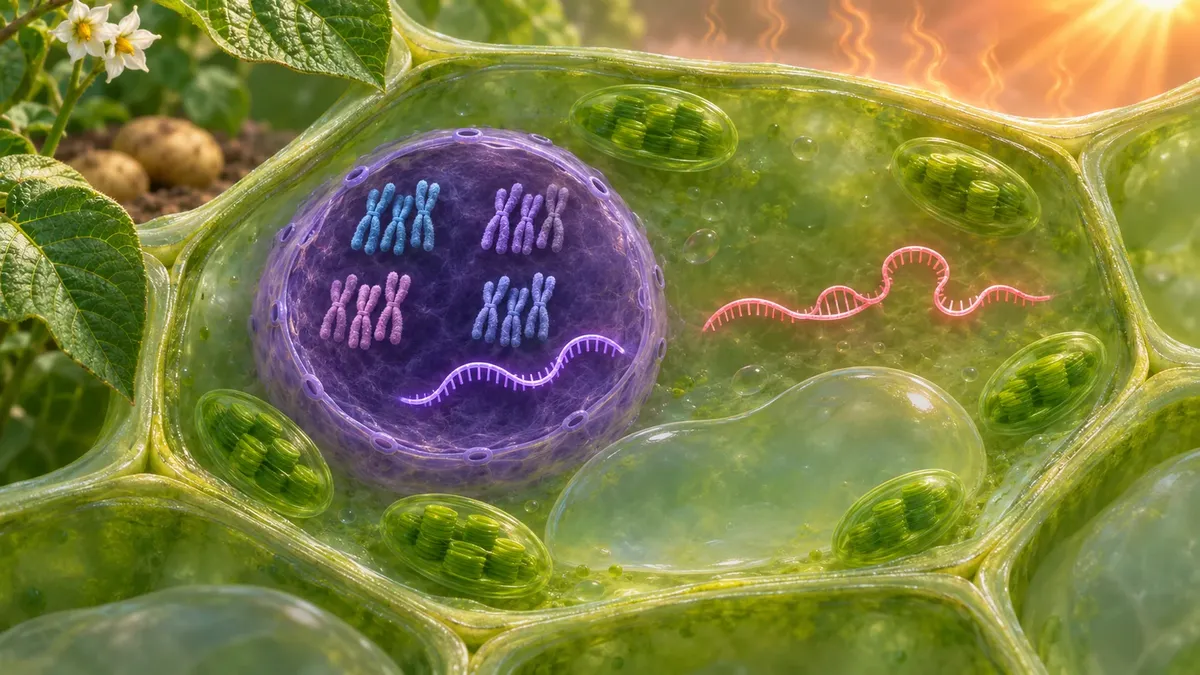
Potato has four chromosome sets, but that does not mean every gene has four distinguishable copies. A bioRxiv preprint uses long-read RNA sequencing to examine how versions of genes and RNA isoforms respond to prolonged heat in one potato cultivar.
Looking closer at potato’s heat response
Cultivated potato is tetraploid, with four chromosome sets. The versions of genes across these sets can differ, but the number of distinguishable versions need not be the same for every gene. This study asks whether tracking gene versions and RNA isoforms can reveal details of how potato leaves respond to prolonged heat.
The researchers used long-read RNA sequencing on leaves of potato cultivar Désirée under control conditions and after prolonged heat. Long reads can capture more of an RNA molecule, helping researchers distinguish transcripts associated with different haplotypes—the chromosome versions in a plant—and identify RNA isoforms, alternative forms made from the same gene. The abstract reports that gene-level counts from long-read sequencing correlated with short-read counts, while long reads assigned more reads uniquely to individual haplotypes.
Shared responses, with exceptions
Under control conditions, differences in activity among alleles were widespread. After prolonged heat, most alleles responded in the same way across haplotypes. Some exceptions showed distinctive responses, which the authors describe as candidates for further study—not as proven contributors to heat tolerance.
One candidate was a heat-inducible allele of a gene related to redox homeostasis, the processes that regulate oxidation and reduction in cells. The researchers report confirming allele-specific promoter activity in planta. This supports a difference in how the gene’s regulatory sequence behaves, but does not show that the allele improves heat survival or crop performance.
Heat stress also induced alternative isoform usage in 390 genes. Among them, the authors identified an upregulated isoform of a heat shock protein 40 chaperone gene. Chaperones help other proteins fold or remain stable. The highlighted isoform was found in the nucleus, whereas its alternative isoform was found in the cytoplasm. The abstract does not establish what the difference in location means for the plant’s response.
What remains uncertain
The findings suggest that haplotype-resolved long-read sequencing can help researchers identify allele-specific activity and changes in RNA isoforms. The authors propose that this approach could aid the search for alleles relevant to stress-tolerance breeding. The candidates still require further testing; the abstract does not establish that they confer heat tolerance.
The available source here is the abstract, so it does not provide details needed to assess the full experimental design, including sample sizes and heat conditions. It also does not establish how broadly the findings apply beyond this cultivar. The study is a bioRxiv preprint, which has not been certified by peer review; its claims may change with further scrutiny. The results offer a more detailed view of gene activity under heat, rather than proof of a breeding-ready solution.
- potato
- heat stress
- long-read RNA sequencing
- haplotypes
- allele-specific activity
- RNA isoforms
- plant breeding
Reviewed cross-references
These connections were reviewed by a model, not independently fact-checked by a human. Similarity does not imply agreement; consult the original papers and the evidence below.
How potato plants remember combined heat and drought
Supporting evidence: Both preprints report chaperone-related responses in potato under heat-involving conditions: the Désirée study identifies a heat-upregulated HSP40 isoform that localizes to the nucleus, while the combined-stress study reports stronger chaperone induction under heat–drought than under drought. This supports the bounded connection that chaperone responses occur in these heat-related treatments, not that the same chaperones, mechanism, or outcome are involved; the treatments and experiments differ.
Model review: · openai-codex/gpt-6-luna
Evidence and provenance
Selected excerpts, not complete papers. PDF extraction can omit figures or damage equations, tables and reading order; sources may be preprints.
2026.11.14.766623v1 — Original paper
Excerpt reference:
static/papers/2026.11.14.766623v1.md:18-120
Basis: Paper text
Source SHA-256:46a6f5a08fb1c32b74f35aeabd8191eb13a1dac5cf85aa7c4434d3143fdf59782026.11.11.765576v1 — Original paper
Excerpt reference:
static/papers/2026.11.11.765576v1.md:476-530
Basis: Paper text
Source SHA-256:2615dc3d335e973a1a84d40cebdeb47ad099640d658dd96643cf59102a3279d6
Related reading
Automatically matched by shared topic keywords. These links do not imply that the sources agree or establish a consensus.
Rice seedlings may prepare for heat by responding more selectively
Source published
Shared keywords: heat stress
One liverwort regulator, two distinct roles
Source published
Shared keywords: heat stress
An RNA quality-control pathway has opposing roles in plant heat recovery
Source published
Shared keywords: heat stress
C4 leaf cells show distinct chloroplast-to-nucleus signalling
Source published
Shared keywords: heat stress
Can cacao DNA help find resistance to black pod rot?
Source published
Shared keywords: plant breeding