TRANSMISSION // 2026.11.13.766439v1
How flower-feeding insects reshape tansy chemistry
Source published
A greenhouse study found selective chemical changes in common tansy flowers and leaves after beetle or aphid feeding. Responses varied with insect type and plant chemotype, while overall profiles remained largely stable.
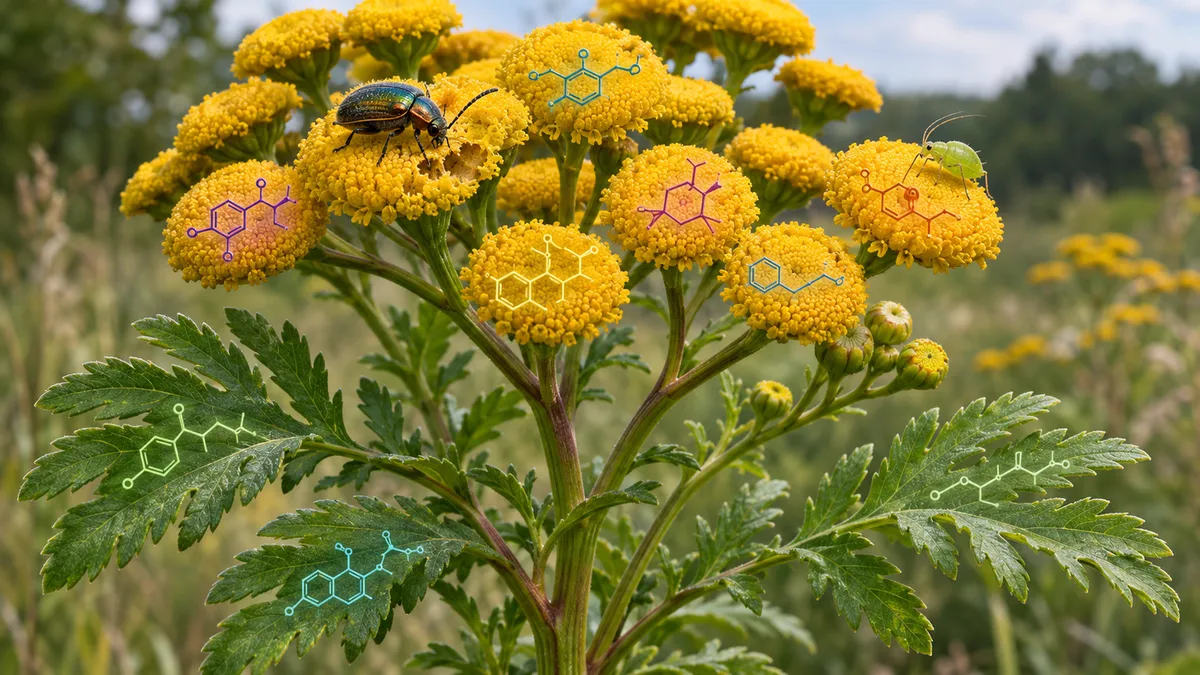
Flowers are both reproductive structures and food for insects. A study of common tansy asks how two kinds of flower-feeding insects alter plant chemistry—and whether the effects depend on the plant’s existing chemical profile.
A flower under attack does not necessarily change its entire chemical signature. In a bioRxiv preprint, researchers report that common tansy (Tanacetum vulgare) mostly maintained its overall chemical profiles after flower-feeding insects arrived, while particular compounds shifted in flowers and leaves. Which compounds changed depended on both the insect and the plant’s chemotype: a category based on its characteristic chemical profile.
The question matters because flowers face competing demands. They support reproduction and may attract pollinators, but can also be eaten or tapped for nutrients. Plants can respond to damage by altering specialised metabolites—chemicals involved in interactions with other organisms. Yet floral responses, effects elsewhere in the plant, and variation among individuals of the same species are less studied than leaf responses to herbivores.
Comparing insects, plant types and tissues
The team studied five tansy chemotypes with different terpene profiles. They made clonal copies of plants and assigned copies to one of three conditions: flower-head feeding by Olibrus beetles, feeding by Macrosiphoniella tanacetaria aphids, or no insects. Beetles chew flower tissues; aphids feed on sap. The insects were kept on flower heads for four days, at densities the researchers describe as reflecting natural levels. The team then examined flower heads and leaves, allowing them to look for local responses and chemical changes in another plant organ.
Three analytical approaches captured different parts of the chemical picture. Gas chromatography–mass spectrometry measured emitted floral volatile compounds and stored terpenes. Liquid chromatography–mass spectrometry produced broader metabolic fingerprints, detecting many chemical features without identifying every one as a specific compound.
The study did not have equal numbers of successfully sampled plants in every chemotype. The researchers report four successfully sampled triples—sets of clonal plants assigned across treatments—for each of two chemotypes, and up to nine for another. Some plants did not flower. These smaller, uneven samples matter when interpreting differences among plant types.
Selective shifts, not a wholesale chemical overhaul
Overall profiles of flower volatiles and stored terpenes did not clearly separate by insect treatment. Broad metabolic fingerprints showed detectable but not strong treatment separation in flower heads, and weak separation in leaves. Still, individual chemicals changed in abundance. The researchers found responses in both flower heads and leaves, and changes were often specific to a particular insect, chemotype and organ.
Among the measured volatiles, 30 were reported as responsive to florivory, with most changes specific to a chemotype and insect. Stored terpenes also shifted: the study identified 20 responsive terpenes in flower heads and 12 in leaves. Many were minor compounds. The dominant terpene artemisia ketone decreased in the flower heads of one chemotype after aphid feeding and increased in another after either insect treatment. These contrasting outcomes illustrate why a result from one tansy chemical type may not describe another.
The broad metabolic fingerprints showed a similar pattern of specificity. When the researchers analysed chemotypes separately, they identified many more responsive features than in analyses pooling them together. Most of these features were not identified as particular molecules. Of the responsive features, 15 received compound-level annotations; many were linked to the shikimate and phenylpropanoid pathways, which include phenolics and flavonoids. These pathways are associated with plant chemical interactions, but the experiment did not test what the chemical changes do to insects or pollinators.
What the findings can—and cannot—say
The results suggest that flower feeding is associated with selective, organ-specific chemical responses, rather than a uniform switch in the plant’s chemistry. Chemical changes in leaves were observed after flower-head infestation, but the study did not establish how those changes arose. Nor does detecting a shift show that it deters insects, attracts natural enemies, changes pollination, or benefits the plant. The authors identify ecological consequences under natural conditions as questions for future work.
Statistical choices add another reason for care. For the volatile and untargeted fingerprint analyses, very few or only one feature remained significant after correction for multiple testing. The researchers therefore also reported features meeting unadjusted significance and fold-change thresholds. Those results can help identify patterns to investigate, but should not be treated as definitive evidence for every reported feature—particularly given the small samples in some chemotypes.
The experiment took place under controlled conditions and focused on one plant species, two insect types and a short feeding period. Volatile samples could include compounds released by the insects as well as by the flowers. The paper is a bioRxiv preprint and has not been certified by peer review; its authors say chemical data, metadata and code will be made available upon acceptance. The findings are best read as evidence of possible chemical responses in this experiment, not a final account of how tansy behaves in the field.
- plant chemistry
- florivory
- common tansy
- chemotypes
- metabolomics
- plant-insect interactions