TRANSMISSION // 2026.11.13.766425v1
How two genes shape protoxylem development
Source published
A single-cell atlas and experiments in Arabidopsis point to ZHD3 and ZHD4 as regulators of protoxylem development—and show why wall pattern alone may not define a cell’s identity.
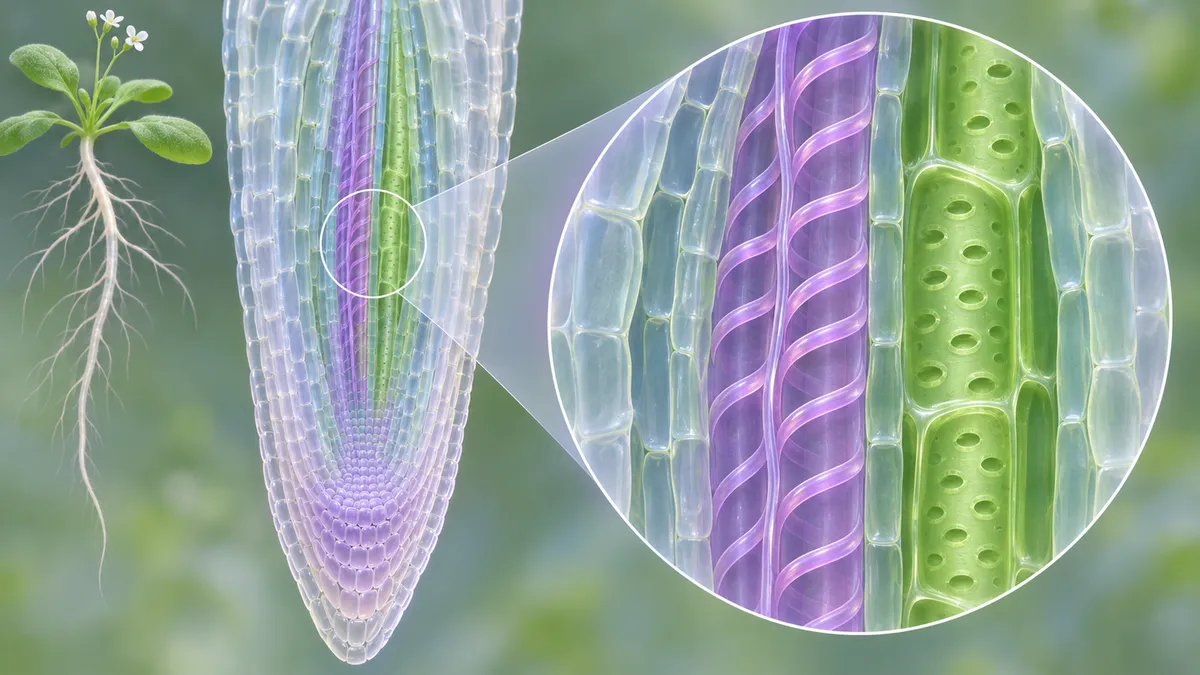
Xylem cells become water-conducting tubes with distinctive reinforced walls. In Arabidopsis roots, researchers identify two transcription factors that help steer one xylem type toward its characteristic wall pattern, while finding that appearance does not necessarily tell the whole story of cell identity.
Xylem is the plant tissue that carries water and minerals through roots and shoots. As xylem cells mature, they build strong secondary cell walls and then undergo programmed cell death, leaving hollow conduits. In Arabidopsis roots, two xylem types are distinguished in part by their wall patterns: protoxylem has helical bands, while metaxylem has a pitted pattern.
Scientists know many regulators of later xylem differentiation, but the earlier steps that help establish different developmental paths are less clear. A new bioRxiv preprint investigates this gap, focusing on developing xylem in the primary root of Arabidopsis thaliana.
A closer look at developing xylem
Xylem cells are relatively rare in root tissue, making them difficult to study in standard single-cell surveys. The researchers used fluorescent reporter lines to identify and enrich xylem cells before sequencing their RNA one cell at a time. The resulting atlas included 27,185 cells. They assigned cells to developmental groups using known marker genes, then checked those assignments with 23 additional reporter lines.
The atlas captured distinct gene-expression profiles across protoxylem and metaxylem lineages. It also suggested that inner and outer metaxylem—despite their similar wall appearance—have different transcriptional profiles. The team used a computational method to infer gene-regulatory networks from these data, recovering many known xylem regulators. That provided a check on the approach before the researchers examined less-studied candidates.
Two candidates stood out: the transcription factors ZHD3 and ZHD4. Reporter experiments supported the prediction that both are expressed specifically in protoxylem, with ZHD4 appearing earlier during development. When the researchers reduced either gene’s activity using CRISPR-based mutations, they observed abnormalities in mature xylem, including gaps in the xylem strands. These results support a role for both genes in normal protoxylem development.
Wall pattern is not the whole identity
The team next tested what happened when ZHD3 or ZHD4 was switched on in a broader set of xylem cells. In metaxylem positions, cells began forming helical, protoxylem-like wall bands. This did not happen when the genes were activated in pericycle cells outside the xylem axis, suggesting that the effect depends on cells already developing along a xylem path.
But the altered cells did not simply become typical protoxylem. Their wall features differed from those of normal protoxylem, and they retained some metaxylem-associated gene expression. The researchers therefore interpret the result as activation of part of the protoxylem differentiation program, rather than a complete change in cell identity. The finding highlights a distinction between a cell’s visible structure and its broader developmental state.
To investigate the underlying program, the researchers induced ZHD4 and measured gene expression over time. Genes associated with multiple stages of xylem development increased, including genes linked to the known regulator VND7, wall construction, and programmed cell death. The results are consistent with ZHD4 helping activate a wider differentiation pathway. They do not, by themselves, establish exactly which genes ZHD4 binds directly or how it acts at the molecular level.
The experiments also have boundaries. The atlas is based on Arabidopsis primary roots, and the authors note that their cell-isolation approach did not capture the final stages of metaxylem differentiation. Induced gene expression tests what a regulator can do under the experimental conditions; it may not reproduce the timing or strength of its normal activity. The mutant defects support a requirement for ZHD3 and ZHD4 in normal development, but the reported observations do not show that these factors alone specify every feature of protoxylem.
Overall, the study proposes ZHD3 and ZHD4 as early regulators that help transmit protoxylem-like characteristics through the xylem differentiation program. It also cautions against assigning cell identity from wall appearance alone: molecular markers and developmental context may be needed to distinguish a true identity change from a partial shift in cell features.
This article describes a bioRxiv preprint posted November 16, 2026, which has not been certified by peer review. The paper says sequencing accessions would be added upon submission. Separately, it says the interactive browser would be made publicly available upon manuscript acceptance; the preprint does not report that either step had occurred.
- xylem
- protoxylem
- Arabidopsis
- ZHD3
- ZHD4
- single-cell RNA sequencing
- plant development
- transcription factors
Reviewed cross-references
These connections were reviewed by a model, not independently fact-checked by a human. Similarity does not imply agreement; consult the original papers and the evidence below.
Two flowering regulators help limit woody tissue in tomato stems
Supporting evidence: Both preprints provide evidence that transcription factors influence xylem development or wall-related programs: in Arabidopsis, ZHD3/4 overexpression induced protoxylem-like secondary-wall patterns in other primary-xylem files; in tomato, FUL2/STM3 loss was associated with changes in candidate NAC and MYB regulators linked to secondary xylem and wall formation. This supports only the bounded point that transcriptional regulators can affect xylem-related programs; the species, developmental contexts, factors, and evidence differ, so it does not establish a shared mechanism. Both are preprints.
Model review: · openai-codex/gpt-6-luna
Evidence and provenance
Selected excerpts, not complete papers. PDF extraction can omit figures or damage equations, tables and reading order; sources may be preprints.
2026.11.13.766425v1 — Original paper
Excerpt reference:
static/papers/2026.11.13.766425v1.md:351-422
Basis: Paper text
Source SHA-256:1a7617c8d3bd5ff34bed21823c8734430d7279ebc1ac6847ad4e6d021265a1612026.11.04.763880v1 — Original paper
Excerpt reference:
static/papers/2026.11.04.763880v1.md:1065-1169
Basis: Paper text
Source SHA-256:2c698a86ca1200759ddd7f8d0da4ecfacdb4547cd6f2fcb6305f830a02cfe00a
Related reading
Automatically matched by shared topic keywords. These links do not imply that the sources agree or establish a consensus.
One liverwort regulator, two distinct roles
Source published
Shared keywords: plant development, transcription factors
A two-scale approach to mapping gene regulation
Source published
Shared keywords: single cell rna sequencing
Why two maize genes share the work of growth
Source published
Shared keywords: plant development
A neighboring cell layer may help rice stems respond to gravity
Source published
Shared keywords: plant development