TRANSMISSION // 2026.11.12.766257v1
Why two maize genes share the work of growth
Source published
Maize plants with mutations in both Cabbage genes develop severe growth and fertility problems, pointing to overlapping roles in brassinosteroid production.
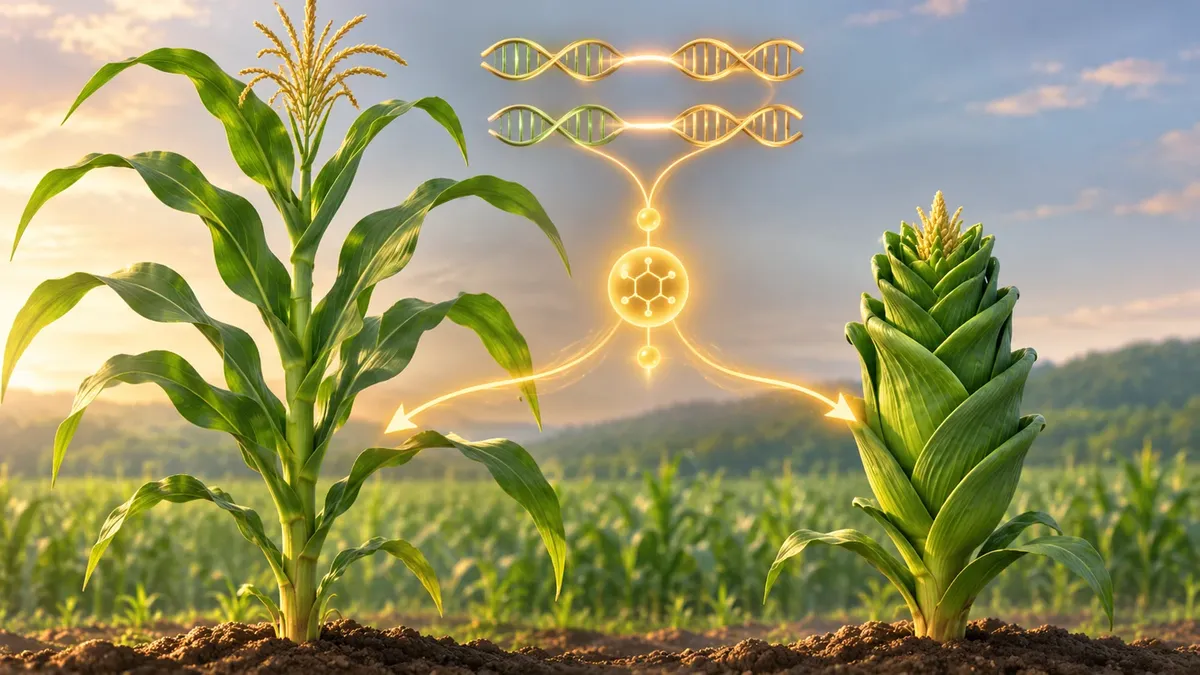
When one of two related maize genes is disrupted, plants appear much like their unaffected siblings. Disrupt both, and growth changes dramatically. A bioRxiv preprint links this contrast to genes involved in making brassinosteroids, hormones that help shape plant development.
Maize has two related genes called Cabbage1 (Cbg1) and Cabbage2 (Cbg2). Both are thought to encode CYP90A proteins, enzymes involved in producing brassinosteroids: plant hormones that help regulate growth and development. The researchers asked whether the genes do similar jobs, and whether one can compensate when the other is disrupted.
The question matters because plant architecture—the height, leaf form and branching of a plant—affects how crops grow. Upright leaves are one trait of interest for planting maize more densely. But this study tested gene function and plant development; it did not test whether changing Cbg1 or Cbg2 improves field yield.
Testing one gene at a time—and both together
The team studied maize plants carrying transposon insertions in Cbg1 or Cbg2. Transposons are DNA sequences that can interrupt a gene. They examined several independent mutant versions of each gene, then crossed plants to produce offspring with mutations in both. The plants were assessed in greenhouse and field conditions, and researchers measured plant features including height, leaf traits and tassel branching.
To investigate the hormone pathway, they measured selected brassinosteroid-related compounds in seedling shoots. They also grew germinating seedlings in darkness with either propiconazole, a chemical inhibitor of brassinosteroid production, or brassinolide, a brassinosteroid. They measured the length of the mesocotyl—the young shoot segment that extends during germination—as well as primary roots.
The combined mutation had the strongest effects
Plants with a mutation in just Cbg1 or just Cbg2 had no obvious developmental differences from their wild-type siblings under the conditions tested. In contrast, plants with mutations in both genes were dwarfed, with compressed stem segments, shorter leaves and more upright leaf angles. Their tassels had fewer branches, and their ears were smaller.
Some double-mutant plants developed tightly twisted leaves that formed a compact, cabbage-like head. This could physically obstruct the emergence of tassels and ears. The researchers reported that the tassels were infertile, with anthers that failed to shed pollen. The results support the idea that the two genes have overlapping roles: when one is disrupted, the other can help maintain development, but disrupting both has much more severe effects.
The chemical measurements fit that interpretation. Two compounds downstream of CYP90A in the brassinosteroid pathway were reduced in mutant plants. In dark-grown seedlings, propiconazole shortened the mesocotyls of wild-type and single-mutant plants, producing a response resembling that of untreated double mutants. Adding brassinolide alone did not restore mesocotyl elongation in the double mutants. Roots responded differently: propiconazole moderately reduced root length, while brassinolide treatment inhibited root elongation across genotypes.
What the evidence does—and does not—show
Taken together, the genetic, chemical and hormone-treatment results are consistent with Cbg1 and Cbg2 contributing to brassinosteroid production and development in maize. They do not establish every biochemical detail of the genes’ roles. The researchers note that they measured selected pathway compounds, not a comprehensive set, and that biologically active brassinosteroids were below the detection limit even in wild-type samples. Why brassinolide did not restore mesocotyl growth also remains unresolved; further measurements and tests with another hormone-related compound are needed.
The work used transposon mutant lines in the W22 maize background, so the findings do not establish that the same visible effects will occur in every genetic background or growing environment. The proposed agricultural relevance is therefore a possibility for future study, not evidence that altering these genes will improve crop performance. Severe double-mutant defects, including loss of male fertility, underline why any effort to tune growth-related genes would need to consider effects beyond plant height or leaf angle.
This research is available as a bioRxiv preprint. It has not been certified by peer review, so its methods and conclusions have not yet undergone that formal evaluation.
- maize
- Cabbage genes
- brassinosteroids
- plant development
- CYP90A
- plant genetics
Related reading
Automatically matched by shared topic keywords. These links do not imply that the sources agree or establish a consensus.
Extra lobes on morning glory leaves point to a more complex genetic story
Source published
Shared keywords: plant genetics
A barley gene changes which parent’s copy is active as grain develops
Source published
Shared keywords: plant genetics
A seed color switch tracks what happens to DNA delivered into plants
Source published
Shared keywords: plant genetics
Genetic study identifies candidate markers for Pakistani wheat variety testing
Source published
Shared keywords: plant genetics
Plant lineages diverge when DNA demethylation is impaired
Source published
Shared keywords: plant genetics