TRANSMISSION // 2026.11.12.766148v1
Rice seedlings may prepare for heat by responding more selectively
Source published
A bioRxiv preprint reports that a mild heat treatment helped young rice seedlings grow better after a later, more severe exposure. The authors link this benefit to a more restrained gene-expression response, retention of a repressive histone mark and higher levels of a chaperone protein. The proposed mechanisms remain uncertain.
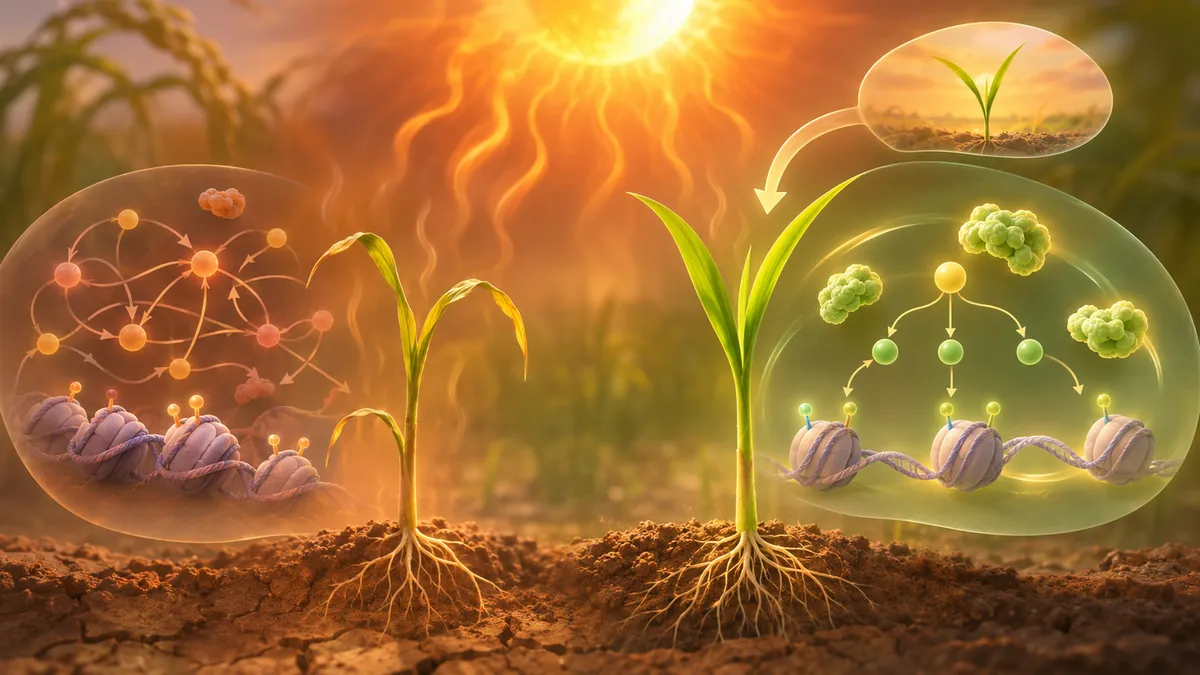
Plants can carry a molecular trace of past stress that changes how they respond when stress returns. In young rice seedlings, researchers tested whether mild heat exposure could improve performance after a later, severe heat treatment—and what molecular changes accompanied that difference.
A smaller response, with growth better preserved
A plant facing heat must protect its cells, but a broad stress response can coincide with changes to processes needed for growth. Could an earlier, milder exposure help a plant respond to a later heat shock with fewer gene-expression changes? A bioRxiv preprint by Akshay U. Nair and colleagues explores this question in rice seedlings, focusing on the molecular features associated with heat “memory.”
The team used five-day-old seedlings of one rice variety, Nagina22, grown under controlled conditions. Some received a two-hour treatment at 37°C, followed by two hours of recovery. Both these “primed” seedlings and seedlings with no earlier heat exposure were then exposed to 45°C for four hours. The researchers measured growth eight days later and examined gene activity at several points around the treatments. They also assessed histone marks, proteins and inferred networks linking transcription factors to genes.
After severe heat, the primed seedlings had better shoot and root growth and greater fresh weight than the unprimed seedlings. This indicates improved performance under this particular laboratory regime; it does not establish effects on mature plants, grain yield or field resilience.
Fewer gene changes, across varied processes
After the severe heat, the researchers identified 3,957 genes whose activity differed from the comparison condition in primed seedlings, versus 4,748 in unprimed seedlings. Among upregulated genes, expression changes were smaller on average in the primed group, and their dispersion was lower. The authors describe this as a more restrained response. Many genes were shared between the groups, so priming did not replace the basic heat response.
At the same time, the primed seedlings’ gene changes were associated with a larger number of enriched biological-process categories. These included stress responses and processes linked to maintaining or building cell components. The pattern is not simply “less activity everywhere”: fewer genes changed, but those changes mapped to a range of functions.
The team also constructed networks of potential links between transcription factors—proteins that help regulate genes—and their targets. The inferred primed network was smaller, with fewer predicted connections. These networks are computational inferences based on promoter and expression data, not direct observations of regulatory interactions inside living cells.
A histone mark and a chaperone protein
The researchers examined H3K27me3, a histone modification generally associated with reduced gene activity. After severe heat, global levels of this mark were lower in unprimed seedlings, while primed seedlings retained levels closer to controls. Sequencing-based analysis also found more H3K27me3-marked genes in primed seedlings. Marked genes were less likely to show differential expression in the primed group.
This association is consistent with the idea that the mark may help restrain some gene responses. But the authors explicitly note that they did not test causality: the results do not show that retaining H3K27me3 is necessary or sufficient for better growth. Other molecular changes could contribute.
A second feature involved OsHSP26, a rice chaperone—a protein that helps other proteins maintain or regain their proper structure. Its transcripts remained slightly elevated after priming and recovery. After the later heat treatment, primed seedlings had more OsHSP26 protein than unprimed seedlings, even though its transcript level at that measurement was slightly lower. The authors suggest that retained transcripts may contribute to the protein difference, but the study does not establish the steps connecting transcript levels to protein abundance.
What the study does not establish
Together, the findings support a proposed model: priming is associated with a more restrained transcriptional response, retention of H3K27me3 and greater OsHSP26 protein abundance after triggering heat. The authors suggest that these features could help seedlings cope while preserving growth-related processes. However, the study’s sampling does not track the response continuously after the severe heat treatment, so it does not demonstrate that the response is faster. “Speed” is part of the authors’ interpretation, not a measured result here.
The experiments concern very young seedlings, one rice variety and a specific sequence of temperature treatments in controlled conditions. Whether the findings hold across varieties, developmental stages, repeated heat episodes or field settings remains uncertain. The authors also say it is not yet known whether this proposed regulatory pattern is conserved across species. The network links are inferred, and the role of H3K27me3 has not been tested directly.
This work is a bioRxiv preprint and had not been certified by peer review when posted. The paper says raw transcriptome data would be made available upon manuscript acceptance, so independent inspection of those data may not yet be possible. The findings offer leads for studying heat memory in rice, but further testing is needed before drawing conclusions about crop improvement or climate resilience.
- rice
- heat stress
- thermopriming
- plant stress memory
- gene regulation
- H3K27me3
- chaperone proteins
Related reading
Automatically matched by shared topic keywords. These links do not imply that the sources agree or establish a consensus.
An RNA quality-control pathway has opposing roles in plant heat recovery
Source published
Shared keywords: heat stress
A two-scale approach to mapping gene regulation
Source published
Shared keywords: gene regulation
One liverwort regulator, two distinct roles
Source published
Shared keywords: heat stress
C4 leaf cells show distinct chloroplast-to-nucleus signalling
Source published
Shared keywords: heat stress