TRANSMISSION // 2026.11.12.766145v1
Pearl Millet’s Leaf Minerals and Drought Response
Source published
In field trials at one Senegal site, leaf-mineral stability was associated with stability in some plant traits. Potassium was the only measured element with a significant genotype-by-treatment interaction, and a chromosome 6 region was linked to potassium plasticity.
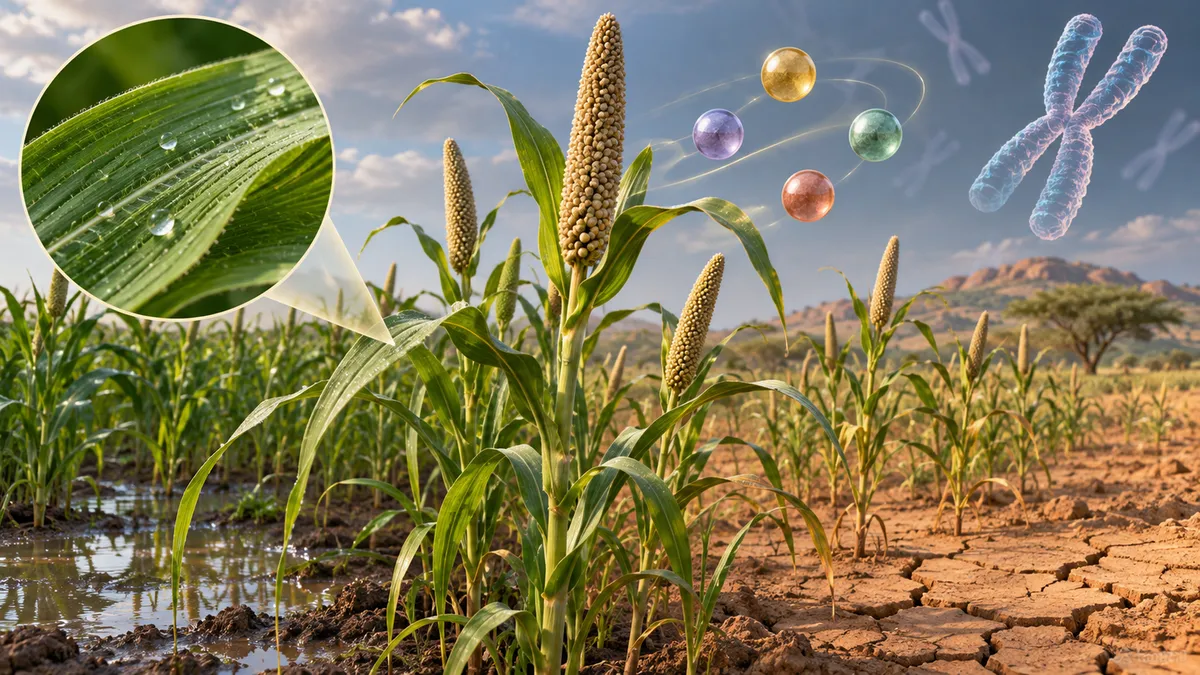
Early-season water shortages can constrain pearl millet establishment and yield. To investigate how leaf minerals respond, researchers measured 17 elements in 175 pearl millet lines during two seasons of field trials in Senegal.
Pearl millet is an important cereal in semi-arid West Africa, where early-season water shortages can constrain crop establishment and yield. Plants need mineral elements for many functions, and drought can alter their concentrations in leaves. Do these changes vary among pearl millet lines, and are they associated with plant performance? A bioRxiv preprint by Nakombo-Gbassault and colleagues investigates these questions.
Testing leaves under early water stress
The researchers grew 175 diverse pearl millet inbred lines at one field site, Bambey, Senegal, in 2021 and 2022. Each season, plants received either regular irrigation or a period without irrigation during vegetative growth. This imposed stress lasted 28 days in 2021 and 21 days in 2022. Afterward, plants were re-irrigated and followed to maturity.
At the end of the stress period, the team measured 17 elements in leaves using inductively coupled plasma mass spectrometry. They compared concentrations across watering treatments and years, examined relationships among elements and plant traits, and searched for genetic markers associated with mineral concentrations or their responses to stress.
The study defines plasticity using a log₂ ratio of a trait’s value under stress to its value under well-watered conditions: a measure of the relative change between treatments. It also uses a stress-tolerance index to represent performance across both conditions. The authors examine whether stability in mineral concentrations is associated with stability in plant traits; stability here does not mean that every element remains unchanged.
A shared response, with potassium standing out
Several mineral changes appeared in both years: magnesium, cobalt, manganese and copper increased under water stress, while sodium, potassium, zinc, lithium and phosphorus decreased. Calcium and strontium shifted in opposite directions between years. The overall pattern of relationships among elements remained recognizable, although fewer pairwise correlations were significant under stress.
Across lines, stability in leaf mineral concentrations was associated with stability in flowering time. Associations with biomass and yield-related traits were less extensive. The authors report fewer relationships between mineral plasticity and plant performance. These associations do not show that stable mineral levels directly cause better performance.
Potassium stood out genetically. Among the 17 elements, it was the only one with a significant genotype-by-treatment interaction: lines differed in how their leaf potassium concentrations responded to watering conditions. A genome-wide association analysis identified a chromosome 6 region, qKP-6, associated with potassium plasticity. In the study, A/A lines showed a smaller average percentage loss of potassium under stress than G/G lines. However, potassium concentrations under stress did not differ significantly between these genotypes, and the association with potassium levels under well-watered conditions was no longer significant after adjustment for flowering time. The nearby gene is a positional candidate, but its function is unknown and has not been experimentally confirmed.
The researchers also tested whether mineral profiles from well-watered plants could predict drought performance within their panel. In repeated cross-validation, the mean correlation between predicted and observed grain-weight stress-tolerance scores was 0.300 for the best-performing predictor, the overall mineral-profile axis. For biomass tolerance, the multi-ion predictor had a mean cross-validated correlation of 0.422. These are prediction results within the study’s analysis; they do not establish how well the approach would work for other lines or growing conditions.
What the findings can—and cannot—tell us
The results suggest that, in this panel, stability in leaf mineral concentrations was associated with stability in some plant traits during early drought. They also identify potassium response as a potentially heritable feature for further study. Correlations cannot establish that mineral stability produces better performance, and the qKP-6 association does not prove that the region causes drought tolerance.
The trials were conducted at a single site, and stress lasted different lengths of time in the two years. The findings may not transfer to other environments, drought timings or pearl millet lines without further testing. The candidate gene’s role also needs functional study before its mechanism or breeding value can be established.
This study is a bioRxiv preprint posted in November 2026 and has not been certified by peer review. Its findings should be read as preliminary research, not as established evidence for a breeding strategy.
- pearl millet
- drought
- plant ionome
- potassium
- crop genetics
- plant breeding
Reviewed cross-references
These connections were reviewed by a model, not independently fact-checked by a human. Similarity does not imply agreement; consult the original papers and the evidence below.
Shared chemical clues connect tomato genes to unidentified metabolites
Shared method: Both studies use genome-wide association mapping to identify genetic associations: the pearl millet study maps potassium drought plasticity, while the tomato study maps metabolite features under control and water-deficit conditions. The traits, species and mapping analyses differ, so this is a shared broad method, not evidence that their findings validate one another.
Model review: · openai-codex/gpt-6-luna
Evidence and provenance
Selected excerpts, not complete papers. PDF extraction can omit figures or damage equations, tables and reading order; sources may be preprints.
2026.11.12.766145v1 — Original paper
Excerpt reference:
static/papers/2026.11.12.766145v1.md:2530-2655
Basis: Paper text
Source SHA-256:f71e2922b86b14d77e6418ea91e0e08def6c7c26bfe410ea301a260c789503d22026.11.03.763898v1 — Original paper
Excerpt reference:
static/papers/2026.11.03.763898v1.md:662-776
Basis: Paper text
Source SHA-256:0e11f7185a12c7b1b8bfae0c39f55f749055414bd27fdf78eafae91cec260023
Related reading
Automatically matched by shared topic keywords. These links do not imply that the sources agree or establish a consensus.
Wild, feral and domesticated Brassica rapa respond differently to drought
Source published
Shared keywords: plant breeding
Hop varieties show different responses to reduced watering in a greenhouse
Source published
Shared keywords: plant breeding
Can cacao DNA help find resistance to black pod rot?
Source published
Shared keywords: plant breeding
Smaller, more densely packed leaf pores linked to higher winter wheat yields
Source published
Shared keywords: plant breeding
Waterlily study links pollen rejection to reactive oxygen and two interacting proteins
Source published
Shared keywords: plant breeding