TRANSMISSION // 2026.11.12.766139v1
How plants build ayahuasca-associated compounds
Source published
Researchers mapped key steps in harmine production and engineered plants to make harmine and DMT together, while several pathway details remain unresolved.
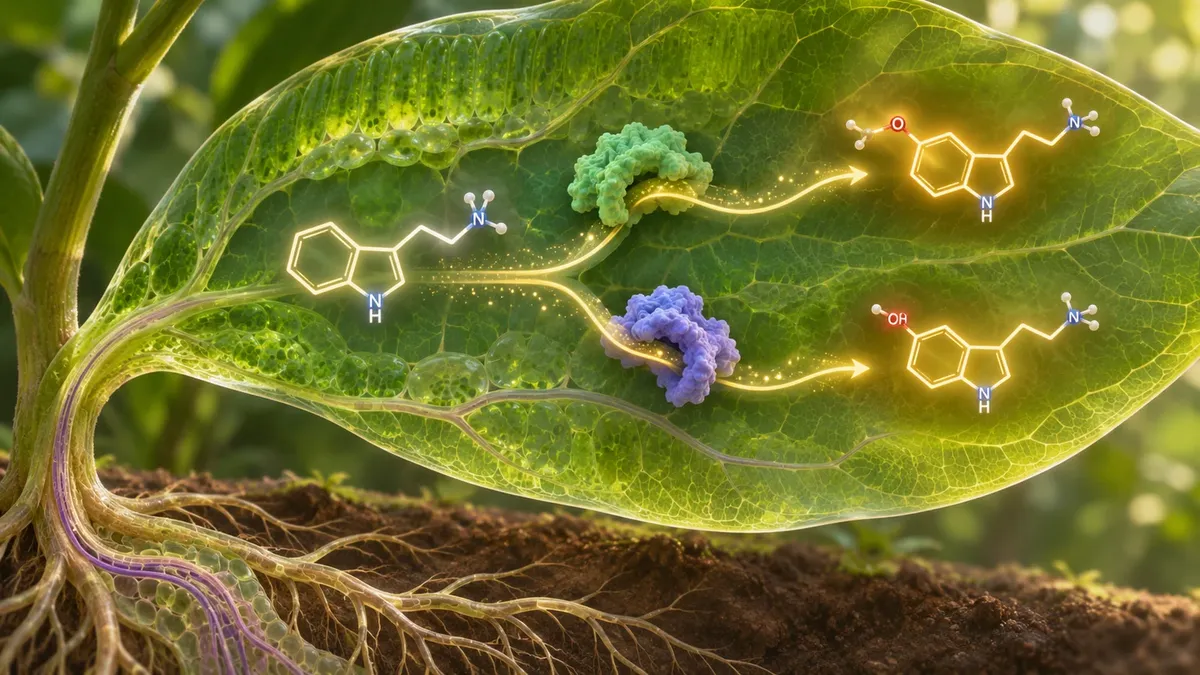
A plant’s route to harmine, a β-carboline found in ayahuasca-related preparations, has been only partly understood. Researchers now identify key enzymes in that route and show that two plant systems can produce harmine and DMT together. The work reconstructs a chemical pathway in laboratory plants; it does not recreate the brew or establish a medical use.
The traditional Amazonian brew ayahuasca brings together plants that provide β-carbolines and the psychoactive compound N,N-dimethyltryptamine (DMT). β-carbolines such as harmine inhibit an enzyme called monoamine oxidase A, helping make DMT active when taken orally. Although these compounds have long cultural and medicinal histories, the plant chemistry that produces β-carbolines has remained incompletely mapped. A new bioRxiv preprint investigates how Peganum harmala makes harmine and whether that pathway can be combined with DMT production in other plant systems.
Tracing the chemical route
The researchers first measured metabolites in tissues of P. harmala and Banisteriopsis caapi, then used mass-spectrometry imaging to see where compounds accumulated within roots. They paired these measurements with RNA sequencing across plant tissues to identify candidate genes whose activity matched the metabolite patterns. Because P. harmala roots contained substantial harmine, the team focused its pathway search on that species.
Candidate enzymes were tested in several ways: in laboratory enzyme assays, in yeast, and through temporary gene expression in Nicotiana benthamiana, a plant commonly used to test engineered pathways. The team also used cell-free chemical reactions to investigate whether some pathway steps could happen without a dedicated enzyme. Finally, structural modeling and targeted mutations were used to test why two related enzymes modify tryptamine at different positions.
A branch point in tryptamine metabolism
The proposed route begins when PhaTDC1 converts tryptophan into tryptamine. Two related cytochrome P450 enzymes then steer tryptamine down different branches: PhaT6H produces 6-hydroxytryptamine, while PhaT5H produces serotonin, or 5-hydroxytryptamine. The researchers’ experiments support 6-hydroxytryptamine as an entry point to β-carboline production.
Structural models suggested that two amino-acid differences in the enzymes’ active sites help determine which position is hydroxylated. When the researchers changed both corresponding residues, each enzyme’s preference switched in the tested system. This offers a specific explanation for how closely related enzymes can direct the same starting molecule toward different products. It does not, by itself, show how this difference arose during evolution.
The pathway’s next steps appear less dependent on specialized catalysts than expected. The team found evidence that pyruvate-derived compounds can react with 6-hydroxytryptamine to form β-carboline-related scaffolds in cell-free assays. They also identified PhaOMT2, an enzyme that adds methyl groups to several β-carboline intermediates. Together, the identified enzymes enabled N. benthamiana to produce harmine and related compounds without adding tryptophan or tryptamine from outside the plant. The authors suggest that spontaneous chemistry or native host enzymes may handle some remaining oxidation steps.
Combining two pathways
The researchers next combined β-carboline production with genes for DMT production. In transiently engineered N. benthamiana leaves, both harmine and DMT accumulated. They also introduced DMT-pathway genes into P. harmala hairy roots—cultured roots induced through transformation—and detected DMT alongside the roots’ naturally produced β-carbolines. These results show that the pathways can operate together in these experimental plant systems, not that the plants produce a traditional ayahuasca preparation.
The findings provide a clearer map of harmine biosynthesis and a platform for studying how plant pathways compete for shared starting materials. They may eventually inform research into producing plant compounds, but the study does not demonstrate commercial-scale production, therapeutic benefit, or conservation impact.
Important uncertainties remain. Some later reactions in the proposed pathway have not been experimentally assigned to specific enzymes, and spontaneous reactions may occur alongside enzyme-driven ones. Some metabolites were identified tentatively rather than against an authentic standard. The experiments were conducted in sampled tissues, cultured roots, or transiently engineered plants, so they do not establish how the full pathway behaves in intact plants under natural conditions.
This report describes a bioRxiv preprint, posted November 19, 2026, that had not been certified by peer review when posted. The authors state that raw sequencing data and gene sequences will be made public upon manuscript acceptance. The results should therefore be treated as preliminary until independently assessed and tested further.
- β-carbolines
- harmine
- DMT
- plant biosynthesis
- Peganum harmala
- metabolic engineering