TRANSMISSION // 2026.11.12.766128v1
Mapping leafy biomass for Rubisco recovery
Source published
A high-throughput profiling study reports that leafy plant species differ in cell-wall features linked to Rubisco extractability, pointing to questions for biomass choice and extraction design.
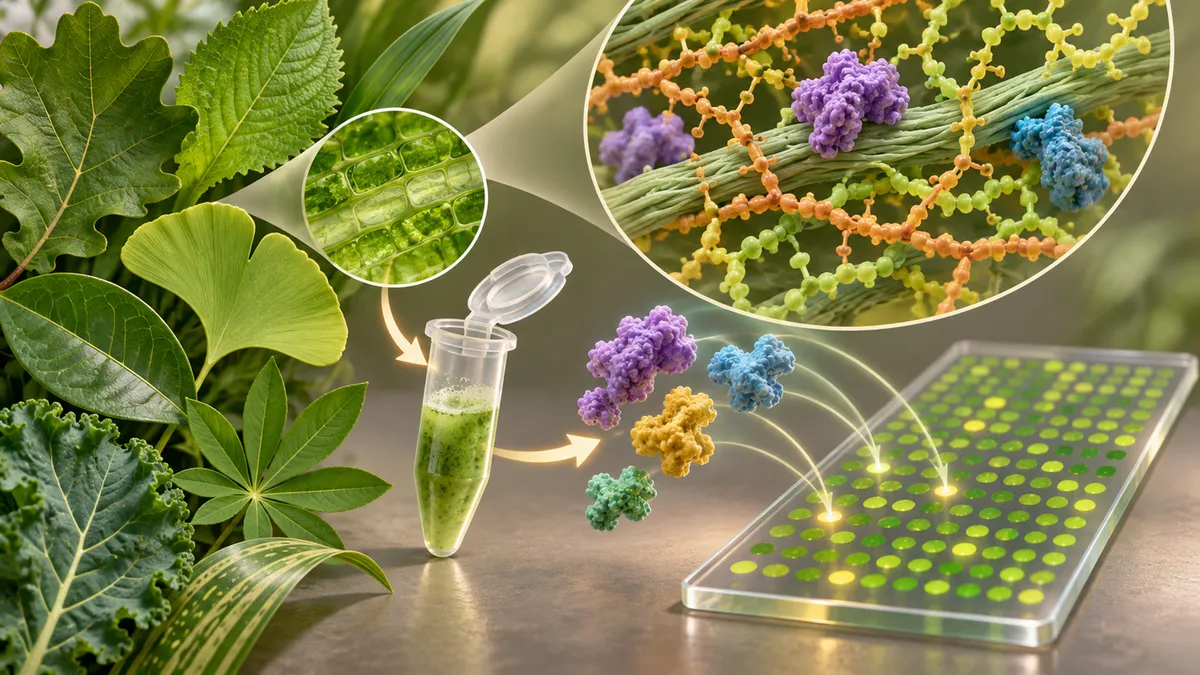
Rubisco is abundant in green leafy biomass and has nutritional and functional properties that make it a possible plant-based protein. Yet extracting it can be costly and inefficient. A bioRxiv preprint uses a microarray profiling approach to explore whether cell-wall chemistry helps explain differences in protein recovery.
Rubisco is present in green leafy biomass and, according to the study’s abstract, has nutritional and functional properties that make it a potential plant-based protein. Despite that potential, it remains underused: extraction can be costly and inefficient, and results may vary between plant species.
A bioRxiv preprint by J. C. D. Pattinson and colleagues asks whether the plant cell wall may help explain that variation. In particular, the authors focus on interactions between cell-wall carbohydrates and proteins, which they say are not well understood as factors affecting Rubisco yield.
A microarray view of plant biomass
The team applied Microarray Polymer Profiling, or MAPP, to diverse leafy biomass sources. The abstract describes MAPP as a high-throughput platform for mapping polysaccharides and proteins at the same time. This lets researchers examine cell-wall components alongside proteins across plant material.
The authors also used MAPP to evaluate carbohydrate-active enzymes in relation to Rubisco recovery. These enzymes act on carbohydrates, so this part of the work examines whether targeted cell-wall modification is associated with changes in recovery.
The available source is the abstract only. It does not identify the plant species or number of samples, name the enzymes, or describe the detailed workflow. It also provides no numerical yields or comparisons among species or extraction conditions. The scale and strength of the reported effects therefore cannot be judged from the available evidence.
What the study reports
The authors report differences between species and glycan–protein interactions that influence protein extractability. Glycans are carbohydrate structures; in this study, the relevant structures are associated with plant cell walls. The reported findings point to cell-wall chemistry as a factor to consider when attempting to recover proteins from leafy biomass.
The authors say these insights can inform biomass selection and the optimisation of extraction protocols. That suggests a research strategy: compare plant materials and investigate whether extraction methods should be tailored to their cell-wall characteristics. The abstract also says MAPP was used to evaluate enzyme effects on Rubisco recovery through targeted cell-wall modification.
However, the abstract does not report a best-performing plant source or enzyme treatment, or quantify any increase in recovery. It therefore does not establish a specific treatment as an effective extraction recipe, nor does it show that a change in cell-wall chemistry caused a particular improvement.
What remains uncertain
If cell-wall composition is related to how readily proteins can be extracted, profiling it could help researchers design more focused tests of biomass and processing methods. But the abstract does not establish that this approach reduces costs, improves nutritional quality, or works at industrial scale. It also does not show whether the reported observations apply broadly across leafy plants.
Because the evidence here is limited to the abstract, readers cannot assess the detailed methods, study design, statistical support, or magnitude of the reported relationships. The work is identified as a bioRxiv preprint; the supplied information does not establish its peer-review status. Its findings should be read as preliminary, and the full paper and further research would be needed to evaluate their strength and practical relevance.
For now, the study offers a research direction rather than a finished processing solution: cell-wall features may help explain variation in protein extractability, and high-throughput profiling could help investigate that variation across leafy biomass.
- Rubisco
- plant protein
- Microarray Polymer Profiling
- cell wall
- protein extraction
- leafy biomass
Related reading
Automatically matched by shared topic keywords. These links do not imply that the sources agree or establish a consensus.