TRANSMISSION // 2026.11.11.765837v1
Elm seeds carry fungal communities linked to disease resistance
Source published
A study of nine Ulmus minor genotypes found that fungal communities in their winged seeds differed with Dutch elm disease resistance. Susceptible trees had richer communities, while resistant trees had less diverse, more compositionally distinct communities. The observational results point to fungal candidates for testing, not proof that seed fungi protect elms.
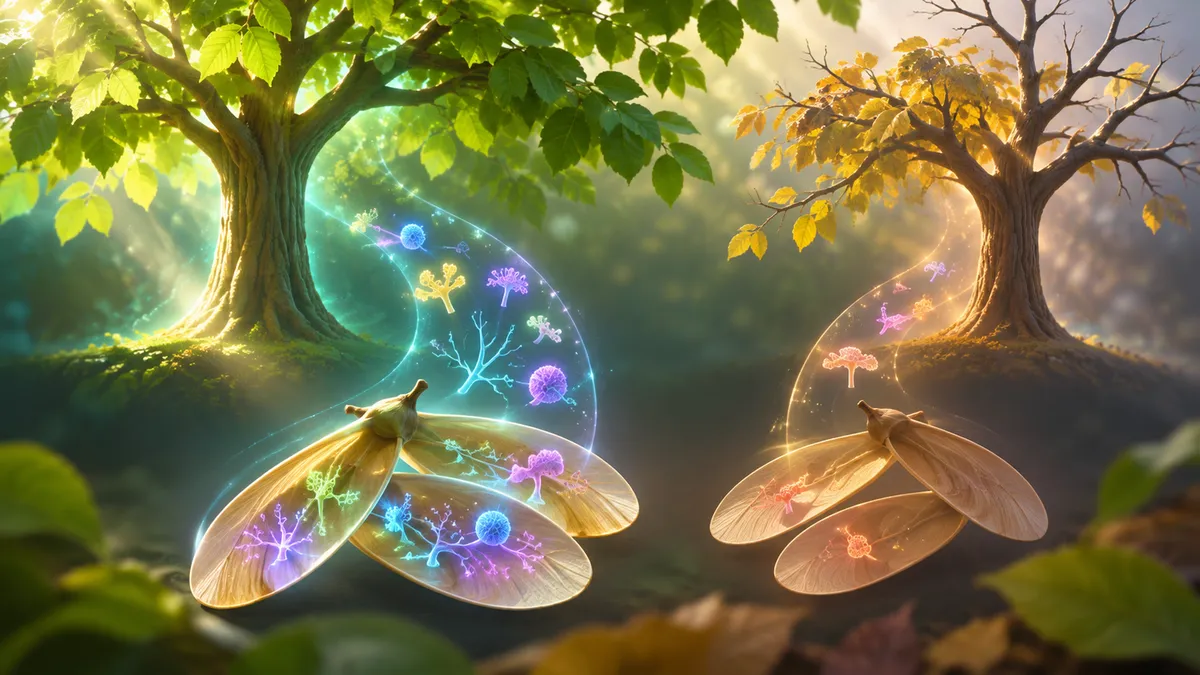
Could the fungi carried by an elm seed offer clues to whether its parent tree resists Dutch elm disease? Researchers compared seed-associated fungal DNA from nine field-grown Ulmus minor genotypes previously classified by disease response. They found patterns associated with resistance, but the study does not show that the fungi cause it.
Dutch elm disease has devastated elm populations, and identifying trees that withstand it is important for conservation and replanting. Resistance is not necessarily explained by the tree’s genes alone: microbes living with a plant may also shape its health. Seeds are one possible route by which fungi pass from a parent tree to a seedling. But whether seed-associated fungi vary with disease resistance in long-lived trees has received little attention.
To investigate, researchers sampled samaras—the winged fruits containing elm seeds—from nine Ulmus minor genotypes growing in the same conservation plot in Madrid. Earlier inoculation trials had classified three genotypes as resistant, three as intermediate and three as susceptible to Dutch elm disease. The team collected samaras from one adult tree per genotype, then analyzed three batches of samaras from each tree. They sequenced the fungal ITS1 DNA marker, which helps identify fungi, and used the resulting data to compare community diversity, composition, and patterns of association among fungi.
The analysis retained 522 fungal sequence variants after filtering. The broad fungal groups Dothideomycetes and Tremellomycetes were prominent across the samples. However, the communities differed among resistance classes. Susceptible genotypes had the greatest fungal richness; resistant genotypes had intermediate richness, and intermediate-resistance genotypes had the lowest. Susceptible samples also had higher Shannon diversity than the other two groups. This measure reflects both how many types are present and how evenly represented they are.
The kinds of fungi present also varied. Overall community composition differed among resistance classes, with the clearest separation between resistant and susceptible genotypes. The researchers identified 21 genera that differed in abundance in at least one comparison. Protofenestella was more abundant in resistant genotypes, while Taphrina was more abundant in intermediate and susceptible ones. These are associations: sequencing shows which fungal DNA was detected, not what those organisms do in elm seeds or seedlings.
The researchers also built co-occurrence networks from correlations among fungal sequence variants. The resistant group’s network was more modular than expected from random networks, while the susceptible group’s network was not. The susceptible network had more connections than the resistant one. Such patterns describe statistical relationships among taxa; they do not establish that fungi interact directly, or that a particular network structure makes a tree more resistant.
There are important limits to the evidence. The study included only nine genotypes and one sampled mother tree per genotype. The three batches from each tree are useful technical or within-tree subsamples, but they do not provide independent trees for each resistance class. As the authors note, the differential-abundance analysis could not explicitly model the dependence among subsamples from the same tree. The comparison is also observational: resistance class and fungal community were measured, but the experiment did not manipulate fungi to test whether they alter disease outcomes.
The samples were intact samaras, including both seed and fruit tissue. The design therefore cannot establish which fungi are inside seeds, whether they are passed to seedlings, or whether they came from the parent, flowers, or surrounding environment. The authors compared seed-associated fungi with a previously studied stem community, but shared taxa alone do not prove transmission. Nor does a genus-level DNA identification reliably tell whether a specific organism is beneficial, neutral, or harmful in elm.
The findings make the samara mycobiome a promising subject for further work, not a ready-made conservation treatment. Controlled experiments could isolate candidate fungi such as Protofenestella, track whether they colonize seedlings, and test whether inoculated plants respond differently to the Dutch elm disease pathogen. The paper is a bioRxiv preprint and is explicitly not certified by peer review. Its results should therefore be treated as preliminary until independently assessed and tested across more trees and conditions.
- Dutch elm disease
- Ulmus minor
- seed mycobiome
- fungi
- elm conservation