TRANSMISSION // 2026.11.11.765576v1
How potato plants remember combined heat and drought
Source published
A preprint study finds that potato leaves respond to combined heat and drought in ways that differ from either stress alone, and reports stronger activation of ABA-biosynthesis genes during a second stress cycle.
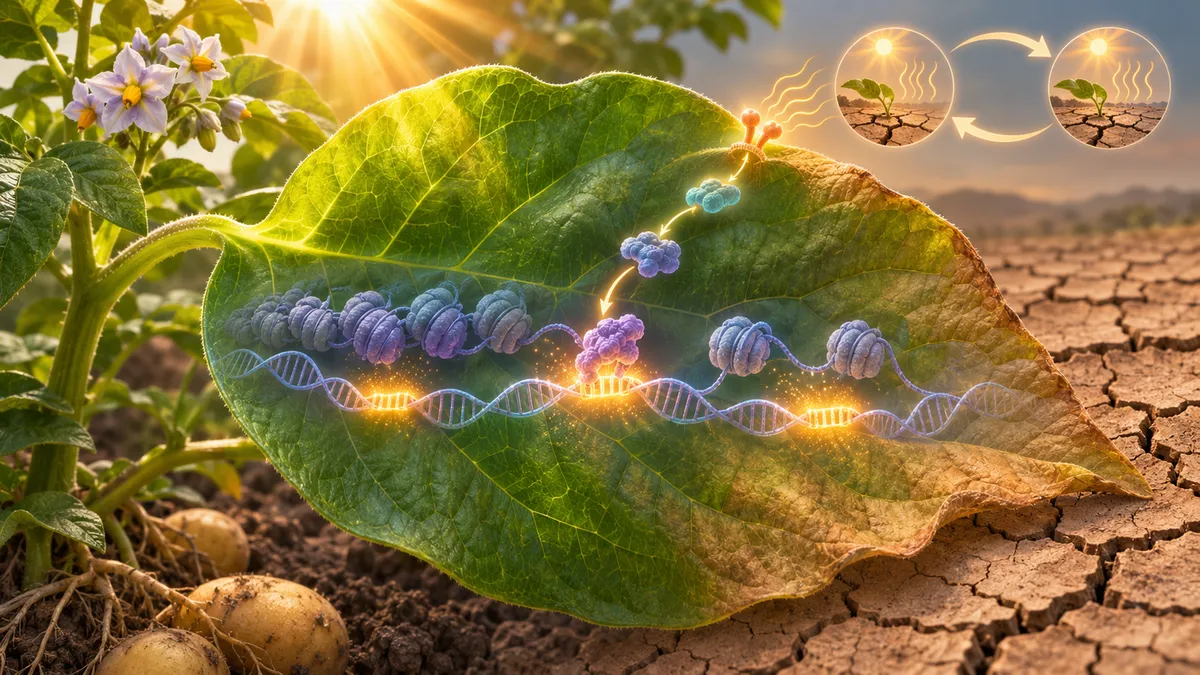
Plants often face more than one environmental stress at once. In a bioRxiv preprint, researchers tracked gene activity and accessible chromatin in two potato cultivars to investigate how heat and drought interact—and whether a first exposure changes the response to a later one.
Why study stress combinations?
Heat and drought can occur together during a growing season, but a plant’s response to both may not simply add up the effects of each one. The researchers asked how prolonged heat, drought, waterlogging, and combined heat and drought change gene activity and chromatin accessibility in potato leaves. Chromatin is the structure that packages DNA; accessible regions are more available to regulatory proteins that can influence gene activity.
They studied two genetically distinct cultivars, Désirée and Lady Rosetta. The team used ATAC-seq to map accessible DNA regions and RNA-seq to measure gene expression. In a separate experiment, they exposed Désirée plants to two cycles of combined heat and drought, with a recovery period between them, and examined whether the second cycle produced a different transcriptional response.
Stress responses were not interchangeable
Most regions whose accessibility changed did so in response to just one stress regime. Drought, combined heat and drought, and waterlogging shared some responses, including changes around genes associated with abscisic acid (ABA) and dehydration. ABA is a plant hormone involved in stress responses.
The cultivars differed in their chromatin landscapes and in some responses to stress. Waterlogging produced the largest accessibility changes in both. Heat alone had a comparatively small effect in this experiment, especially in Lady Rosetta. These results caution against treating one cultivar’s response—or one stress treatment—as a stand-in for all potatoes or field conditions.
Combined heat and drought produced a distinctive expression pattern. Across the genome, its responses resembled drought more than heat, but many genes responded specifically to the combined treatment. Protein-quality-control genes, including chaperones that help proteins fold, were more strongly induced under combined stress than under either stress alone. By contrast, several drought-responsive genes involved in ABA signalling and dehydration protection were less strongly induced, or did not show the same response, under the combined treatment. This included the potato gene StABF2. Thus, water deficit did not produce an identical molecular response when heat was present too.
Changes in accessibility and gene expression were related, but not in a simple one-to-one way. When both measurements changed significantly for a gene, promoter accessibility generally shifted in the same direction as expression. Yet the size of accessibility changes only moderately tracked expression changes, and most differentially expressed genes with a measured promoter region did not also show a significantly altered promoter. Accessibility is therefore one part of regulation, not a direct measure of how much a gene will be expressed.
A signal that strengthened on repeat exposure
In the repeat-stress experiment, the ABA signalling response was induced to a similar extent in the first and second cycles. Some ABA metabolism genes, however, responded more strongly the second time. These included StNCED3, which encodes an enzyme involved in a rate-limiting step of ABA production, and StCYP707A1, involved in ABA breakdown.
The researchers focused on StWRKY33b, a transcription-factor gene whose expression also increased more in the second cycle. They found that StWRKY33b activated an StNCED3 reporter in a transient assay using Nicotiana benthamiana leaves. This supports the possibility that StWRKY33b helps regulate StNCED3. The experiments do not establish that it is the sole cause of the stronger response in potato plants.
Notably, the study did not find that stress-memory genes generally underwent larger accessibility changes. Instead, memory-associated genes had more accessible regions, and StNCED3’s promoter was already accessible. The authors suggest that the availability of transcriptional regulators may help explain stronger reactivation, rather than new chromatin opening at that gene.
What remains uncertain
These findings come from controlled growth-chamber experiments on leaves, not field-grown crops or measurements of harvest yield. The repeat-cycle analysis focused on Désirée, selected because it showed the stronger chromatin response in the initial experiment; it does not show that both cultivars share the same memory pattern. The heat–drought treatment also applied heat before drought, so treatment sequence may have shaped the outcome. And the reporter test was performed in another plant species, not by directly manipulating StWRKY33b in potato.
The study is a bioRxiv preprint and, as labelled in the source, had not been certified by peer review. Its results offer a molecular account of how potato leaves respond to these laboratory stress treatments, not proof that this mechanism improves crop resilience or yield in the field. Further testing will be needed to establish how broadly the findings apply.
- potato
- heat and drought
- chromatin accessibility
- plant stress memory
- abscisic acid
- StWRKY33b
Reviewed cross-references
These connections were reviewed by a model, not independently fact-checked by a human. Similarity does not imply agreement; consult the original papers and the evidence below.
Rice seedlings may prepare for heat by responding more selectively
Supporting evidence: Both preprints report that prior stress exposure changes later stress-response transcription: the potato abstract reports memory involving StNCED3 and StWRKY33b after repeated combined heat and drought, while the rice study describes a restrained transcriptional response after heat priming. This supports only the bounded proposition that prior stress can shape later transcriptional responses in crops; species, treatments, developmental stages and reported outcomes differ, and both papers are non-peer-reviewed preprints.
Model review: · openai-codex/gpt-6-luna
Evidence and provenance
Selected excerpts, not complete papers. PDF extraction can omit figures or damage equations, tables and reading order; sources may be preprints.
2026.11.11.765576v1 — Original paper
Excerpt reference:
static/papers/2026.11.11.765576v1.md:12-68
Basis: Paper text
Source SHA-256:2615dc3d335e973a1a84d40cebdeb47ad099640d658dd96643cf59102a3279d62026.11.12.766148v1 — Original paper
Excerpt reference:
static/papers/2026.11.12.766148v1.md:12-147
Basis: Paper text
Source SHA-256:4c61b8dbec279b420794622691bfb8c4bb8767be04847894ddd89050741eeefb
Related reading
Automatically matched by shared topic keywords. These links do not imply that the sources agree or establish a consensus.
Maize’s extra chromosomes are active in pollen—and may echo across the genome
Source published
Shared keywords: chromatin accessibility
Rice seedlings may prepare for heat by responding more selectively
Source published
Shared keywords: plant stress memory
An early cellular transport step helps tune plant stress-hormone sensitivity
Source published
Shared keywords: abscisic acid