TRANSMISSION // 2026.11.10.765735v1
sorAI uses sequence patterns to estimate fern ploidy
Source published
A machine-learning suite called sorAI classifies fern samples as diploid or polyploid from target-capture DNA data. Its authors report stronger test performance than two frequency-based methods, while noting that accuracy is imperfect.
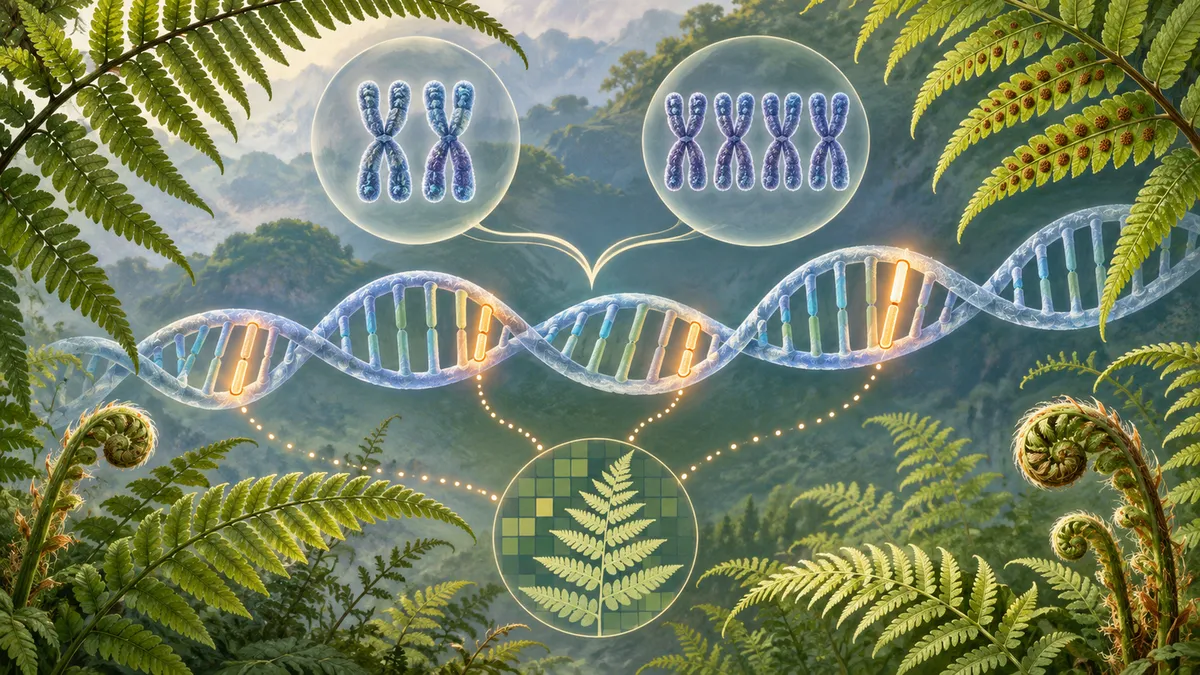
A plant’s DNA can contain different numbers of chromosome sets, but determining an individual plant’s ploidy is not always straightforward. A new study introduces sorAI, machine-learning models that use DNA sequence data to estimate whether fern samples are diploid or polyploid.
Why estimate chromosome sets from DNA data?
Polyploidy—having more than two sets of chromosomes—is a persistent feature of land-plant evolution. Yet determining the ploidy of an individual plant can be difficult. Meanwhile, target-capture sequencing produces DNA data from selected regions across plant samples. The researchers ask whether those data can help distinguish diploid from polyploid ferns.
Their answer is a collection of machine-learning models called sorAI. This account is based on the study’s abstract; the full paper’s methods and results are not available in the evidence provided here.
How the models work
The researchers used chromosome-count data alongside fern target-capture sequences generated with the GoFlag probe set. They trained a convolutional neural network (CNN) for each probe locus. CNNs are models that can learn patterns in structured data. The team also developed ensemble models combining two loci and a random-forest model using all loci.
They tested the models on held-out GoFlag datasets across ferns and on an independent test set from the genus Lygodium. They also examined which locus and sequence features were associated with model performance, and tested performance as sequence depth decreased. The abstract does not give sample counts, detailed test design, or results for each model individually, so those details cannot be assessed here.
What the authors report
Across the held-out GoFlag test datasets, the authors report that sorAI outperformed two frequency-based approaches, nQuire and nQuack. These methods use patterns in allele frequencies—the proportions of different versions of a DNA position in the sequencing data. The authors say sorAI can also use the positions of DNA variants and covariation among sites, rather than relying only on individual-site frequencies.
The random-forest model, which uses all loci, is described as robust to varying dataset features. Its reported accuracy is approximately 71–78% across test datasets and sequencing depths. The authors also report that the models perform well at low sequence coverage, though the abstract does not define “low” precisely or give a breakdown of performance at each depth.
That accuracy range indicates useful but imperfect classification: some samples may be assigned the wrong category. A prediction is therefore not the same as a confirmed chromosome count, and its reliability in a particular application would depend on how well that application matches the tested data.
What remains uncertain
The abstract reports held-out tests and an independent Lygodium test set, but does not explain how samples were divided between training and testing, how many samples were included, or how accuracy was calculated. These details would help readers judge how well the results might transfer to new species, sequencing workflows, or datasets. The abstract also does not establish performance beyond ferns or beyond the GoFlag target-capture data used in the study.
The comparison with nQuire and nQuack applies to the reported held-out GoFlag tests; it does not establish that sorAI performs better for every plant group or sequencing dataset. Since this account is based only on an abstract, finer-grained methods and results cannot be independently evaluated here. The supplied source does not establish the study’s peer-review status, so no conclusion about that status is warranted.
The authors say sorAI is available through GitHub and that trained models are available through Hugging Face. The results suggest that patterns across DNA sites may help estimate fern ploidy from target-capture data, while the reported accuracy and limited scope of the abstract leave important questions about how predictions will generalize.
- plant polyploidy
- fern genomics
- target capture sequencing
- machine learning
- ploidy prediction
- bioinformatics
Related reading
Automatically matched by shared topic keywords. These links do not imply that the sources agree or establish a consensus.
One Energy Lens for Many Kinds of Machine Learning
Source published
Shared keywords: machine learning
Machine learning connects atomic physics to simulations of stellar winds
Source published
Shared keywords: machine learning
PHISHREV+ uses explicit rules to reconsider phishing alerts
Source published
Shared keywords: machine learning
Satellite links detect rain better when neighboring receivers share information
Source published
Shared keywords: machine learning
Heart failure prediction models need stronger validation, review finds
Source published
Shared keywords: machine learning