TRANSMISSION // 2026.11.10.765595v1
Two cellular delivery routes help plants block pathogen entry
Source published
A bioRxiv preprint reports that two plant trafficking regulators, RabE and RabA, make different contributions to defenses against attempted pathogen invasion. In Arabidopsis experiments, RabE inhibition impaired resistance to powdery mildew and reduced PEN1 accumulation at attack sites, while RabA inhibition affected several proteins’ locations and was especially consequential in tests with an oomycete. The results suggest distinct defense routes, but the work remains a preprint and the experiments do not establish every step of the proposed mechanisms.
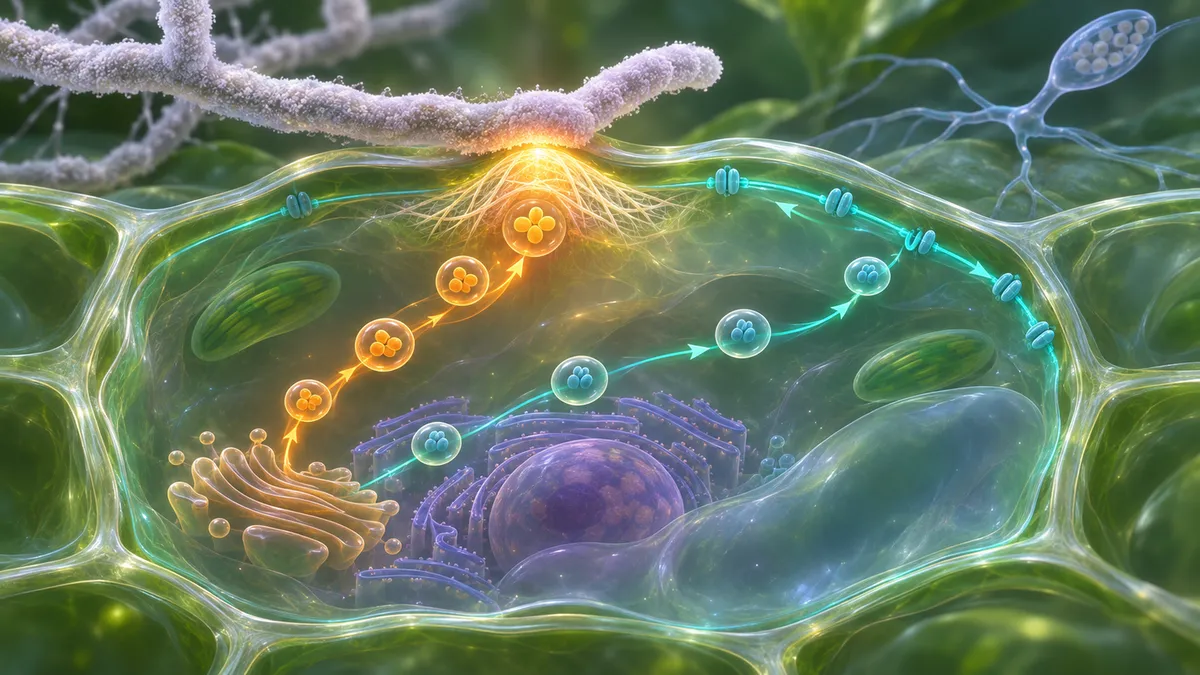
Plants can mount a defense at the precise spot where a fungus or oomycete tries to enter. How do cells deliver the right components to that vulnerable point? This study examines two molecular traffic regulators—and finds evidence that they support different parts of the response.
A defense assembled at the point of attack
A fungus or oomycete invading a leaf must get past the plant’s outer cell layer. Plants can respond by assembling a small protective structure called a papilla beneath the attempted entry site. Building that local barrier requires materials to move through the cell and arrive in the right place. The process resembles a delivery network: membrane-bound compartments carry proteins and other cargo to the cell surface, where defenses can be organized.
The study focuses on RabA and RabE, families of small proteins that help regulate this membrane traffic. Earlier work had established roles for the membrane-fusion proteins PEN1 and SYP122 in plant defense, but the trafficking machinery that supports them was less clear. The researchers asked whether RabA and RabE help deliver defenses through one shared route or through distinct pathways.
Disrupting traffic in Arabidopsis
The team used Arabidopsis thaliana plants engineered to produce dominant-negative versions of RabA or RabE when induced. These versions interfere with the normal activity of the corresponding Rab proteins. The researchers then challenged plants with powdery mildew fungi or the oomycete Phytophthora infestans, and assessed how often pathogens successfully penetrated leaf epidermal cells.
They also used confocal microscopy to track fluorescently tagged proteins, including PEN1, and stained leaves to examine callose, a cell-wall material that accumulates at defense sites. The experiments included several pathogen and plant-genetic contexts, among them plants with mlo mutations, which have strong resistance to powdery mildew. Because RabA disruption could affect ordinary cell functions as well as defense, the timing of induction mattered: the researchers compared rapid and prolonged inhibition.
RabE and RabA show different patterns
Short-term inhibition of RabE increased successful penetration by the powdery mildew fungus Blumeria hordei. A mutation affecting SCD1, a protein that activates RabE, also compromised resistance in the study’s tests. RabE inhibition reduced the focal accumulation of PEN1 at papillae, while callose deposition was not substantially affected. The authors also found that RabE inhibition partially weakened the strong powdery mildew resistance of mlo mutant plants.
RabA’s effects looked different. Short-term RabA inhibition did not measurably impair resistance to B. hordei, but repeated or prolonged inhibition did. It disrupted the plasma-membrane location of several proteins, including PEN1 and SYP122, before the researchers detected a decline in resistance. The study reports that RabA inhibition preferentially impaired resistance to P. infestans, while RabE inhibition did not produce the same effect in that pathogen test.
Taken together, the findings support a model in which RabE helps PEN1 gather at powdery mildew attack sites, while RabA contributes to a broader pathway and helps maintain the proper location of selected proteins at the cell surface. The difference between PEN1 and callose is notable: disrupting RabE could weaken resistance and reduce PEN1’s local accumulation without substantially reducing callose. A visible wall deposit, then, may not capture every important part of the defense response.
What the results do—and do not—show
The results point to specialized trafficking modules rather than a single delivery route for every pathogen. But the proposed routes are a model supported by these experiments, not a complete map of the molecular machinery. In particular, the RabA results leave open whether its effects on powdery mildew resistance arise directly from defense-specific trafficking or indirectly from gradual disruption of cell-surface protein organization. The authors themselves suggest that RabA may primarily support plasma-membrane protein homeostasis, with immune consequences emerging after prolonged inhibition.
The work also has limits of scope. It tests particular pathogens and conditions in Arabidopsis, so it does not establish that the same division of labor applies across plant species or all fungal and oomycete infections. The inducible dominant-negative approach can help reveal protein-family functions, but it is not identical to selectively removing one natural Rab protein. A temperature-sensitive SCD1 test in the mlo background was inconclusive: few or no pathogen penetrations occurred, and the authors note that temperature may have hindered the fungus and masked any effect.
This report is a bioRxiv preprint, posted in November 2026, and the posted version states that it has not been certified by peer review. Its conclusions should therefore be treated as provisional. Follow-up studies will be needed to test the proposed pathways and determine how broadly they operate. For now, the research offers a useful picture of plant immunity as a localized logistics problem: different cellular traffic systems may help deliver different defenses against different attackers.
- plant immunity
- membrane trafficking
- RabA
- RabE
- powdery mildew
- Arabidopsis
Related reading
Automatically matched by shared topic keywords. These links do not imply that the sources agree or establish a consensus.