TRANSMISSION // 2026.11.10.765594v1
How the world’s largest flowering-plant genus became so diverse
Source published
A phylogenomic study of Astragalus, a genus with more than 3,100 species, points to a long and complex history of diversification—not one sudden burst. The researchers report a largely stable picture of deeper relationships, alongside conflicting genetic signals in younger lineages. Their analyses give strongest support to a possible whole-genome duplication near the origin of Neo-Astragalus, but chromosome-scale genomic data are needed to test that hypothesis.
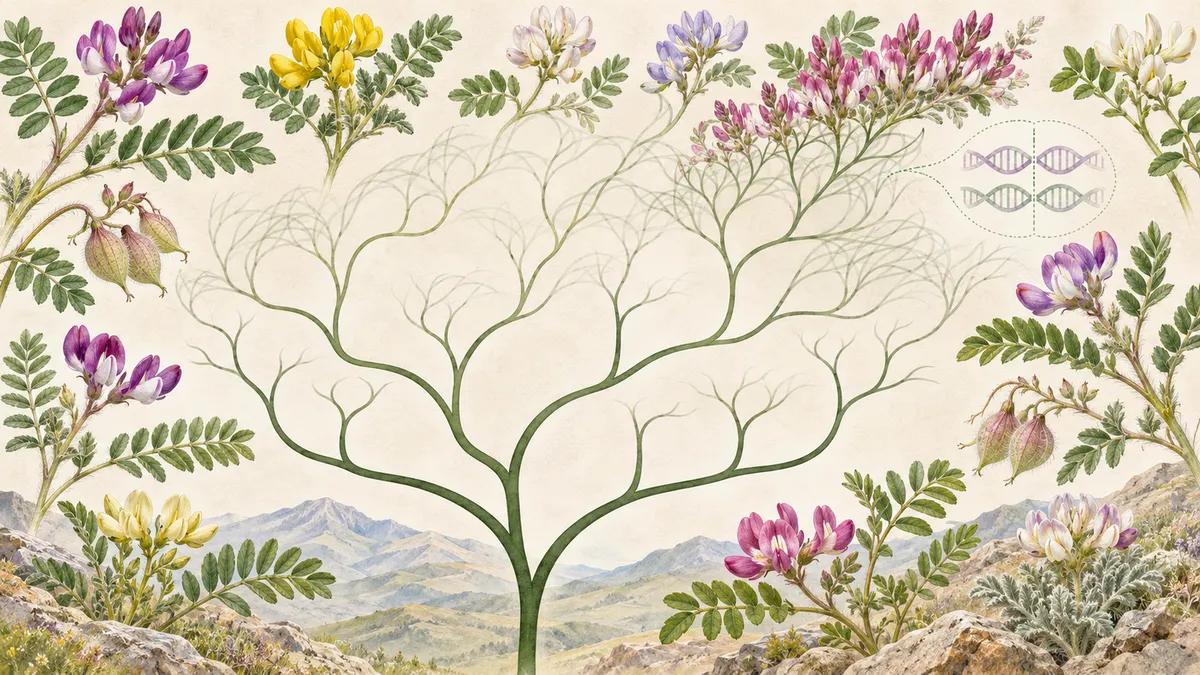
Why do some branches of life contain vastly more species than others? Astragalus, the largest genus of flowering plants, offers an unusually rich case study. Its evolutionary history has been difficult to reconstruct, so researchers combined several genetic datasets to build a broader family tree and investigate how its diversity accumulated.
A broader family tree
Astragalus includes more than 3,100 species, but its size has made it challenging to understand how its branches are related and when they diversified. The researchers set out to build a comprehensive evolutionary framework and use it to examine the genus’s history of diversification and genome evolution.
They integrated newly generated target-enrichment data from 127 samples, representing 123 Astragalus taxa, with previously published target-capture, transcriptomic and genome-skimming datasets. The resulting phylogeny includes 407 accessions—sampled entries—representing 379 species. For some analyses, the team used a smaller representative dataset to estimate divergence times, assess variation in diversification rates, examine disagreement among gene-based trees and compare possible placements of whole-genome duplication.
A phylogeny is an estimate of evolutionary relationships, not a direct record of every past event. When lineages diversify rapidly, different genes may support different family-tree branches, making parts of that history harder to resolve.
An uneven, extended history
The study reports that relationships among Astragalus’s deeper branches are largely stable. The picture becomes less consistent among younger radiations: gene-based trees often disagree about relationships. The authors say this pattern is consistent with incomplete lineage sorting—the persistence of ancestral genetic variation across newly formed species—and with reticulate evolution. The abstract does not establish which processes produced the conflicting signals or demonstrate that genetic exchange occurred.
The analyses indicate sustained lineage accumulation over approximately 18 million years, with pronounced changes in diversification rates in several clades. Particularly notable shifts occur within Neo-Astragalus, a species-rich lineage. This does not mean the whole genus arose in one brief burst. The authors instead describe its megadiversity as the outcome of sustained diversification together with periods of faster change.
The team also compared alternative scenarios for where whole-genome duplication might fit in the evolutionary tree. Their analyses gave the strongest support to a duplication at the crown node of Neo-Astragalus—the node representing the common ancestor of the lineage’s sampled members. Alternative placements received weaker support. This is a testable hypothesis, not confirmation that the event occurred: the authors say chromosome-scale genomic data will be needed to establish its occurrence and timing.
What remains uncertain
Taken together, the findings do not point to one evolutionary innovation as the explanation for Astragalus’s exceptional richness. The authors propose that sustained diversification, reticulate evolution, genome restructuring and likely environmental change coupled with ecological adaptation contributed over time. The abstract does not quantify the contribution of each factor or show that any one of them caused the genus’s diversity.
This article is based on the study’s abstract, not its full text, so it cannot assess detailed methods, statistical support or limitations beyond those the abstract states. The study is a bioRxiv preprint; preprints have not necessarily undergone peer review. In particular, the proposed whole-genome duplication remains uncertain pending further genomic evidence.
- Astragalus
- phylogenomics
- plant evolution
- biodiversity
- whole-genome duplication
Related reading
Automatically matched by shared topic keywords. These links do not imply that the sources agree or establish a consensus.
Gene-copy patterns track photosynthetic differences in daisy relatives
Source published
Shared keywords: plant evolution, whole genome duplication
One liverwort regulator, two distinct roles
Source published
Shared keywords: plant evolution
A weed’s old enzyme finds a new job against herbicide
Source published
Shared keywords: plant evolution