TRANSMISSION // 2026.11.10.765395v1
How Arabidopsis Reads Winter’s Temperature Swings
Source published
A bioRxiv preprint reports that Arabidopsis plants respond to steady cold and freezing dips in different ways at the FLOWERING LOCUS C gene. The findings point to antisense RNA processing and local chromatin changes as parts of how winter conditions are registered, but the proposed mechanism remains under investigation.
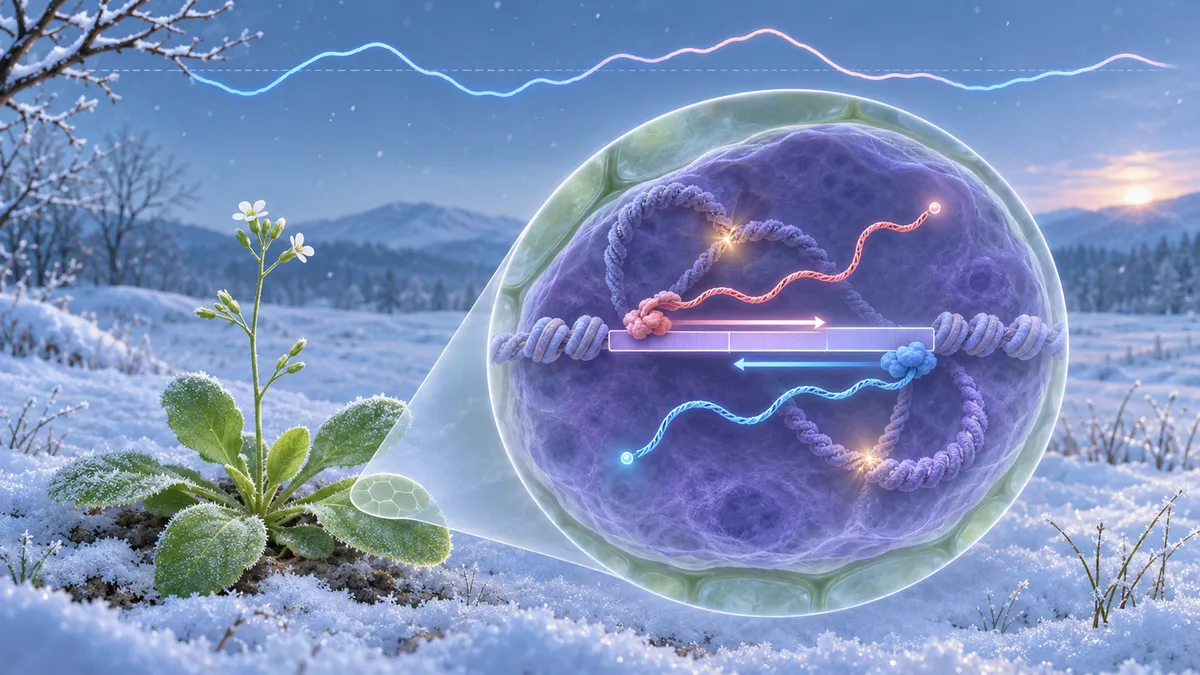
Winter is not a steady chill: temperatures rise and fall, sometimes dropping below freezing. How can a plant’s gene-control system respond to both the length of winter and its sharp fluctuations? A study of Arabidopsis suggests that RNA made across a flowering-related gene changes its processing according to the temperature pattern.
For many plants, prolonged winter cold helps time flowering. In Arabidopsis, a small flowering plant used widely in research, the gene FLOWERING LOCUS C (FLC) acts as a brake on flowering. Cold gradually reduces FLC activity, and another molecular system can maintain that repression after temperatures warm again. But winter temperatures fluctuate, and a constant chill does not tell the whole story of a real winter.
A new bioRxiv preprint asks how plants register different aspects of cold. The researchers focused on COOLAIR, a set of noncoding RNA molecules transcribed from the DNA strand opposite FLC. “Antisense” here means that the RNA is copied from the opposite strand, not that it necessarily blocks FLC by directly pairing with it. The team’s central question was whether the way COOLAIR is made and processed changes with temperature, and whether those changes are linked to FLC repression.
Following RNA as it is made
The researchers compared Arabidopsis seedlings grown in steady cold with seedlings exposed to daily temperature swings that included below-freezing dips. The two cold regimes had the same reported mean temperature, allowing the team to examine responses to the pattern of temperature rather than simply to a colder average. They used several approaches: sequencing chromatin-associated RNA to map COOLAIR transcript ends and splicing, profiling RNA polymerase II (the enzyme that copies DNA into RNA), imaging RNA accumulations in cells, and mapping contacts between nearby regions of DNA. They also studied genetic lines in which COOLAIR transcription or processing was altered.
In steady cold, COOLAIR changed over time. Polymerase progression, RNA splicing and the choice of where transcripts ended did not all shift at the same pace. With longer exposure, the team detected increased splicing of an intron in COOLAIR. This suggests that plants’ responses to sustained cold are not one immediate switch, but a sequence of changes in how the RNA is produced and processed.
The fluctuating, below-freezing treatment produced a different pattern. COOLAIR transcripts frequently ended prematurely near a site within the gene, and more RNA was retained on chromatin—the DNA and associated proteins in the nucleus. In the study’s measurements, these prematurely ended forms made up a substantially larger share of chromatin-bound, polyadenylated COOLAIR under the fluctuating regime than under steady cold. Polyadenylation is the addition of a tail that helps mark an RNA’s end. The fluctuating treatment did not simply increase the splicing response seen in steady cold; it changed where transcription tended to stop.
The researchers then examined the DNA region around FLC. Under fluctuating cold, the pattern of COOLAIR termination coincided with altered local DNA contacts, including increased contacts between the FLC promoter—the region that helps initiate transcription—and parts of the gene body. These changes also coincided with reduced FLC transcription and a decrease in a histone mark called H3K4me1 in the relevant region. The authors’ genetic tests strengthen the case that COOLAIR processing is connected to the contact pattern: changing processing shifted where contacts were enriched. But the relationships are not a simple chain in which more contact automatically means less FLC. For example, a genetic line with increased contacts did not show detectable FLC repression in warm conditions.
A plausible mechanism, not a final answer
Together, the results support a model in which COOLAIR acts as a kind of molecular record of winter’s changing conditions. Different features of its transcription and processing respond on different timescales; those features are associated with local chromatin organization and FLC activity. The authors argue that this could help plants repress FLC across winters with different temperature profiles. The experiments do not establish that every observed chromatin change directly causes gene repression, and the proposed physical explanation for how transcription termination might shape DNA contacts remains a possibility rather than a demonstrated mechanism.
The scope also matters. The work examines a specific gene-control system in Arabidopsis seedlings under laboratory growth regimes. The authors report that temperature-related changes in antisense RNA processing may also occur at other genes, but that broader observation does not show that the same mechanism governs seasonal responses throughout plants. The study’s own experiments include biological replicates, but findings from one system still need independent testing and extension.
This report is a bioRxiv preprint, posted November 12, 2026, and the manuscript states that it had not been certified by peer review at posting. Preprints can provide timely access to research, but their methods, analyses and interpretations have not yet passed that formal review process. The results therefore offer a detailed, testable account of how Arabidopsis may integrate cold patterns—not a settled explanation of how plants everywhere sense winter.
- Arabidopsis
- vernalization
- COOLAIR
- FLC
- RNA processing
- chromatin
- plant temperature sensing
Reviewed cross-references
These connections were reviewed by a model, not independently fact-checked by a human. Similarity does not imply agreement; consult the original papers and the evidence below.
Cold changes how plants process RNA as genes are copied
Supporting evidence: Both preprints report that prolonged cold alters co-transcriptional RNA processing in Arabidopsis: the origin paper describes changes in COOLAIR splicing and other processing features, while the target reports enhanced splicing across Pol II-associated transcripts. These findings are compatible but differ in scope and assay: one focuses on COOLAIR and the other surveys nascent transcripts more broadly, so they do not establish the same mechanism.
Model review: · openai-codex/gpt-6-luna
Evidence and provenance
Selected excerpts, not complete papers. PDF extraction can omit figures or damage equations, tables and reading order; sources may be preprints.
2026.11.10.765395v1 — Original paper
Excerpt reference:
static/papers/2026.11.10.765395v1.md:12-74
Basis: Paper text
Source SHA-256:d6bae1193cafbdaf74e01727045c930649b58ab0543b648fbe2a711320993fda2026.10.27.762179v1 — Original paper
Excerpt reference:
static/papers/2026.10.27.762179v1.md:12-80
Basis: Paper text
Source SHA-256:5810db7f83198ee712100c1a314b2043fa53c388504948c308c76bc270c2cd88
Related reading
Automatically matched by shared topic keywords. These links do not imply that the sources agree or establish a consensus.