TRANSMISSION // 2026.11.08.765164v1
Inside larger soybean seeds: bigger cells, more oil and altered hormone signals
Suppressing an oil-breakdown gene produced heavier soybean seeds in a greenhouse study. Microscopy and chemical analyses link the change to enlarged cells, more cell-wall material and altered hormone profiles, but the causal connections remain unresolved.
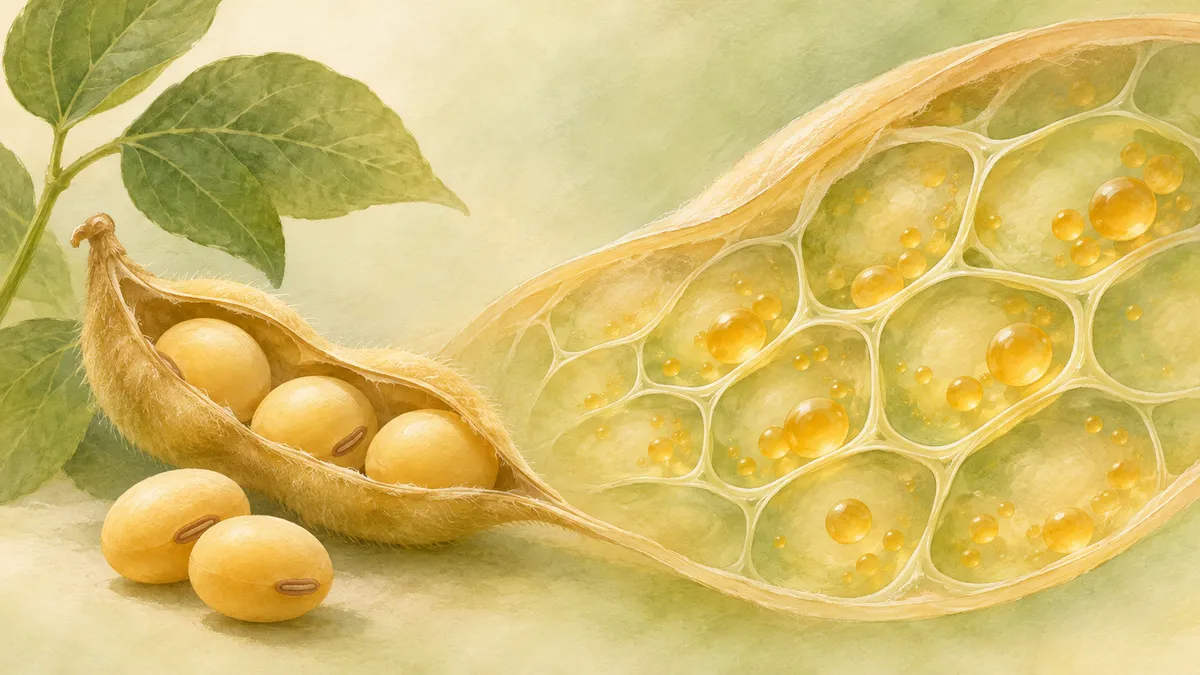
A soybean seed does not simply accumulate oil until it ripens: it also breaks some of that oil down. Reducing this breakdown can leave seeds both oilier and larger. A new study explores what changes inside those bigger seeds—and finds a developmental story extending beyond oil storage.
Why interfere with oil breakdown?
Soybean seeds typically contain about 20% oil and 40% protein. Improving their value involves understanding how developing seeds distribute incoming resources among oil, protein, sugars and structural material.
One target is GmSDP1, a gene encoding an enzyme that breaks down stored oil. Earlier work showed that suppressing this gene specifically in soybean seeds increased oil content without reducing protein content. The seeds also became heavier, raising a further question: what changes during development allow them to grow larger?
Thiya Mukherjee and colleagues at the Donald Danforth Plant Science Center and collaborating institutions investigated that question using microscopy, chemical measurements and gene-expression analysis. Their study is a bioRxiv preprint, posted November 10, 2026, and has not been peer reviewed.
Heavier seeds, not more seeds
The researchers compared ordinary Williams 82 soybeans with three genetically modified lines in which RNA interference reduced SDP1 expression in seeds. RNA interference suppresses the activity of a gene rather than necessarily removing it.
For measurements of mature plants and seeds, the team grew four to six plants per group in randomized greenhouse positions. They counted pods and seeds, weighed seeds and measured their outlines from photographs.
Mature seeds from the suppressed lines weighed 18–25% more than controls. Their photographed area was 13–21% greater. The researchers detected no significant differences in pod number, seed number or the number of stem nodes. Larger seeds therefore increased the total seed biomass produced per plant under these conditions.
These results concern greenhouse-grown plants in pots, not harvested yield across agricultural fields. They do not establish how the plants would perform across different environments or soybean varieties.
Looking inside the extra size
To investigate the cellular basis of the change, the team stained cell walls and examined mature seed sections with a confocal microscope. Image analysis showed that average cell cross-sectional area was about 4–12% greater across the three modified lines.
The researchers found no significant difference in cell counts within the imaged fields. Together, the observations support cell enlargement as part of the explanation, although counting cells in sampled images is not a complete census of every cell in a seed.
The team also isolated a cell-wall-enriched fraction from mature seeds. Its amount per seed was 23–32% higher in the modified lines. That establishes more wall-associated material per seed, not necessarily thicker walls or a particular change in wall chemistry.
Developmental sampling showed that the weight difference was not detectable at the earliest seed-filling stage examined, but had emerged by mid-development. Both fresh and dry weights increased, showing that the difference was not simply extra water.
More oil—but percentages need care
At maturity, the modified seeds contained 27–34% more oil per seed. This reflected both their greater size and their higher oil proportion.
The distinction between concentration and total amount matters for other ingredients too. Raffinose and stachyose, sugars belonging to the raffinose family, represented a smaller percentage of mature seed biomass. Yet a larger seed can contain more of a substance even when its concentration falls.
Total raffinose per mature seed was higher, significantly so in two lines. Stachyose per seed decreased in two lines but increased in the third. The findings therefore do not support a blanket claim that every modified seed contained less of these sugars.
Hormone clues, not a proven chain of events
The researchers measured hormones during mid- and late-stage seed development. OPDA, a precursor in the jasmonate hormone pathway, was lower in all three modified lines at both stages, with statistically significant differences in late development. JA-Ile, a molecule that activates jasmonate signaling, was lower in all three lines at mid-development and slightly lower in two at the later stage.
These patterns suggest altered jasmonate-related regulation. They do not demonstrate that reduced jasmonate signaling caused the larger seeds. Other hormone changes depended on the developmental stage and modified line.
RNA sequencing, performed on one modified line and controls, found most gene-expression differences late in development. These included genes associated with cell-wall processes and protein disposal, including F-box and RING/U-box family members. The authors explicitly caution that the identified genes have not been established as jasmonate regulators in soybean.
What remains unresolved
Activity of PEPCK, an enzyme involved in making sugars from non-sugar starting materials, was generally lower in the modified seeds. This is consistent with reduced capacity for that pathway, but does not directly measure how much carbon flowed through it.
The study connects larger seeds with enlarged cells, additional wall material, altered metabolism and hormone profiles. Establishing which changes drive growth—and which follow it—requires further functional experiments. SDP1 suppression remains a potential crop-improvement strategy, not yet a demonstrated route to higher field yields.
- soybean
- GmSDP1
- seed development
- oil accumulation
- cell expansion
- plant hormones
- jasmonate
- RNA interference