TRANSMISSION // 2026.11.06.764942v1
Bacteria from wild lupin roots reduce potato wilt in greenhouse tests
Two Pseudomonas strains reduced cumulative wilt severity in greenhouse-grown potatoes. Their combination also improved growth and tuber counts, but the findings come from an unreviewed preprint and still require field validation.
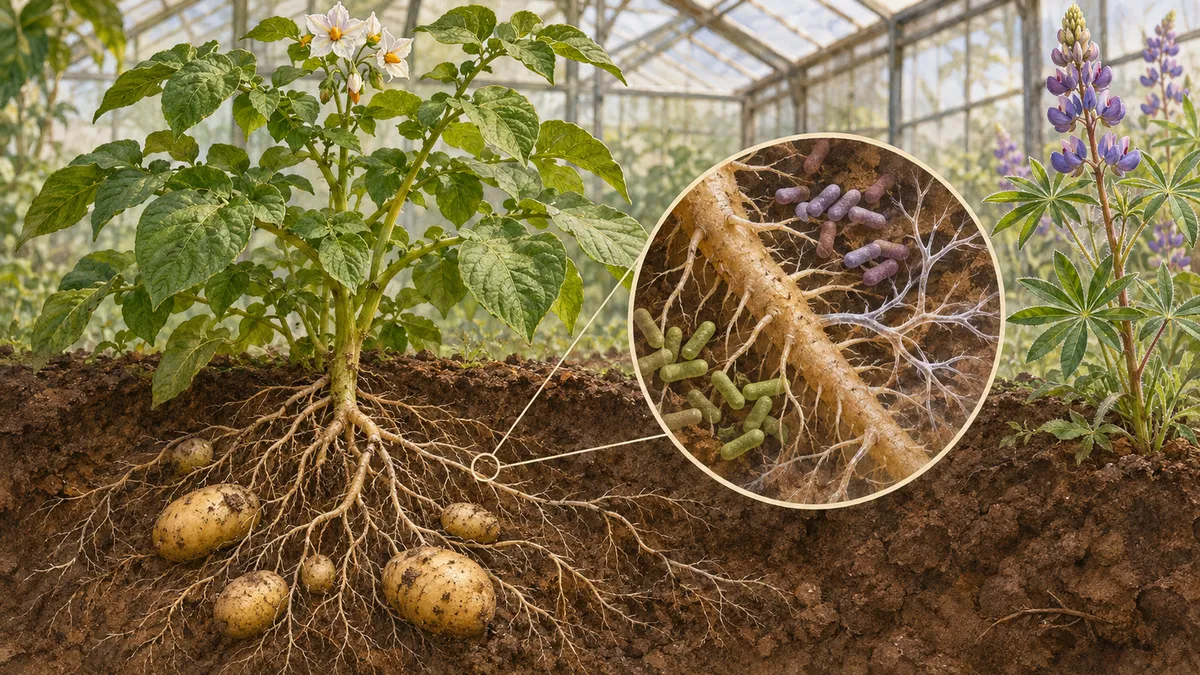
Bacteria isolated from wild lupin roots in Québec helped potatoes withstand a fungal disease under controlled greenhouse conditions. Combining the two strains generally supported stronger plant growth, although it did not suppress disease significantly better than either strain alone.
Verticillium wilt is difficult to manage partly because the fungi responsible can persist in soil. The disease damages potato plants, causing yellowing, wilting and reduced tuber production. Researchers investigating biological alternatives to conventional controls have now tested two bacterial strains recovered from inside wild lupin roots.
Numan Ibne Asad and colleagues report that the strains, called B18 and B14, reduced wilt symptoms and improved potato growth in greenhouse experiments. Their study was posted on bioRxiv on November 9, 2026, and has not been certified by peer review. It identifies candidates for further research, not a treatment ready for farm recommendations.
From wild roots to greenhouse pots
The researchers collected healthy lupins in December 2024 from exposed sites near McGill University’s Macdonald Campus in Québec. These plants persisted in cold conditions and nutrient-limited soils. After disinfecting root surfaces, the team isolated bacteria from the internal tissues and screened 24 isolates for their ability to restrict Verticillium growth on laboratory plates.
B18 and B14 were selected for further testing. Partial sequencing of the bacterial 16S rRNA gene placed both within the genus Pseudomonas, but did not establish their exact species.
The greenhouse experiment used the wilt-susceptible potato cultivar Russet Burbank. There were 64 pots: eight treatment combinations, each with eight biological replicates. Plants received B18, B14, an equal mixture of both, or no bacteria, with each treatment tested both with and without Verticillium dahliae. Treatments were randomized within blocks to account for greenhouse variation.
Bacteria were applied to potato tuber pieces before planting and again as a soil drench three days afterward. The fungus was introduced later, approximately one week after emergence. This therefore tested preventive treatment, not rescue of plants with established disease.
Less wilt, with additional growth benefits
Researchers scored visible disease symptoms at weekly intervals from seven to 28 days after pathogen inoculation. They combined those assessments into the area under the disease progress curve, or AUDPC: a measure of accumulated symptom severity over time.
Compared with plants receiving the pathogen alone, cumulative disease severity fell by 91.6% with B18, 84.6% with B14 and 89.6% with the mixture. The three bacterial treatments did not differ significantly from one another. These results describe reduced symptoms, not proof that the fungus was eliminated from plants or soil.
The mixture’s clearest advantage was broader plant performance. Under fungal challenge, plants receiving both strains reached about 27.0 centimetres in height, compared with 16.6 centimetres for pathogen-only plants—roughly 62% taller. They produced about 79.6 leaves, versus 39.4 in the pathogen-only group.
Average daughter-tuber counts rose from 0.63 per plant with the pathogen alone to 2.63 with the bacterial mixture, approximately 4.2 times as many. That is a tuber-count result, not evidence of a corresponding increase in harvested tuber weight or commercial yield. The mixture also improved several biomass and root measurements, and growth benefits occurred without the pathogen as well.
Different traits, unresolved mechanisms
Laboratory tests suggested different functional profiles. B14 produced numerically greater inhibition of three Verticillium species on plates, although the reported statistical groupings did not distinguish the two bacterial strains within each fungal species. B18 produced more indole-3-acetic acid, a plant-growth-related hormone, in the assay used. Both strains dissolved otherwise insoluble phosphate, without a significant difference between them.
Both also showed preliminary nitrogen-fixation-associated activity. However, the screening assay did not directly demonstrate conversion of atmospheric nitrogen into biologically usable nitrogen.
Separate seed experiments used tomato, not potato. B18 accelerated early germination, but differences in final germination were no longer statistically significant by day three. Filtered culture liquid without live B18 cells also stimulated germination and early root growth at low concentration, suggesting activity from secreted compounds. By contrast, 10% B14 culture filtrate completely inhibited early root elongation in that assay.
The active compounds remain unidentified. Nutrient uptake and the proposed plant-response pathways were not directly measured, and interactions between the strains were not investigated. Complementary functions are therefore a plausible explanation, not demonstrated molecular synergy.
What remains to be tested
All experiments took place under controlled conditions, and the potato trial used one cultivar. Field performance, persistence, interactions with native microbes and biosafety require further assessment. The cold-site origin of the isolates also does not itself demonstrate bacterial cold tolerance or protection of potatoes against cold.
The work was funded by McCain Foods and supported through ECODA; the authors declared no competing interests. Its strongest conclusion is that these strains merit further testing for preventive wilt management and growth support.
- potato
- Verticillium wilt
- Pseudomonas
- endophytic bacteria
- lupin
- biological control
- greenhouse experiment
- microbial consortium