TRANSMISSION // 2026.11.06.764920v1
Mapping a plant cell’s chromosome-separation checkpoint
A preprint maps interactions among three proteins involved in a checkpoint that helps dividing Arabidopsis cells distribute chromosomes.
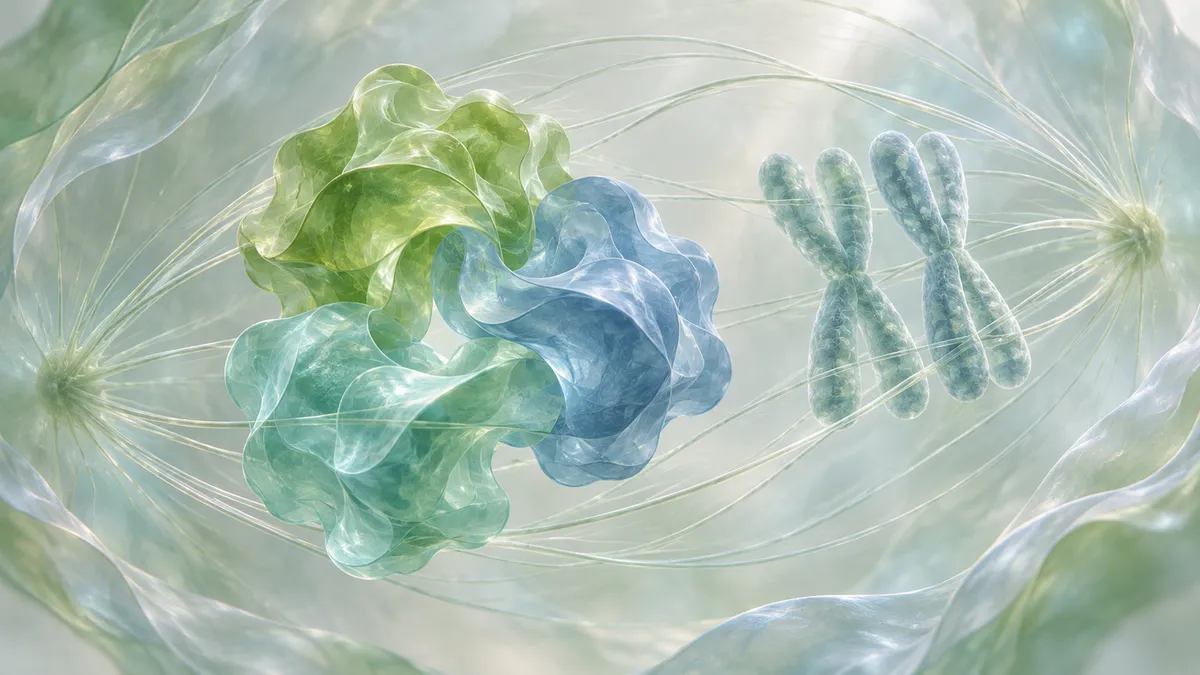
Before a cell divides, its chromosomes need to be attached to the machinery that will pull them apart. Researchers are investigating how a plant’s checkpoint proteins fit together.
A checkpoint for cell division
A dividing cell must distribute its chromosomes correctly. A mechanism called the spindle assembly checkpoint monitors the attachment of chromosomes to the spindle, the machinery that separates them. A group of proteins known as the mitotic checkpoint complex helps carry out that control. How its components interact in plants is less well understood than in some other organisms.
In a preprint, researchers studied proteins from Arabidopsis thaliana, a widely used research plant. They focused on three core components, AtCDC20, AtBubR1 and AtMad2. Their question was how these proteins contact one another and what those contacts might suggest about the plant checkpoint.
Finding molecular contacts
The team used a protein-production system called bigBac alongside chemical crosslinking, mass spectrometry and structural analysis. Crosslinking joins nearby parts of proteins; mass spectrometry can then help identify the linked pieces. The resulting links provide constraints on proximity, rather than a complete picture of a moving molecular machine.
The researchers report multiple potential interaction sites across the three proteins. These include regions of AtCDC20, AtBubR1 and AtMad2. They also describe a proposed hierarchy of interactions and evidence consistent with two Mad2 dimers joining into a tetramer, a four-unit assembly. The paper identifies a possible new KET box within AtBubR1, alongside other regions implicated in binding.
The researchers did not identify protein interactions for AtBub1 or AtBub3:1 in their experiments. That is a finding about the methods and conditions used, not proof that those proteins can never interact in plant cells. The authors interpret their observations as pointing to differences from checkpoint-complex formation described in other eukaryotes.
These observations offer a structural starting point, not a complete demonstration of how every interaction regulates chromosome separation in living plants. The study is a preprint and has not been certified by peer review. Further work is needed to establish how the proposed contacts and interaction hierarchy operate in cells.
- plant cell division
- Arabidopsis
- spindle checkpoint
- protein interactions