TRANSMISSION // 2026.11.06.764846v1
A weed’s old enzyme finds a new job against herbicide
A bioRxiv preprint reports that one herbicide-resistant barnyardgrass line uses a nitrilase normally involved in cyanide detoxification to break down an herbicide. The authors link resistance to both a change that raises the enzyme’s production and a protein substitution that appears to improve access to its active site. The work traces a plausible route by which an existing plant function can be recruited for rapid adaptation, while leaving open when and how the genetic changes arose.
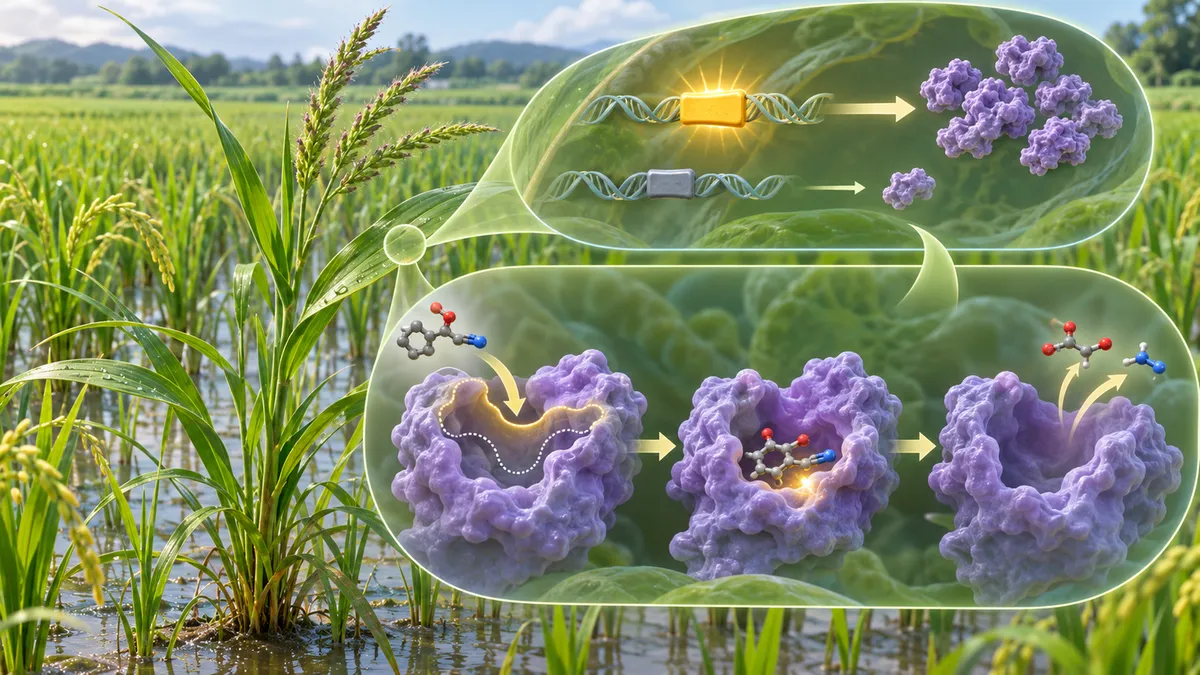
Evolution does not always require a wholly new biological tool. Sometimes an existing one is put to work in a new way. Researchers studying barnyardgrass describe how an enzyme associated with ethylene-related cyanide detoxification may help one resistant line neutralize a herbicide. Their evidence combines genetic mapping, chemical measurements and experiments that test the enzyme’s function.
Herbicides can kill weeds by disrupting essential plant processes. But some weeds survive because they can chemically transform a herbicide into a less harmful compound. How does that metabolic resistance evolve so quickly? A study of barnyardgrass (Echinochloa crus-galli) offers a detailed example: an enzyme with an established role in plant metabolism appears to have been recruited to help break down a herbicide.
The researchers focused on cyhalofop-butyl, used in rice farming. In plants, this compound is converted into cyhalofop-acid, its active herbicidal form. Further conversion to cyhalofop-diacid inactivates it. The study compared two resistant lines, R1 and R2, with a susceptible line, S1. After treatment, cyhalofop-diacid built up to high levels in R1, but not in R2 or S1. Both resistant lines were less sensitive than S1 to cyhalofop-acid itself, but the chemical measurements pointed to rapid detoxification as an explanation specifically for R1’s resistance. The researchers therefore concentrated their follow-up work on R1.
To find the genetic basis, they crossed R1 with S1 and examined the offspring. Genetic mapping linked resistance to a region of the genome. The team then compared gene activity in R1, R2 and susceptible plants, using two transcriptome analyses. Within the mapped region, EcNIT4A2 was the gene consistently more active in R1. It encodes a nitrilase: an enzyme that breaks certain chemical bonds. NIT4 normally helps plants process cyanide produced during ethylene biosynthesis, through a pathway involving the compound β-cyanoalanine.
Several experiments strengthened the case that EcNIT4A2 matters for resistance. High expression of the gene tracked with resistance in offspring from the R1–S1 cross. Introducing the R1 gene into another Echinochloa species conferred resistance in experimental assays. In rice, disrupting either of two related NIT4 genes made plants more sensitive to cyhalofop-butyl, suggesting that ordinary NIT4 activity can contribute to some baseline tolerance. These results support the idea that the enzyme’s existing chemistry can act on the herbicide’s active form.
The authors also investigated why the R1 version appears especially effective. Compared with the susceptible version, its protein carries a change at position 317: aspartic acid is replaced by glycine, called D317G. Tests in plant cells found that the R1 version conferred stronger resistance than the susceptible version; introducing D317G into rice NIT4A also increased resistance in the assay. Molecular dynamics simulations suggested a possible explanation: the substitution may widen an entrance between parts of the enzyme complex, making it easier for cyhalofop-acid to reach the catalytic pocket. This structural account is based on computer models, not a direct observation of the enzyme in action at atomic resolution.
A second change affects how much enzyme the plant makes. In R1, a stretch of DNA in the region upstream of EcNIT4A2 differs in structure from the corresponding region in S1. The R1 promoter variant tracked with higher gene expression in the offspring. In a reporter assay using rice callus, the R1 promoter drove about ten times the normalized activity of the S1 promoter. The results suggest a two-part route to resistance: more of the enzyme is produced, and a protein change improves its ability to process the herbicide.
There are important limits to what the study establishes. R1 is one resistant line, and the other resistant line, R2, did not show the same detoxification pattern or elevated EcNIT4A2 expression. Resistance can therefore arise by other routes. The authors also cannot yet say whether the promoter variant and D317G arose together, one after the other, or were already present in weed populations before herbicide exposure. They note that a similar promoter configuration occurs in a published barnyardgrass genome, but broader population studies would be needed to resolve the variants’ history. The effect of D317G on the enzyme’s normal role in cyanide metabolism also remains uncertain.
Overall, the work proposes a specific example of co-option: a familiar metabolic enzyme taking on a new task under human-driven selection. The paper is a bioRxiv preprint posted in November 2026 and was not certified by peer review at posting. Its findings should therefore be treated as provisional pending peer review and independent follow-up.
- herbicide resistance
- barnyardgrass
- plant evolution
- nitrilase
- cyhalofop-butyl
- metabolic detoxification